Showing posts with label Hou Hsiao-hsien. Show all posts

Saturday, May 8, 2021

Review - Daughter of the Nile

May 9, 2021

Daughter of the Nile – Taiwan, 1987

Hou Hsiao-hsian’s Daughter of the Nile is about a family in the process of coming apart, one which, interestingly, takes place the year Taiwan officially ended martial law. This development took place in the waning years of Taiwan’s economic miracle, as China began opening up and companies started relocating there to gain greater access to the Chinese market and save money on labor costs. The characters in the film, as well as Hou himself, had no way of knowing this when the film was made, and any sense of foreboding tragedy is likely the result of audience’s projecting onto the film a tone and mood that was unintended. Still, I’m not sure that there was ever a moment when I believed a happy ending was in the cards.

The film begins with a dash of Shakespeare: A young woman named Hsiao-yang (Yang Lin) looks directly at the camera and establishes the back story of the family we are about to follow. We learn that death has reared its ugly head more than one. The matriarch of the family died after a long battle with cancer, the older brother is also gone, though the details of his fate remain unexplained. We learn the siblings – Hsiao-fang (Jack Kao), Hsiao-yang, and Xiao-wei - relocated to northern Taiwan, while the father (Fu Sheng Tsui) remained in the southwestern city of Chiayi, likely due to a job in law enforcement. The arrangement essentially makes Hsiao-fang, a dashingly handsome young man who dropped out of school to pursue economic opportunities, the head of the family. His sister Hsiao-yang, who works at KFC, is taking night classes, while also helping to raise Hsiao-wei, the youngest of the siblings. It is a set-up that benefits no one.

Well, almost no one, for sometimes great responsibility brings out the best in people. For all the talk of Hsiao-fang’s uncontrollable childhood wildness, the young man we see in the beginning seems to have his life on track. He’s opened a restaurant, is in a relationship, and resolves disputes with surprising composure. And while he has not completely given up his wicked ways – in one scene, we witness him escaping from an apartment after burglarizing it – we sense that his ultimate goal is to turn over a new leaf.

Smartly, Hou avoids overly dramatic scenes in favor of short snippets which, added up, give up enough of the story to understand the sentiments of those involved. There are a few interesting scenes featuring the sibling’s grandfather (Tianlu Li) that illustrate just how emasculated he has become and explain why he would take such an interest in mentoring Xiao-wei. There are also scenes of Hsiao-yang passing her time in her brother’s restaurant, a habit that exposes her to a few less respectful members of society, and we see enough of Xiao-wei’s academic struggles to see that in a few years she could be where her sister is now.

I realize I’m making Daughter of the Nile into a bit of a downer, which is not entirely accurate, for when we get a glimpse into Hsiao-yang’s life, we are reminded of it’s many wonders – a shy boy’s attempts at asking a young lady to the movies, the everyday tussles of the classroom, and the inevitable approach of adulthood. During one moving sequence, we see Hsiao-yang and her friends joyfully celebrating life and friendship at a beachside bonfire, while hearing an older Hsiao-yang explain the impermanence of the moment. Some classmates, she tell us, would soon leave for college; others would join the army or go overseas. Life is never static. And, of course, there are plenty of squandered opportunities.

With Daughter of the Nile, Hou created a film that is both beautiful and heartbreaking. It captures the many highs and lows of youth, as well as its promise and disappointment. In it, we see the opportunity that economic progress allows and just how easy it is for it to slip away, especially for those who are their own worst enemy. We enable, we cut corners, we put our heart over our head. We’ve all been there. And maybe that is the true genius of Hou’s films. While they are about Taiwan, there’s something universal about them. We’ve all lost people, we’ve all had first loves, we’ve all had moments of moral regression, and we’ve all had moments when we were suddenly aware of the fleeting nature of many of life’s pleasures. I remain grateful to Hou and his masterful screen writer Chu Tien-Wen. He and movies like Daughter of the Nile are true treasures. (on DVD and Blu-ray)

4 stars

*Daughter of the Nile is in Taiwanese and Mandarin.

Thursday, August 23, 2018

Review - Taipei Story

August 23, 2018

Taipei Story, Taiwan, 1985

I am about to embark upon a mission that will undoubtedly conclude with a high rate of failure. I say this, for there is perhaps no harder task for a movie reviewer than to convince people to watch a film that shines such a harsh light on the world around us, one featuring characters that have the deck stacked against them, and who disprove the old adage that good people win in the end. But watch it people should, and so here I go.

The film being referenced is Edward Yang’s Taipei Story. It was his second, and its release came two years before the order that lifted martial law in Taiwan. Given that, it is somewhat amazing that it was made at all, seeing how the purpose of entertainment in such a state is often to convince people how great their lives are and how much the government is doing for them. Taipei Story, while shying away from any overt political message, couldn’t be more different.

The film depicts Taipei as a city of contrasts. In its residents, we see evidence of both hope and despair; we hear of the freedoms experienced by those who got out and the crushing conditions of those without the means of doing so. It is a city of bright lights and dark shadowy structures, and, at what may now be described as the advert of globalization, it is clear that the chasm between the have’s and have not’s is both growing and irreversible, one in which what we think of as progress may in fact be about to leave far too many people behind.

The film follows Lung (played by actor-director Hsiao-hsien Hou), a former baseball player who now owns a fabric shop, and his girlfriend, Chin, who works as a personal assistant to the head of a construction company. In the film’s opening scene, we see the two of them inspecting a vacant apartment, Lung while casually smoking, Chin while dressed in all-white business attire. The contrast could not be more telling. We soon learn that Chin is moving out of her parents’ house. This is practically unheard of, as she is still single. However, Chin gives the impression of this being a new world, one that is breaking the shackles of the past, and for good reason. Not only does she have a good job, but she recently got a raise. Independence is the logical next step – at least it is to her. As for Lung, he is preparing to visit his mother, sister, and brother-in-law in the United States, and if you know anything about Chinese culture, you’ll know how unusual it is for a mother to live with her daughter after she gets married.

The film follows these two as they struggle to maintain their relationship in a world that increasingly fails to reward people for making the morally correct decision or for having their hearts in the right place. To say that Lung has a heart of gold may be an overstatement, yet what is clear is that when faced with a choice of either helping others in need or acting to ensure his own well-being, he ends up doing the former. A good example of this is his actions regarding a young unfortunate father of three named Qin, whose wife is gambling away the family’s present and future. Chin matches Lung in good intentions. Early on, her company is the victim of a hostile takeover, and her new bosses not only fire her old boss but reduce both Chin’s job title and duties. She quits, outwardly reasoning that she can do the same job elsewhere, but inwardly standing up for her former boss. It’s a position that many of us have envisioned ourselves taking.

Anyone who has ever dealt with severe financial difficulty or felt the hopelessness that can set in when you experience unemployment will recognize what follows – the toll such conditions take on love, the insecurities that it causes to bubble up to the surface. And Yang never lets up. The script, written by Yang, Hou, and Chu Tien-wen, is a series of good intentions, unfortunate events, and tantalizing temptations, ones that offer transitory relieve and satisfaction, but would ultimately end in despair and regret. In other words, these characters seem fated to suffer. What other conclusion is there when both the right and wrong decisions lead to the same outcome?

See, I was right. I have painted the film in such dark and depressing colors that I really can’t imagine that anyone reading this will elect to seek it out, and in not accomplishing this, I may be replicating the experience of critics in 1985. After all, many of the Taiwanese films that came out in the 1980s struggled to find an audience. They diverged so much from the happy-go-lucky films that preceded them that they were rejected in favor of either lighter local fare or imported American films. Yang would make just seven films in his lifetime, and directors such as Hou and Ming-liang Tsai became much more popular on the international circuit than they were in their home countries. It is telling that Tokyo Story is not available on DVD in Taiwan and that Yi Yi, despite its stellar reputation globally, draws blank stares from the majority of my students and co-workers.

So, here’s what I like about the film. For one, the cast is superb. As Lung, Hou adopts a look of a social outsider who has been beaten down by life, but refuses to completely give in to despair. And in quieter moments, ones in which Chin leans on his shoulder and gently holds his hand, Hou, in the lightening of his eyes and the disappearance of physical tension, shows us just how he can find the strength to keep going. That he does this without uttering a single word makes his performance even more impressive. Chin is played by Chin Tsai, a regular in both Hou’s and Yang’s films, and in a way she has the harder part. She has to make us see something in Lung that could easily be missed by eyes that only see the lost soul he is close to becoming. In other words, she has to make us see the potential in him and the wonder that he once inspired in her. And she has to make us see someone who is worth being with even after everything that occurs in the film. She succeeds magnificently.

I cared for this couple. I wanted them to make it. It’s rare that you see characters as authentic as these, and the more you know about Taiwan, the more you’ll appreciate the film. It is equally rare to see movies that are this realistic. Chin and Lung experience circumstances that are entirely plausible, and their reactions, even the ones we wish they wouldn’t have, are equally understandable. The film is a lesson in the need for empathy for our fellow human beings, as well as a reminder that this quality is one of the earliest casualties in times of economic and social upheaval. The tendency to turn inward can be extremely powerful in dark times, and the film is a prayer that we can reverse this.

So, I hope people watch Taipei Story. If they do, they’ll see many things, including an intriguing look at Taiwan in transition, superb performances, and a story that makes you feel like few others do. You’ll also see one of the greats at work, for Edward Yang had a way with stories that few have matched since. He met complexity head on and was unafraid to hold a mirror up to society and ask people if they liked what they saw. Sure, too few took him up on the offer, but I have no doubt those that did - and that are willing to do so today - came out a little better than they were when they went in. Great films do that. (on DVD and Blu-ray as part of Criterion’s Martin Scorsese’s World Cinema Project Vol. 2)

4 stars

*Taipei Story is in Mandarin and Hokkien with English subtitles.

Thursday, July 7, 2016

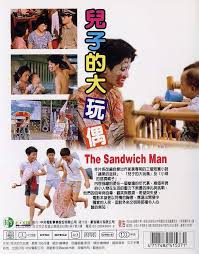
Review - The Sandwich Man (1983)

July 7, 2016

The Sandwich Man – Taiwan, 1983

I’m convinced that films like The Sandwich Man are nearly impossible to do well. They require multiple directors to create works that both blend together and stand alone as solo films. They often have world-renowned directors, yet invariably one or two parts tend to stand out, while what remains either slow the film down, makes dramatic shifts in tone, or tells a story so distinct from the others that one may wonder why it was included in the first place (think Michelangelo Antonioni’s “The Dangerous Thread of Things” from 2004’s Eros). Luckily, the three stories that make up 1983’s The Sandwich Man share enough in common that it seems logical that they are included together. Unfortunately, as the film progresses, both quality and tone decline, and what we’re left with resembles a three-course meal whose concluding dish doesn’t quite leave you wholly satisfied.

The stories that make up The Sandwich Man are all set in Taiwan in the 1960’s, a time when martial law was still in place and Taiwan was still recognized by the UN as China. Therefore, it seems entirely apropos that each one is in some way connected to the influence of the outside world on Taiwan. The first two showcase the influence of Japan on advertising and economics; the latter has to do with the presence of foreigners – mainly, the American military – on average Taiwanese citizens. The theme of family also runs through all of three stories, and most of the lead characters are deeply motivated by the need to provide better lives for them.

The film’s first chapter, set in 1962 and directed by Hsiao-hsien Hou, is “Son’s Big Doll” about a man who is inspired by a newspaper clipping of a Japanese man who dresses in a costume and walks around town as a living billboard. It reminded me of 1958’s masterful Giants and Toys, a film in which characters do things like this to push sales and promote products, often to surprising effect. Having lived in Taiwan now for over eleven years, I immediately thought that it would almost certainly be less effective here. However, our hero, Qun-Shu (Bor Jeng Chen) is undeterred, and in one scene, we watch as he rushes home and makes a costume out of a blanket that was probably being put to good use already.

Smartly, the film is less about his attempts at advertising than it is about his relationship with his wife (Li-Yin Yang) and very young son, and theirs is a tough relationship. We see the strain that economics is having on them, and many of their conversations contain words that are intentionally hurtful – mostly from him. Failing to bring home the bucks can do this to someone as proud and industrious as Qun-Shu, and being the object of scorn and snickers doesn’t help either. In one scene, we see a family member openly express his embarrassment at Qun-Shu’s choice of a profession. I was moved by this story, for in just a short time it created interesting characters, established realistic situations, and presented real emotions. In fact, it is only in its final moments that the film takes a turn from realism to symbolism, but even that is hard to fault completely.

The second film, set in 1964, is less successful, yet still weaves a tale of good people putting too much faith in both themselves and the decency of companies. Directed by Zhuang Xiang Zeng, this part is entitled “Vicki’s Hat,” and it tell the story of two men sent to a small area of southern Taiwan to sell Japanese cooking pots, which, as they frequently remind potential customers, will reduce the time in which it takes to cook from two hours to ten minutes. Again, the film presents us with a family man, here Zai-fa Lin (Ting-li Fang), trying to earn enough money so that his very pregnant wife will finally be able to quit her job, and like Qun-Shu, we hear anecdotally that Zai-fa has had pressure from in-laws.

The story drags somewhat, relying too heavily on attempts to sell the pots. This leaves precious little time to explore the film’s other, more interesting subplots, such as Zai’s fa’s colleague’s interest in a local school girl, the only girl in town, it seems, who wear a hat, and intriguing flashbacks that call into question Zai-fa’s abilities as a salesperson, as well as his constant depiction of himself as prepared and knowledgeable. As a result, I was less involved in this one, and not even its strong finale was enough to pull me back in completely.

At this point in the film, drama has been its consistent tone, and for the first few moments of the third piece, Jen Wan’s “The Taste of Apples,” it appears that the film will continue in this tenor. However, it quickly veers into unadvised and discomforting attempts at comedy, and at times, I could not tell whether the film wanted the audience to laugh with the characters or at them. This portion of the film takes place in Taipei in 1969, and it is about what happens after a southerner living in Taipei with his family is hit by a car driven by an American colonel (another foreign influence on average Taiwanese). Along with a local interpreter, the colonel goes to the man’s home, picks up the man’s family, and takes them in his shiny car to a hospital for Americans. Seeing the looks on the family’s faces, it is clear that they’ve never seen anything like it.

There are things that ring true about this tale, from the joy and playfulness of the two young boys to the mother’s worry over the family’s well-being if her husband dies or cannot work for a long stretch of time. The film also contains a reference to “selling” the family’s oldest daughter into marriage that will remind viewers just how different times were back then. However, all too often this part of the film veers into situation comedy, depicting the family’s interest in seeing the bathrooms or their abrupt switch from sad to happy at the mention of a financial settlement. It’s a film that doesn’t take its characters seriously and seems to see negative or real emotions as simply steps to the next comic moment. In other words, it establishes a character’s negative emotions only to show them smiling and acting silly a moment later. In fact, the message of this segment seems to be that everyone would be fortunate to be hit by a car driven by an American officer.

It reminded me of the last segment in In Our Times, also from 1983, and I wondered why there was such an interest in ending with laughter. Sure, movies have always tried to end with moments of big excitement, huge impressive spectacles, and sheer hilarity, yet usually those are the themes of the movie throughout. Here, it isn’t, and the effect is jarring. It’s as if the directors underestimated their audience, viewing them as capable of handling only so much “realism.” This is unfortunate, for with just a few tweaks, The Sandwich Man could have been that rarest of films – the combination of divergent stories that gelled well together and added up to something special. As it is, the film is watchable, yet much less memorable than it should have been. (on DVD and Blu-ray in Region 3/A as part of the Taiwan New Wave Cinema: 1982 – 1983 box set)

3 stars

*The Sandwich Man is in Mandarin, Min Nan, and English.

*It has incorrect subtitles throughout, and this is truly inexcusable.

Thursday, April 30, 2015

Review - Cafe Lumiere

April 30, 2015

Café Lumiere – Taiwan, 2003

Hsiao-Hsien Hou’s 2003 film Café Lumiere is an homage to the great Japanese director Yasujiro Ozu. The film opens with the familiar image of snow-capped mountains that viewers of Ozu’s films will recall immediately, and in the film’s early moments, we see an image that appears frequently in Ozu’s films – the train, that symbol of modern life moving on despite life’s everyday hiccups. Later Hou presents a scene inside a family home, and we see Ozu’s familiar furniture arrangement and recognize his lower-than-usual camera angle. In fact, I half expected to see Chishu Ryu and Setsuko Hara walk in. The plot of Café Lumiere is also reminiscent of many of Ozu’s films, for it revolves around a family that has grown apart and is set in a time when parents have no more wisdom to impart to their children. However, it is hard for me to imagine Ozu ever being as opaque about what is going on as Hou is.

The central character in the film is Yoko Inoue (Yo Hitoto), a headstrong and independent young woman who is simultaneously aimless. She seems somewhat caught between the past and present, wanting the freedom that comes with living in the big city and being unencumbered by restrictions while also holding firmly to the past. In many ways, she is like the characters played by Hara and other young women in Ozu’s films. She is polite, yet not quite as open as she could be, and her actions indicate that she values politeness and reciprocity. Where she differs most from one of Ozu’s traditional heroines is in her assertiveness. This is a woman who travels on her own, picks her own boyfriends, and does not adhere to traditional thoughts on sex. And yet even here, she wavers slightly. When told that a woman directly asked a male friend of hers to be her boyfriend, she is immediately suspicious of her motives. It seems that her views on female independence and directness do not extend as far as they could.

The film’s other central character is Hajime (Tadanobu Asano), the owner of a small bookstore. Hajime doesn’t do much in the film other than interpret Yoko’s dreams and help her find locations associated with Jiang Wen-ya, a Taiwanese classical musician who lived in Japan for most of his life. Yoko even interviews his widow, although it is unclear what exactly she gets out of that event. Hajime is also in the habit of recording the sounds of trains, and he enjoys doing it so much that he often closes his bookstore and just rides around all day with his recording equipment. What it all means, I am not sure. There is both a poetic beauty about his actions that I think Ozu would have enjoyed and a murkiness that he might not have. Ozu left many things unsaid outright in his films, yet very little was indecipherable.

So little “happens” in Hou’s film that I fear I may have given away too much already. There is a central conflict in the film, and the fact that it is not resolved speaks volumes about the differences between the times in which Ozu’s films took place and the present day. In one key scene, Yoko’s stepmother implores her husband to stop being evasive and to talk to his daughter about it, yet even when the conversation is finally broached, there he sits passively silent. Perhaps he has no more advice to give to a member of a generation he clearly can’t understand. There’s also a nice scene in which Yoko and her stepmother visit Yoko’s landlady both to thank her for helping Yoko as much as she does and to borrow some sake. I found the stepmother’s sense of shame in this scene to be particularly telling. After all, was there ever a scene in one of Ozu’s films in which sake wasn’t readily available whenever someone asked for it?

As much as I can appreciate Hou’s efforts here, I have a hard time recommending the film. It is somewhat satisfying as a tribute to a man Hou obviously has great respect for, yet the film is ultimately unsatisfying by itself. Each character is well crafted and somewhat intriguing, yet their eccentricities have little purpose, and the mental effort required to assemble the film’s bits and pieces into a coherent character study produces little in the way of payoff. Is the film trying to say that Japan’s youth are lost and lack the hopes and dreams of their parents’ generation, or is it saying that they are stuck between the strong sense of collectiveness that has held Japan together over time and the modern pull of individualism that gives priority to the individual? I honestly cannot say. Both Yoko and Hajime appear to be looking back and cutting off the future, but to what end?

There will undoubtedly be some viewers who see in Café Lumiere a powerful statement about present-day Japan, and they will read a lot into the film’s many quiet moments and into the characters’ apparent need for repetition and familiarity. They may be correct. However, audiences that reach those conclusions are likely responding to concepts that they went into the film with and not revelations brought on by the film. In other words, the film will have reconfirmed what they already thought. A good film should not require this, however. Audiences should be able to read the director’s purpose through the images that he or she presents on the silver screen and not understand a film exclusively through their own experiences or pre-conceived notions. Many of Hou’s most ardent supports will likely say that I just didn’t get the film. Well, they’re right. I didn’t. (on DVD)

2 and a half stars

*Café Lumiere is in Japanese with English subtitles.

Thursday, December 11, 2014

Review - Summer at Grandpa's, A

December 11, 2014

A Summer at Grandpa’s – Taiwan, 1984

Ah, a cinematic trip to Grandfather’s house. What else could be better for young children? After all, what kid wouldn’t want to spend their summer vacation frolicking in the countryside far away from the hustle and bustle of the big city and its never-ending barrage of illumination, clamor, and technology?  The answer to this rhetorical question is of course most children, but the grandparents in these movies have nothing to fear. By time the credits start rolling, the child in question will no doubt utter those predictable sentiments, “This was the best summer of my life!” Such a remarkable turnaround is often accompanied by a second epiphany, “My grandparents aren’t that bad after all.” This is the script that most films with set-ups similar to that of Hsiao-Hsien Hou’s A Summer at Grandpa’s follow, yet Hou is not content to stick with the formula.

A Summer at Grandpa’s is about two young children, Tung-Tung (Chi-Kuang Wang) and Ting-Ting (Shu-chen Li), who are sent to spend some time with their grandparents in southern Taiwan. The script for films of this sort calls for these two youngsters to be deviants, but here they are simply regular kids coping with complex emotions and occasion bouts of insensitivity. In the film’s opening scene, we watch as their mother dispenses a series of instructions for them, and instead of rolling their eyes or protesting, they listen intently and nod to show that they understand and will try to comply. Curiously, the instructions continue for some time, and the scene becomes slightly uncomfortable to watch. There is a reason for this – the children’s mother is in the hospital and clearly afraid that she may be speaking to her children face to face for the last time. The children cannot know this of course, but the tone of their mother’s voice seems to relate to them the gravity of the moment if not the reasons behind it.

And so off to the countryside the children go. They are escorted by their somewhat immature uncle, who doesn’t seem to grasp the severity of his sister’s condition and whose own immaturity causes him nothing but trouble later on. He is the kind of likeable character who somehow always finds a way to make a bad situation unintentionally worse; however, Hou has a degree of empathy for the character, as if he understands the code that he lives by and the unfortunate thought process that precedes the actions he takes.

As one would expect, the countryside is outwardly beautiful, with its lush, green landscapes, stunning views of nature, and idyllic country life, and for a moment, Hou lulls us into a false sense of security, into an outdated and stereotypical way of thinking about secluded areas such as this. It helps that the children make friends almost immediately and that they feel no sense of danger after a mix-up at a train station. In fact, what takes place reinforces the notion that the countryside is an area replete with security and community.

Over the course of the summer, however, the siblings will have to cope with the specter of death; the existence of violence, greed, and sexual assault; and the fear and irrationality that can come when one’s future security seems uncertain. Not all of these things are obvious to the two children, but there is no doubt that they affect their interactions with the adults around them. The film has lighter moments of course. One particularly memorable one involves a trip to the river and a minor act of revenge that brought a smile to my face. I also admired the way the film often explains a character through the children’s limited viewpoints and then shatters these notions completely. Childhood can be like that.

It is not always easy to balance scenes that draw on the innocence of childhood with ones with more serious content, and many films have faltered as a result of a director’s inability to find the right balance. Hou, for the most part, succeeds. He does this partly by presenting events from two points of view. First, Hou presents things from the children’s perspective. We see their joy and hear their wonderful interactions, while also observing their reactions when society’s darker elements come into view. In one frightening moment, we watch as a group of children come across a crime in progress, and we see the shock and fear on their faces. Clearly, they are not used to seeing such things. Simultaneously, Hou allows us to see events through the eyes of the adults, most often the grandparents, who provide the film’s somewhat imperfect moral compass. These characters are not always right, and in several key moments, their words only add to other people’s hurt and pain; however, they deliver the kind of messages that their two grandchildren will reflect back on in time and understand the importance of. It is a reminder that the right message can be delivered by people who make their fair share of mistakes.

A Summer at Grandpa’s is a rather remarkable accomplishment. It is a film filled with memorable moments and realistic, sympathetic characters. It is of course not these characters’ entire story, but that is acceptable. We see enough of their lives for us to feel confident that they are on their way to the next stage of their lives somewhat wiser and much more prepared for whatever life has in store for them. In truth, this is one of my favorite kinds of films, and A Summer at Grandpa’s is one of the favorites of Mr. Hou’s many splendid creations. (on DVD in Region 3)

4 stars

*A Summer at Grandpa’s is in Taiwanese and Mandarin with English subtitles.

Thursday, June 12, 2014

Review - The Boys from Fengkuei

June 12, 2014

The Boys from Fengkuei – Taiwan, 1983

There is sometimes timeless about Hsiao-Hsien Hou’s 1983 film The Boys from Fengkuei (a.k.a. All the Youthful Days). The film is about four restless Taiwanese youths trying to find their place in the world and not entirely succeeding at it, yet the tale the film weaves could have taken place in any country at any time in history, for when have there not been young men who opted out of the social contract that the majority of their peers accepted? The central characters in Hou’s film are young men whose mornings are spent in pool halls and morning markets instead of school and who are more concerned about their small circle of friends than they are about their futures. These kinds of characters have been the focus of films since the beginnings of cinema itself, yet The Boys from Fengkuei avoids the trappings of many other films in its genre. There are no gunfights, no rising up the ranks of the criminal world, no great love affair to warm a criminal’s hardened heart. Instead, we get a much more realistic film, one focusing on human frailties and the pursuit of life’s eternal intangibles – hope, understanding, belonging, and love.

The young boys begin the film on Penghu, an island to the west of central Taiwan. In a series of vignettes, we see the four of them go about their everyday routine – billiards, watching movies they didn’t pay for, hanging out in markets, and getting into fights in which they are often the aggressors and have an unfair advantage. One of these incidents puts a man in the hospital, and the four flee to a small rundown home near the sea. There, they pass the time by playing jokes on each other, making fools of themselves in front of a young woman, and talking about the future. In one respect, the four of them are like other young people in rural settings – They too envision themselves moving to the city and getting high-paying jobs. To them, the city also holds the promise of a new beginning and a better life. They are just too young to know that this isn’t always the case.

The Boys from Fengkuei was made at a time when many newer and younger Taiwanese directors were striving to produce films that demonstrated a sense of realism. Therefore, many movies from this time are about everyday people in extremely plausible situations, perhaps on the assumption that, like Italian and Japanese moviegoers, Taiwanese audiences were also eager to see themselves sincerely portrayed on the silver screen. The Boys from Fengkuei is a good example of one of these films. The film does not have a plot in a strict sense of the word, and it avoids the clichéd, predictable elements of its foreign counterparts. Therefore, it is not striving to produce the kind of happy ending or reaffirmation of traditional values that many of its predecessors had. Like the protagonists in Hou’s Dust in the Wind, Three Times, and Flowers of Shanghai, the main characters in The Boys from Fengkuei get endings that ring true for people in their situation, even if they are not the ones audiences necessarily wish for them.

Eventually, three of the young boys find their way to Kaohsiung, a city that in 1983 was developing, but not fully developed, and it is this city that completes their maturation. The film is primarily concerned with Ching-Tzu (Doze Niu), who, more than any one else, takes advantage of the opportunities that his new surroundings afford him. Along his journey, he meets a young lady named Hsiao-Hsing (Lin Hsiao-Ling), who is in a relationship that is nearing its inevitable end. He falls in love for the first time; she thinks of him as a friend. Things like this happen in the real world. Ching-Tzu finds a job, but it is far from glamorous and offers very little chance of advancement. Things like this happen, too. And unlike earlier Taiwanese films (and more recent ones) in which characters who had to choose between family and individual happiness almost always chose family, The Boys of Fengkuei seems intent on breaking stereotypes of family unity and everlasting bonds. In one sad and frustrating scene, we watch as Ching-Tzu returns home only to find that his family sees him as the same troubled boy, one incapable of making sensible decisions or staying out of trouble. In a way, Hou’s film is reminiscent of those of Yasujiro Ozu, which often depicted the dissolution of families rather than holding them up in their much more idealized form. Here, Ching’s only means of making it is to break from tradition and set out on his own.

The Boys of Fengkuei remains an important and fascinating film. It has strong characters that we pull for, and a cast that is a joy to watch. And the film ends in a way that perhaps only the most skillful and thought-provoking of directors could think of ending it. It cuts away from its lead characters and focuses on a series of older market vendors, many of them with hunched backs and hats covering their faces to block out the sun. All of them look as if life has utterly exhausted them. It is as if Hou is forcing us to wonder: Is this what awaits the boys from Fengkuei? (on DVD in Asia)

3 and a half stars

*The Boys from Fengkuei is in Taiwanese and Mandarin with English subtitles. The subtitles (not from the disc pictured above) are less than perfect.

Wednesday, October 27, 2010

Review – Dust in the Wind


October 27, 2010

Dust in the Wind – Taiwan, 1986

Hou Hsiao-hsien’s 1986 film Dust in the Wind takes place in a mountainous region of Taiwan called Jiufen. It’s a place popular with both locals and tourists, primarily because of its carefully crafted tourist district that has earned a well-deserved reputation for its shopping and restaurants. I’ve been there twice, once in 2005, the second time in 2006, and each time I’ve been amazed by the breathtaking view of a lush valley stretching out to the open sea. The view so impressed me that I recognized it the moment it appeared in Dust in the Wind, and while the shot clearly places the film in a specific location, its story, as well as its central characters, is so universal as to make it possible for the film to be taking place almost anywhere on the island, let alone in any country in the world. Put these two characters in 1960’s New York, and they would fit right in.

Dust in the Wind is set in the 1960’s, during a period of great transition for Taiwan. During this time, Jiufen has two main industries: coal mining and farming. Towards the beginning of the film, we met a sixteen year old boy named Wan (Chien-wen Wang) whose family is dependent upon both of these industries. His father works in the mines, and his grandfather works the fields. Neither of these professions offers the kind of life that would interest Wan. The beginning of the film also introduces us to Huen (Shufen Xin), Wan’s close friend practically since birth. Their eventual courtship and marriage are a foregone conclusion, regardless of their rather youthful ages. Early in the film, Wan tells his father he no longer wants to continue his education; he’d rather go to Taipei to work. From his father’s reaction, it’s likely he didn’t have much of a choice. Those final years in high school can be quite expensive. Huen, perhaps for the same reason, follows Wan to the city. There, Wan gets a job at a printing press, although his job also seems to include preparing lunch for his employer’s son. As for Huen, she finds employment as a seamstress.

The film follows these two characters over the next few years of their lives. Sometimes they grow closer; other times work or Wan’s temperament gets in the way, and like most couples, they must negotiate their way past some rough patches. Through it all, Wan acts as Huen’s protector as best he can, and Huen dedicates herself to helping Wan stay on the right path. Others from Jiufen in similar situations as them – and equally young - join them in Taipei, often working long hours for little pay. In addition, we learn that a friend of theirs has an employer who occasionally beats his employees with a steel pipe. In this regard, Wan and Huen are lucky, for their employers seem like good people. And of course, they have each other – not necessarily in a physical sense, although there are indeed hints that they have both thought about that. Perhaps the belief that they are going to be together in the future removes the necessity to act impulsively the moment they are alone.

While the film is primarily about Wan and Huen, it is also filled with fascinating smaller characters. One such character is Wan’s grandfather, played by the late great puppetmaster Tianlu Li, whose own fascinating life story was made into a film in 1993. In the beginning of the film, the grandfather tries to get his grandson to eat by telling him that if her doesn’t he’ll die and not be able to see his mother or father again. I know what you’re thinking: It sounds terrible. In fact, according to my students, some Taiwanese parents tell their children things that read much worse than this. However, words on a page and words that are second-hand can be deceiving, and Tianlu Li’s delivery made me finally understand the care and love that often lies behind such statements. He has a few other scenes that are equally heartfelt; one having to do with a broken promise is so quietly powerful that it may resonate within viewers for some time. According to IMDB, Tianlu Li made just four films before his death in 1998. It’s a shame that he wasn’t able to do more.

Dust in the Wind would probably not have as much esteem as it does today if it were simply the story of teenage love, which the film is clearly not. In the film, we get a picture of a community shaped by constant instability. Politically, first, there were the Japanese, then the Kuomingtang and the Westerners. Economically, the communities depend on mining, which is not always safe, and the weather, which can wreck havoc with their crops in the form of powerful and often destructive typhoons. And then there’s the perceived – and possibly very real at that time – threat of invasion from the Mainland. Despite all of these obstacles, the family unit and the community survive. Other things, such as love, anger, fear, are impermanent, often changed irrevocably by time. Like dust, they rise for a short time and then settle back down to the earth in a slightly altered state. One need only look at Jiufen today to see evidence of this. (on DVD in Region 3)

4 stars

*Dust in the Wind is in Min Nan, Mandarin, and Cantonese with English subtitles.

Wednesday, August 29, 2007

Review - The Puppetmaster


August 18, 2007

The Puppetmaster - Taiwan, 1993

It is said that Hou Hsiao-Hsien’s films are an acquired taste. His film Three Times literally becomes a silent film for forty minutes and Flowers of Shanghai has characters that look so alike that it’s often hard to know which plotline you’re looking at. That said, I enjoyed both those films, just as I did The Puppetmaster.

The Puppetmaster tells the true story of Li Tienlu, from his father’s controversial marriage (he marries into a woman’s family and takes her last name) to his experiences as an artist in Taiwan during its years under Japanese occupation. It shows how difficult it was to be an outdoor artist after World War II began, and yet the film is not anti-Japanese. For that matter, the film is not judgmental about any of its characters. When Li decides to accept a position performing propaganda for the Japanese government, it is depicted as a logical decision because it allows him to feed and shelter his family.

Throughout the film, the viewer is treated to clips of the real Li talking about key moments in his life. They are humorous and insightful, in particular his stories of his mother and grandmother.

The film is almost two and a half hours long and at times slow, but it is certainly worth the time.

Three and a half stars