Showing posts with label Taiwan. Show all posts

Sunday, February 11, 2024

Review - The Falls

February 12, 2024
 
The Falls – Taiwan, 2021
 

While watching Chung Mong-hung’s 2021 film, The Falls, I was reminded of something one of my child development teachers remarked, that tears and anger are often the result of an accumulation of frustrating experiences – tough mornings, disagreements with friends, difficulty at work or school – not just the result of what has recently happened. However, there are times in history when the proverbial straw that broke the camel’s back is so powerful and unexpected that it has the potential to send people spiraling into the abyss. For some people, Covid-19 was such an event, and The Falls is the first film I’ve seen that attempts to show the impact of the pandemic on both people’s personal and psychological states.
 
The Falls begins with a scene of dysfunction, one that I’m sure many people are unfortunately familiar with. It is a school day, and for Lo Pin Wen (Alyssa Chia), just getting her daughter up and out the door is a momentous task. It should be easier, of course. Her daughter, Xiao-Jing (Gingle Wang), is 18 and a senior in high school, yet their morning is filled with a string of unfeeling inquiries and caustic backtalk. And it only gets worse as the day goes on.
 
At work, Pin Wen receives a double whammy. First, there’s a rather heartless email requesting that all staff members decide how much of a “voluntary” pay cut they receive. Then, as if that weren’t enough, she is informed that one of her daughter’s classmates has tested positive for Covid, automatically triggering home quarantine for the entire class. Pin Wen offers to keep working, but her boss tells her to take some time off. It’s an understandable decision, but it deprives Pin Wen of the one thing that she needs to feel in control of the chaos surrounding her, and without it, her descent is rapid and severe.
 
The Falls could easily have focused solely on the ensuing two weeks, detailing what quarantine is like and how these characters deal with their unwanted joint confinement. Instead, it elects to pivot in a way that allows for Pin Wen and Xiao-Jing to switch roles. Covid gives way to mental illness, and Xiao-Jing must now effectively become the head of the household. Unfortunately, the change is too abrupt, and Xiao-Jing’s sudden maturity seems unexplained. This is a character who, while possibly infected, was so spiteful as to take off her mask while standing close to her mother and tell her to keep away, a move that can only be seen as an aggressive attempt to create both emotional and physical distance. To see her acting kind and responsible so quickly was more than a bit jarring.
 
Hurting the film more is its apparent desire for its characters to resolve problems with very little effort. Need your mother’s financial information? Just make an emotional plea to a bank employee. Have money problems? Just sell your house. Never mind that by your own admission the market is bad. Have low savings? Perhaps you too can live off of NT $40,000 (about US $1,300) a month. Writers Chung and Chang Yao-sheng seem to think that there are easy solutions to everything, and that they can be discovered and dealt with in less than ten minutes of screen time. The result is less a journey of discovery than a series of simple steps.
 
Perhaps the most egregious of these “simple steps” is the notion that people with mental illness can, with enough introspection and awareness, eventually diagnose the source of their problems themselves. Twice in the film characters detail sudden flashes of awareness when developments like those are much more likely to be the result of therapy and strenuous reflection. It is as if the spectre of A Beautiful Mind had somehow taken possession of the writers as they looked for another rapid resolution and made them make the following erroneous calculation, Well, if worked in A Beautiful Mind, it will work here. Fortunately, the scenes in which these revelations are divulged are quite moving, and like Nash, one of the characters has developed a somewhat realistic method of coping with something that she knows is not really there.
 
Other aspects of the film also ring true. Many of the companies most directly affected by the pandemic did in fact either reduce their staff or ask them to take pay cuts, despite already having what can only be considered extremely low salaries, and yes, many workers were indeed asked to choose how much of their salaries they would lose. Given that they were told that the alternative was job loss, was it really a choice, though? More importantly, periods of quarantine were not always times when families came together. Those that were already dysfunctional did not magically come together – For many people, there were more arguments, more drinking, more friction, and even suicidal thoughts. Thus, it is not surprising that Pin Wen and her daughter do not come together during their quarantine. Realistically, their journey takes much longer. Also, I admired the way the film slowly puts the pieces of the mother’s condition together. As a result, we get a remarkable understanding of what leads to Pin Wen’s decline.
 
Still, I can’t help thinking of The Falls as a compromised film. The idea behind it is a promising one, and the two lead characters are fascinating to watch. However, the film’s frequent shortcuts undercut the drama, robbing it of much needed momentum. A better film would have left difficulties unresolved for a time, adding them to other conflicts and raising the stakes for its characters. This one does not. A better film would also not have to rely on a shock ending to make its point, for in a family drama, what resonates is the final state of the family, and that point had already been made. In the end, The Falls is a good film, one about sympathetic characters coping with tragic circumstances. It had the potential to be great, though; it just lacked to attention span to pull it off. (on DVD in Region 3; on Netflix)
 
3 stars
 
*The Falls is in Taiwanese and Chinese with English subtitles.
*The Falls won Best Narrative Film at the 58th Golden Horse Awards in 2021.

Saturday, October 30, 2021

Review - Brother Wang and Brother Liu Tour Taiwan

October 30, 2021
 
Brother Wang and Brother Liu Tour Taiwan – Taiwan, 1959
 

I have seen a number of images of long lines snaking around movies theaters in Taiwan during the 1950’s and 60’s, of stars walking the proverbial red carpet as adoring fans make their feelings about their idols perfectly clear, and of hundreds of joyful faces as the magic of film washes over them. These are images of what many have said were the golden years of Taiwanese cinema. However, never have I seen any evidence that these audiences were for a film starring either Laurel and Hardy or Abbott and Costello, yet the influence of these two comic pairings on Lee Hsing’s 1959 film Brother Wang and Brother Liu Tour Taiwan seems unmistakable.
 
The names in the film’s moniker refer to a rather heavy-set poor young man named Wang (Li Guan-chang) and his equally poor, much thinner pedicab-driving roommate and best friend, Liu (Chang Fu-cai). Out of necessity, the two share a bed in a dinky one-bedroom shack that likely doesn’t have a kitchen or anything resembling indoor plumbing. It is in this setting that the two of them discuss their plights and, in one humorous scene, continually utter the only word that comes to mind, alas. The beginning of the film clearly establishes their characters. Liu is the harder working of the two, yet his efforts are often for naught. As for Wang, he can never seem to get enough sleep. In an early scene, Liu drives him to the spot where he shines shoes, only for him to plant his head against a column and fall asleep standing up. His eyes don’t stay open for long at work either.
 
These early moments contain attempts at comedy that were not entirely fresh even in 1959. In one, Liu unsuccessfully attempts to transport two overweight passengers; in another, Wang’s fellow shoeshines take advantage of his narcoleptic tendencies and use shoe polish to make him look foolish. There’s also a gag involving just how many plates of rice the two starving young men can eat. Some of these hit just enough to be entertaining; some of them, alas, are well past their expiration date.
 
The film is more successful – at least initially – during scenes in which Liu interacts with her girlfriend, Ah-Hua. In these scenes, Liu moves beyond the stereotypical role of the lovable loser and acquires a certain level of depth, and it shows during a tender scene in which Liu shows his appreciation by purchasing Ah-Hua a pair of shoes. Ah-Hua is bubbly played by Ke Yuxia, and her scenes with Liu have a tenderness to them that the film has a hard time recreating when she is not on screen, which, alas, occurs far too often. Fortunately, Li and Chang have a good rapport onscreen, and when the material they’re given is halfway decent, as it is in those early scenes, they are quite entertaining.
 
One day, Wang and Liu meet a fortune teller who looks at Wang through a rather large magnifying glass, a la Sherlock Holmes, and proclaims that he’ll strike it rich in three days. To Liu, though, he delivers more somber news – he only has 44 days to live. Incredulous laughter follows these predictions, of course, but there’s Wang, three days later, suddenly rich after winning the lottery. You can probably guess what Liu’s reaction is. The solution, you ask? Well, let’s just say the title isn’t a red herring.
 
Thus begins a series of misadventures that more closely resemble disparate half-hour television episodes than a continuous narrative. There’s a running gag involving a briefcase that Liu carries everywhere and which contains all of Wang’s money. It soon catches the eye of a mysterious traveler. Later, in a much more problematic scene, the two are captured by a group of Taiwanese aborigines and brought into separate huts, where two female tribal leaders attempt to get our heroes to sleep with them – something you certainly never saw in a Laurel and Hardy short. And then there are the gangsters Wang and Liu encounter, a meeting which culminates in the two friends dressed in drag and leading the gangsters on. To say the two men make unconvincing females would be an understatement.
 
Bookending these scenes are brief glimpses of some of Taiwan’s tourist hot spots – destinations like Zhinan Temple, New Beitou, Fort Zeelandia, and Sun Moon Lake – and when I say brief, I mean seconds long. In most of these snippets, we don’t even see Wang and Liu, leaving the impression that the director simply used stock images. Even more problematic is the fact that Wang and Liu never discuss the places they visit or seem particularly affected by anything they see. They don’t even have a reaction to a sign on a trail in Pingtung instructing visitors to speak only Mandarin Chinese. Politically, this is understandable, as Taiwan was in its first decade of martial law. Narratively, though, it stretches credibility.
 
I mentioned earlier the impact that teams like Laurel and Hardy appear to have had on the film. However, it does not appear that Lee Hsing and screenwriter Tung Hsiao truly understood what made many of those early comedy teams so great. First, Laurel and Hardy were never slackers – they had dreams and worked hard, even if they were rarely successful. Then there’s the innocent, boyish excitement they exhibited when a young lady looked in their direction – that aw shucks smile that came across Laurel’s face and the way Hardy shyly fumbled with his tie. While Liu has some of Laurel’s charm, little of Hardy’s innocence comes through in Wang’s mannerisms. And then there are the character’s steady personalities. Laurel was always Laurel, and Hardy was always Hardy. However, in Brother Wang and Brother Liu Tour Taiwan, Wang starts out Hardy and ends up becoming Abbott; Liu starts out Laurel and transforms into Costello. Seriously, can you imagine Laurel ever paying a woman to be able to kiss her cheek, especially if he was engaged, and then getting the girl?
 
Brother Wang and Brother Liu Tour Taiwan is therefore a truly mixed bag. It does an ample job of establishing its lead characters and putting them in situations that have both dramatic and comic potential. However, it does not appear that anyone involved in the film had any idea what to do with them, and so these initially likeable characters inconsistently fumble from one “adventure” to another without ever evolving or acknowledging the reason they took the trip in the first place. Alas, they deserved better. (on DVD in Region 3)
 
2 stars
 
*Brother Wang and Brother Liu Tour Taiwan is in Taiwanese with English subtitles.
 
*I would be remiss if I didn’t mention that Brother Wang and Brother Liu Tour Taiwan has two parts. The first one ends rather abruptly (in the middle of a chase scene, no less) when Liu and Wang appear onscreen and actually utter those famous words to be continued. According to Wikipedia, the second part came out two weeks after the first.
 
*The film also apparently spawned seven sequels. Go figure.

Sunday, September 19, 2021

Review - Red Dust

September 19, 2021
 
Red Dust – Taiwan, 1990
 

Yim Ho’s 1990 film Red Dust is about a young woman named Shen Shao-Hua (Brigitte Lin) whose father locks her in the attic for a number of years. Exactly how long her imprisonment is, we’re not told, but it is long enough for her to attempt suicide, as well as adopt some of the mannerisms of a pack rat upon gaining her freedom. I mention this right away because it automatically casts her as either traumatized or eccentric, and since the movie does not explore the latter, I’ll go with the former. Prior to her imprisonment, which only ends after the death of her father, she appears to have had a boyfriend - it is he we see trying to scale the Shen family gate and screaming for Shao-Hua to be released in the opening scene – and she seems to have had a best friend named Yeuh-Feng (Maggie Cheung), though they curiously avoid the subject of her psychological abuse almost completely. Perhaps this is because neither the director nor the screenwriter, Sanmao (a.k.a. Echo Chen Ping), truly knows what to do with it. It is as if they hope we simply forget about it. After all, they clearly did.
 
Flash forward a few years – again, exactly how many is not clear – and Shao-Hua is living in a dinky apartment and making a living as a writer of romance novels, one of which the film needlessly shows us several moments from. One day a man named Chang Neng-Tsai (Chin Han) shows up outside her door requesting an audience with her and proclaiming himself to be one of her fans. Now, I have no doubt that both men and women read the kinds of novels Shao-Hua writes, but I seriously doubt people like Neng-Tsai are her target audience. The man is no longer a romantic teenager, and his job certainly does not really allow him much time to devote to reading anything other than official reports. And before you start thinking he’s the same person we see trying to break her out in the opening scene, which would have made a great deal of sense, that character reappears briefly as a happily married man with a baby on the way. Therefore, what’s needed is a simple scene, just a quick glance of Neng-Tsai sitting in a chair reading one of her stories. Alas, we don’t even get that.
 
What we get instead is a mixture of espionage and romance, with neither one receiving the focus it requires. We’re asked to simply accept that the couple is in love, something I would have had an easier time doing had Shao-Hua not put a thick scarf over their heads during a supposedly romantic moment dancing and Neng-Tsai not started exchanging flirtatious glances with Yeuh-Feng and holding hands with both of them as they stroll through a park. The film does a better job of depicting the danger and violence that existed during the years of Japanese occupation. In a powerful moment, we witness Shao-Hua leave her father’s home and encounter a parade of Japanese soldiers making their way through the city. The image is striking. She’d traded one prison for another.
 
There’s a lot at stake for these two characters, and yet the film takes detours that dampen its emotional impact. Scenes involving Shao-Hua and Yeuh-Feng are often treated as respites from the chaos, and as such distract rather than entertain. There’s also the little matter of Neng-Tsai’s separation from Shao-Hua. Although perfectly realistic under such circumstances and setting up a horrific scene of retribution, his absence takes away much of the film’s power, sending Shao-Hua into the nervous, bumbling arms of a character who it is hard to believe she’d ever give the time of day to – not even out of necessity. Meanwhile, all we’re told about Neng-Tsai – despite the fact the he narrates the film – is that he has become a man without a future.
 
There’s an old adage about sending audiences home happy with an exciting finale, the implication being that an audience will forget the disappointment they felt earlier if the ending packs a wallop. It is this sentiment that has given us the now standard climactic action scene, and it is clear from reviews of substandard films that ended well that for some people that is enough. Suffice to say, Red Dust has one of these endings. In fact, its final chapter convincingly portrays what it must have been like for people whose only hopes of escaping persecution seemed to be boarding the final ship out of China in the last day of Chang Kai-shek’s rule. And yet the film cannot even get this moment right, for in the madness that erupts we are asked to believe that someone as experienced as Neng-Tsai would believe that a ticket for one would actually work for two, and so as the two lovers etch closer to their destination, there is little suspense as to what will eventually transpire.
 
Red Dust was obviously an inspiration for Ang Lee’s Lust, Caution, and when it focuses on Neng-Tsai and the impact his decisions have on his and Shao-Hua’s future, it can be quite powerful. In fact, what is really wrong with the film is its perspective. Simply put, it is shown through the wrong eyes, for while Shao-Hua’s story has elements of tragedy, she is the less intriguing character. Yes, she’s put through the proverbial ringer, but her drama is frequently undercut by light-hearted conversations and elements of comedy. It is Neng-Tsai whose cold, broken stare drives the film. This is a man fully aware that his actions will inevitably result in the loss of the one thing that keeps him going, and yet carry on, he does, marching into a poisonous web of his own design. It’s fascinating, and yet our view of his fate is obscured by the film’s insistence on holding Shao-Hua up as some kind of national hero. And here is perhaps the film’s most fatal flaw. As portrayed in Red Dust, especially in its final scene, she is a rather mediocre writer. (on DVD and Blu-ray in Asia)
 
2 and a half stars
 
*Red Dust is in Mandarin with occasionally erroneous English subtitles.
*The film won eight awards at the 1990 Golden Horse Awards, including Best Picture, Best Director, Best Actress, and Best Supporting Actress.

Thursday, August 23, 2018

Review - Taipei Story

August 23, 2018

Taipei Story, Taiwan, 1985

I am about to embark upon a mission that will undoubtedly conclude with a high rate of failure. I say this, for there is perhaps no harder task for a movie reviewer than to convince people to watch a film that shines such a harsh light on the world around us, one featuring characters that have the deck stacked against them, and who disprove the old adage that good people win in the end. But watch it people should, and so here I go.

The film being referenced is Edward Yang’s Taipei Story. It was his second, and its release came two years before the order that lifted martial law in Taiwan. Given that, it is somewhat amazing that it was made at all, seeing how the purpose of entertainment in such a state is often to convince people how great their lives are and how much the government is doing for them. Taipei Story, while shying away from any overt political message, couldn’t be more different.

The film depicts Taipei as a city of contrasts. In its residents, we see evidence of both hope and despair; we hear of the freedoms experienced by those who got out and the crushing conditions of those without the means of doing so. It is a city of bright lights and dark shadowy structures, and, at what may now be described as the advert of globalization, it is clear that the chasm between the have’s and have not’s is both growing and irreversible, one in which what we think of as progress may in fact be about to leave far too many people behind.

The film follows Lung (played by actor-director Hsiao-hsien Hou), a former baseball player who now owns a fabric shop, and his girlfriend, Chin, who works as a personal assistant to the head of a construction company. In the film’s opening scene, we see the two of them inspecting a vacant apartment, Lung while casually smoking, Chin while dressed in all-white business attire. The contrast could not be more telling. We soon learn that Chin is moving out of her parents’ house. This is practically unheard of, as she is still single. However, Chin gives the impression of this being a new world, one that is breaking the shackles of the past, and for good reason. Not only does she have a good job, but she recently got a raise. Independence is the logical next step – at least it is to her. As for Lung, he is preparing to visit his mother, sister, and brother-in-law in the United States, and if you know anything about Chinese culture, you’ll know how unusual it is for a mother to live with her daughter after she gets married.

The film follows these two as they struggle to maintain their relationship in a world that increasingly fails to reward people for making the morally correct decision or for having their hearts in the right place. To say that Lung has a heart of gold may be an overstatement, yet what is clear is that when faced with a choice of either helping others in need or acting to ensure his own well-being, he ends up doing the former. A good example of this is his actions regarding a young unfortunate father of three named Qin, whose wife is gambling away the family’s present and future. Chin matches Lung in good intentions. Early on, her company is the victim of a hostile takeover, and her new bosses not only fire her old boss but reduce both Chin’s job title and duties. She quits, outwardly reasoning that she can do the same job elsewhere, but inwardly standing up for her former boss. It’s a position that many of us have envisioned ourselves taking.

Anyone who has ever dealt with severe financial difficulty or felt the hopelessness that can set in when you experience unemployment will recognize what follows – the toll such conditions take on love, the insecurities that it causes to bubble up to the surface. And Yang never lets up. The script, written by Yang, Hou, and Chu Tien-wen, is a series of good intentions, unfortunate events, and tantalizing temptations, ones that offer transitory relieve and satisfaction, but would ultimately end in despair and regret. In other words, these characters seem fated to suffer. What other conclusion is there when both the right and wrong decisions lead to the same outcome?

See, I was right. I have painted the film in such dark and depressing colors that I really can’t imagine that anyone reading this will elect to seek it out, and in not accomplishing this, I may be replicating the experience of critics in 1985. After all, many of the Taiwanese films that came out in the 1980s struggled to find an audience. They diverged so much from the happy-go-lucky films that preceded them that they were rejected in favor of either lighter local fare or imported American films. Yang would make just seven films in his lifetime, and directors such as Hou and Ming-liang Tsai became much more popular on the international circuit than they were in their home countries. It is telling that Tokyo Story is not available on DVD in Taiwan and that Yi Yi, despite its stellar reputation globally, draws blank stares from the majority of my students and co-workers.

So, here’s what I like about the film. For one, the cast is superb. As Lung, Hou adopts a look of a social outsider who has been beaten down by life, but refuses to completely give in to despair. And in quieter moments, ones in which Chin leans on his shoulder and gently holds his hand, Hou, in the lightening of his eyes and the disappearance of physical tension, shows us just how he can find the strength to keep going. That he does this without uttering a single word makes his performance even more impressive. Chin is played by Chin Tsai, a regular in both Hou’s and Yang’s films, and in a way she has the harder part. She has to make us see something in Lung that could easily be missed by eyes that only see the lost soul he is close to becoming. In other words, she has to make us see the potential in him and the wonder that he once inspired in her. And she has to make us see someone who is worth being with even after everything that occurs in the film. She succeeds magnificently.

I cared for this couple. I wanted them to make it. It’s rare that you see characters as authentic as these, and the more you know about Taiwan, the more you’ll appreciate the film. It is equally rare to see movies that are this realistic. Chin and Lung experience circumstances that are entirely plausible, and their reactions, even the ones we wish they wouldn’t have, are equally understandable. The film is a lesson in the need for empathy for our fellow human beings, as well as a reminder that this quality is one of the earliest casualties in times of economic and social upheaval. The tendency to turn inward can be extremely powerful in dark times, and the film is a prayer that we can reverse this.

So, I hope people watch Taipei Story. If they do, they’ll see many things, including an intriguing look at Taiwan in transition, superb performances, and a story that makes you feel like few others do. You’ll also see one of the greats at work, for Edward Yang had a way with stories that few have matched since. He met complexity head on and was unafraid to hold a mirror up to society and ask people if they liked what they saw. Sure, too few took him up on the offer, but I have no doubt those that did - and that are willing to do so today - came out a little better than they were when they went in. Great films do that. (on DVD and Blu-ray as part of Criterion’s Martin Scorsese’s World Cinema Project Vol. 2)

4 stars

*Taipei Story is in Mandarin and Hokkien with English subtitles.

Thursday, March 15, 2018

Review - This Love of Mine

March 16, 2018

This Love of Mine – Taiwan, 1986

Yi Chang’s 1986 tragedy, This Love of Mine, may be one of the most depressing films I’ve ever seen, on par with such films as Albert Nobbs, A Simple Plan, and Requiem for a Dream, none of which will ever be described as fun or uplifting. It is the story of a woman, already suffering from the onset of debilitating phobias, who receives a piece of information that sends her on the kind of downward spiral that few truly ever recover from. It is also the story of the pitfalls of marriage and how what is supposed to provide security and comfort can instead be the cause of insecurity, isolation, and intense pain. In other words, it is not an easy film to sit through. This is not a criticism of the film; it is a reflection of many people’s understandable tendency to look away from depressing images that remind them too much of people they know or situations they’ve been in – and I understand this sentiment. Given a choice between this film and one about superheroes, I’d choose the latter every time.

The film’s central character is Wei-Liang, a happily married woman who, when the film begins, is starting to be severely affected by her rapidly developing fears. In the film’s opening scene, set much later in time, we hear a friend of Liang’s explain that Liang’s fears are centered around one key notion: that of losing everything. In this scene, we observe Liang at what we can only guess is a psychiatric ward staring happily into a mirror and combing her long dark hair. She seems completely oblivious to her friend’s presence. In flashbacks, Chang then shows us what completed her mental collapse.

I say completed because, in a curious narrative decision, Liang’s fears are already in full swing when the flashbacks begin. She’s heard that a child died during a routine dentist’s appointment, so she refuses to allow her daughter to get a bad tooth extracted; she’s heard that some farmers use pesticides on fruit, so she recoils at the notion of her children eating grapes that haven’t been peeled; and she’s constantly reminding her children not to get their hands dirty, a seemingly normal request that she makes to the point of exhaustion. The final straw comes during a visit of an old friend. What starts out cordially quickly turns solemn. Liang’s husband has been seeing her friend’s sister on the side.

From here, it helps to understand Taiwan’s legal system and its traditional customs. In the 1980s, infidelity was – and still is - a criminal offense, so the knowledge that one had been cheated on could be empowering. A wronged woman could put her husband in jail or use that threat to extort money and other concessions from him. In the film, Liang’s first reaction is to get out, yet in this pursuit, she is hampered at every turn – from relatives and friends who essentially blame her for what has transpired and from sexist practices such as requiring a woman to have a husband’s approval to rent an apartment. At one point, she laments that she has no friends and no place to go. It is telling that the woman she is talking to remains silent. Eventually, Liang returns home, where unfortunately things have only gotten worse.

In the role of Liang, Hui-Shan Yang delivers a powerful performance. During one particularly dramatic scene, Chang focuses on Yang’s face just after she confronts her unfaithful spouse, and in her eyes we can see an alarming amount of fear. This gives way to a series of uncontrolled sobs that are extremely unnerving. We are watching a character trying desperately to retain what’s left of her wits and failing. Yang plays these scenes like a pro, and in later ones, she is just as moving and disturbing. The other role worth noting is that of Liang’s mother. While Liang is not a character that most people will truly be able to sympathize with, her mother is. She is warm at times, confused at others, and deeply concerned throughout the film, yet she is also hampered by her divided loyalties. She has remarried, something for which her daughter criticizes her, and at key moments, she feels compelled to assist her husband rather than Liang and the children. In these scenes, we see her inner conflict, and we understand that she is a good woman in an impossible situation. It is a small, but critical role, and the actress who plays her (I can’t seem to find her name anywhere) is thoroughly convincing.

In my mind, This Love of Mine would have made a great 80-minute movie. Alas, the film clocks in at just under two hours, which means that the film drags in parts. And while there is some impressive camerawork, none of it adds much to out understanding of the story or its characters. In fact, many of the characters are poorly fleshed out, and some of their motivations remain opaque. There are also several night scenes that are simply too dark. This may have been done to avoid nudity, but it could also be that Chang wanted to create the impression that the characters themselves are in the dark. However, that was already clear. In fact, at one point, Liang clearly states it, so the effect, if that is indeed what was intended, seems rather superfluous.

There is also the troubling way that Liang and her husband treat their children. As I watched it, I was reminded of what several people said to me when I came to Taiwan - that Taiwanese children were different than American children and could therefore be treated differently. I rejected that sentiment then, and I reject it now (fortunately, many people I’ve met here have rebuffed it as well). Therefore, it was hard to watch the scene in the dentist’s office without alarm bells going off inside my head. In the scene, Liang’s husband tries to force his daughter to get a cavity removed and resorts to forcefully holding her arms behind her back to make sure it gets done. The dentist and his assistant join in, one trying to hold her head in place, while the other tries to pry her mouth open – all the while the child is screaming uncontrollably, obviously out of tremendous fear. Nothing is made of this, and in the very next scene, father and daughter are smiling merrily. Later, Liang slaps her daughter for no apparent reason and that too is presented as nothing to get worked up about. Such scenes are distracting, for they bring concerns about child abuse into a movie in which the audience is supposed to empathize with at least one of the parents, and part of me wished that child protective services would just swoop in and get the kids to safety.

It’s hard to say that I liked This Love of Mine. I certainly understood it, but the film seemed pulled in too many directions. I found the phobias to be a bit of a distraction at times, especially given that they are dropped when it’s convenient. Also, it’s hard to say for sure whether the film is depicting how unjust society was toward women in Liang’s position or just how much mental illness was neglected. By combining these two elements, Chang makes the film unnecessarily convoluted. Perhaps the movie’s message can be found in a simply line referred to earlier: Liang’s admission that she never truly understood her husband. It is telling that he does not respond with a similar remark, one that would put the onus on the two of them for having created a marriage that had always been shaky. Yet he only responds with a remark that confirms her feelings. The message is crystal clear. She truly has no one. It’s a powerful moment in a challenging, yet problematic film. (on DVD and Blu-Ray in Asia)

2 and a half stars

*This Love of Mine is in Mandarin with English subtitles. Alas, there are frequent misspellings and incorrect verb tenses.

Thursday, January 4, 2018

Review - Kuei-Mei, A Woman

January 4, 2018

Kuei-Mei, A Woman – Taiwan, 1985

Recently, an editorial appeared on Fox News detailing the curious reaction that a woman got when she posted a request for sandwich varieties. According to the woman, she made a sandwich for her husband every day as a way of saving money. I suspect it was also a way of expressing her continued affection for the person she married. In any other generation, this would have been a fairly innocuous request, and we would not have heard about it or the replies her inquiry received. That we have heard about it tells you everything you need to know about the messages left below her original request. They were, shall we say, unaccommodating, yet they clearly reflected their posters’ interpretation of a modern woman.

Yi Chang’s 1985 film Kuei-Mei, A Woman is many things, yet one of its most interesting elements is its depiction of “a woman.” It is one of the rare films in which that role is not static. In many movies, women are a step ahead of society, ready to do more, be more, and break down barriers. It is often male society – or that society’s slow acceptance of change – that hinders their wishes, yet eventually, because of their deeply-held convictions, they are able to bring about or hasten change in their immediate surroundings. In other words, it is the world around them that needs to grow up, not them themselves. I like many of these movies, and it is to this genre that Kuei-Mei, A Woman belongs, yet it does something that I especially admired. It shows a female character changing as a result of both the times and necessity.

In an early scene, we see Kuei-Mei (Hui San Yang) sit in long traditional clothing with a potential suitor, a widower named Hou (Lichun Lee), and admit to him that she has been with someone before. Nowadays this would not be an earth-shattering announcement, yet she does it in what appears to be the early 1960s. And the way she says it – in a soft voice, looking downward – shows that she knows the implications of making such an admission. Hou’s acceptance of that fact only strengthens her resolve to make their eventual marriage work. By the end of the film, the woman who believes that love, hard work, and a good marriage are all that are needed for one to be happy has been replaced by someone wiser and stronger, someone who still believes in love, but who also knows the trials and sacrifices that often come with it.

The film also offers a bit of a history lesson. In its early scenes, characters speak of arriving in Taiwan fairly recently and one gets the sense that they are still coming to grips with the notion that they aren’t going to be able to go back. In some of their conversations, there’s a bit of an unrealistic nostalgia for their former lives, as if all of them would have been successful and wealthy if not for the results of China’s civil war. Kuei-Mei seems at first like a woman trying to hold onto a notion of culture and decency that later generations will not necessarily adhere to, and as she changes, we see it in her hair style and choice of clothing, as well as in her words, some of which are given voice to in loud gestures and some uttered in near whispers to the children that will carry on her and her generation’s legacy.
The film follows Kuei-Mei and Hou through some rather tumultuous years. Hou has a gambling problem that has horrendous consequences for the family. At one point, he even suggests that they withdraw their pre-teen daughter (from his previous marriage) from school and send her to work as a servant. Eventually, Kuei-Mei and Hou find work as servants to a Chinese family in Japan, yet they can only take two of their children with them – and they have five. These are sacrifices no parent should have to make, and they never come without severe repercussions.

As we watch Kuei-Mei and Hou, we also get a glimpse of what Taiwan was going through on a global scale. We see evidence of Taiwan’s complicated relationship with Japan and the United States, its growing diplomatic isolation, the coming of its “economic miracle,” and the budding disillusionment of its youth. These are indeed heavy issues, and an entire film could be made about each of them. However, Chang wisely uses these issues to help viewers understand what is behind the characters’ decisions, and because of that, viewers will get a good sense of just how much Taiwanese society has been shaped by issues that were not entirely under its control.

As Kuei-Mei, Yang gives a truly stunning performance. We watch her go from a fragile, yet hopeful young woman to a wise one who is also a bit emotionally scarred, and the expression on her face when she receives a letter towards the end of the film is one of the most poignant and unforgettable images I’ve ever seen. Lee is equally memorable, however, for entirely different reasons. As Hou, he is often subdued, reacting to the things around him as one who feels both entitled and emotionally wronged would. He’s a pawn who thinks he should be a king, and every so often wounded feelings are expressed in violent outbursts. Lee allows us to see these building, and their eruptions are truly frightening.

Chang’s directing style is a bit like Ozu’s. From the opening scenes, we feel as if we are flies on a wall. When we first see Kuei-Mei, it is through the kitchen window, and instead of a close-up of her conflicted face, we see the entire kitchen. As I watched it, I got the sense that it was her sanctuary, the place where she could create and be alone, away from the constant efforts of her cousin to find her a match. Yi maintains this distant focus for much of the film, and I found it deeply moving. He also has the good sense to allow scenes to develop naturally, and nothing comes across as forced or out of character.

Unfortunately, like many releases of its kind, Kuei-Mei, A Woman has frequent translation problems, and some of them, in particular those related to tenses, have the potential to cause momentary confusion. There are also frequent misspellings, and the same word can be misspelled in the same way throughout the film. Also, as it nears its conclusion, the subtitles become even worse, as if someone was in a rush to finish and no longer cared about complete accuracy. This is an annoyance, and in truth I expected better of Central Motion Pictures. Still, I was greatly moved by the film. I cared for its characters and hoped they would attain happiness. In Kuei-Mei, we have a realistic person, someone who grows, matures, has setbacks, and must make difficult choices. It is a role I think everyone - not just women - will see a little of themselves in. (on DVD and Blu-ray in Taiwan)

3 and a half stars

*The version of the film I saw had a running time of 119 minutes. Wikipedia lists it as being 152 minutes.

*Kuei-Mei, A Woman won the Golden Horse Award for Best Feature Film in 1985.

Sunday, November 26, 2017

Review - Zinnia Flower

November 26, 2017

Zinnia Flower – Taiwan, 2015

Tom Lin’s Zinnia Flower begins with one of those multi-vehicle pile-ups that are so often featured on local news programs, and it’s not hard to imagine what one covering it would sound like. Like most of these reports, it would probably be rife with numbers and banal facts. First, we’d learn the number of dead and injured, as well as the name of the driver responsible for the carnage. Then there would be an early – and possibly erroneous - explanation as to how the accident occurred, and that would likely be it. The broadcast would move on – to another story of suffering perhaps, maybe even to the latest sports highlights or the most recent viral video of a cute animal. The next night’s broadcast would likely not even include a reference to the accident. Yesterday’s news, they might say. It isn’t of course, for each death touches someone, and each survivor must now undergo an extremely difficult recovery.

Zinnia Flower is a look at the aftermath of one of these accidents. In the film’s opening scene, we are shown the scene of the accident, and while there are multiple cars involved, the camera focuses on two of them in particular. In one, we see a young woman named Ming (Karena Lam) stretch her hand out to caress the cheek of the man in the driver’s seat. He is unconscious, and she seems to sense that this could be her last moment with him. Blood drips from the top of her head, and as it falls, it takes the shape of a single tear streaming down her cheek. It is an image of both beauty and horror, an emotional pain being manifested by a physical injury, reminding us that the heart bleeds as well. Another man, Yu Wei (Chin-Hang Shih), is also badly wounded. At the hospital, he is awakened by the urgent voice of a doctor asking him a question no one should ever have to answer – Who should the doctors try to save first, his wife or their unborn child?

The film then follows Ming and Yu Wei as they come to terms with their horrific circumstances and try to find a path forward. It is a journey told over 101 days, the first being the day of the accident, and the rest being the number of days in which people Buddhists mourn the dead. To put it mildly, their experiences are pretty disheartening. We watch as the things that once brought them peace of mind now cause them pain and as the people around them fumble for the right words to say, but quite often don’t find them. One intended comforter convey her empathy by mentioning that she recently lost her dog, thereby implying some sort of equivalence. Another tries to relate a humorous anecdote from work, as if laughter can somehow patch together a splintered life. Ming’s sister tries her best to provide emotional support, but mixes it with comments about how much parenthood is taking out of her. It’s almost as if the death of her sister’s boyfriend gives her a convenient excuse to get away.

There is little dialogue in the film, and there is truth in this. These are, after all, two characters who find it hard to express their emotions or relate to the outside world. Lin uses many of these quiet moments to focus on the facial expressions of his lead characters and to allow them to fully express their complicated feelings. We see the slow build to explosive outbursts, and we witness their struggle to cope with day-to-day life. In Ming’s case, she is practically shunned by her boyfriend’s family, and I wondered how they could do that until it dawned on me just how little they probably knew each other. I also found the film’s frequent references to Buddhist traditions, especially ones related to death and mourning, fascinating. At one point, Ming tell Yu Wei that she thinks the 100-day ceremony after a death is meant to benefit the survivors by giving them enough time to recover, and I couldn’t help feeling this was a subtle critique of the simplification that goes with assigning arbitrary timelines to the grieving process.

That said, I couldn’t help feeling that Zinnia Flower stuck too closely to the playbook long established for films of this sort. We watch as Ming and Yu Wei go through the stages of grief, yet much of what we see will not be a surprise to people familiar with movies of this sort. It may be odd to say, but the best moments felt both moving and rote, for as true to life as many of them were, I felt I’d seen them before. At one point, I even wondered if the film knew where it wanted to go because it didn’t seem in any hurry to go anywhere in particular. At least the film doesn’t opt for a Hollywood ending, wherein Yu Wei and Ming somehow fall in love. Instead, while the two of them do have a few scenes together, they barely talk in them, and what they do say is a variation of small talk. Neither of them is in the right place for anything else.

If Zinnia Flower does nothing else, it reminds us that healing takes it own time. Its characters demonstrate that recovering is not a series of simple steps or incantations and that shattered hearts are not so easily mended. In its closing moments, there is a note of acceptance, not of some predetermined fate, but of continued uncertainty and deep emotional pain. Perhaps this is why the closing moments show us characters with blank stares and forced-back tears. They know, and they seem to dread what’s coming. I felt for them. They’re the kinds of people you want to wrap your arms around if just to have the opportunity to say that pain passes. It’s a cliché, I know, but sometimes clichés are all we’ve got. And that’s part of the problem. (on DVD in Region 3)

3 stars

*Zinnia Flower is in Mandarin and Japanese.

Thursday, March 30, 2017

Review - Close to You

March 30, 2017

Close to You – Taiwan, 2010

Picture this: a man is at a train station minding his own business when four men begin to harass a young woman. The scene grows tense, and for a moment it looks as if the thugs will go beyond mere words. Suddenly, in comes a reluctant hero. He first tries to appeal to their rational side, and then when they turn their aggressions toward him, he is forced to take them on – all four of them. As he bobs and weaves, eluding one punch while taking another, his hands seem to develop a mind of their own, leaving him stunned at their ability to both protect and attack. His feet assume a position allowing him to make the best use of his new abilities, and soon one of the ruffians lies wounded on the ground and the other three are hightailing it to safer ground. The look on the young man’s face is incredulous. How did that happen? he seems to be asking himself.

Reading the above description, one could be forgiven for thinking I was describing one of the Jason Bourne films. Far from it. The scene occurs early on in Hsiao-tse Cheng’s ridiculous 2010 film Close to You, a film that is not about spies or trained killers, but boxers and the women that love them. And it is not even the film’s most ludicrous plot point. Instead, it is just one of the many things that make Close to You one of the worst Taiwanese films I’ve seen in some time.

Close to You is a movie that has the power to make you want to ram your head repeatedly into a brick – not because you want to do physical harm to yourself, but because doing so is eminently more entertaining than the film itself. Close to You is the kind of film in which key characters act disrespectfully toward each other for most of the film and then proceed as if standoffishness is the natural byproduct of liking someone and not having the courage to tell them. And before someone says that it can be in high school, let me say that none of the characters in this film are in that fine academic institution.

In Close to You, Taiwanese superstar Eddie Peng plays Jie, the president of a local boxing club that, as we learn in an early scene, is in danger of being shut down. The club desperately needs to demonstrate its worth, which means that someone in the club needs to show his stuff. I have said his here because none of the boxers in the film are women. In this incarnation of reality, boxing is a male sport, and women have nothing better to do than ooh and aah at Jie’s recent exploits in the ring. It matters little to them that every match ends with a loss. With him in the club is a young lady named Kui (Amber Kuo), who is secretly in love with him. How do we know? Because in a later seen, she shouts it to herself after yet another moment in which Jie has been rude to her. Only in poorly written movies do characters loudly proclaim their feeling for someone who has just walked away from them and the other person does not hear them.

Into this picture steps Xiang (Ming Dow), a boxer from Beijing who has returned to Taiwan to get treatment for amnesia, hence his inability to remember that he knows how to box. The woman he defended, Shan-Shan (Renee Yuan), is a classical violinist who just happens to know every detail of his previous life, making her either an extremely obsessive fan or a figure from his past. Take a guess at which one it turns out to be. For her part, Shan-Shan, who is in Taiwan apparently to study classical music, is selected as top violinist instead of Kui’s sister Ling (Zishan Yang), who then decides she has always hated classical music anyway and that her calling is to be a singer-songwriter. However, to succeed at this, she must get over her fear of singing in public and maneuver her way around the sleazy underworld of the music industry.

If all of this sounds convoluted, rest assured it isn’t. That’s because the film follows such an utterly predictable storyline that there are few if any genuine surprises, and when they do occur, they are surprises only in how poorly executed they are. For example, there’s the standard initial distrust between the two boxers, the jealousy one feels when he sees the other talking to the women he likes, and their eventual bonding over a sport they obviously have a great deal of respect for. We also get the usual song and dance between people we know will eventually get together. We’ve seen it before, and we’ve seen it done better.

However, we also get Ling’s subplot, which was absolutely superfluous; a boxing showdown on the roof of a hospital because no hospital actually needs the roof for medical emergencies; and a convenient storyline involving a grandfather with Alzheimer’s. The beautiful thing about putting an Alzheimer’s patient in a movie is that the character’s memory can come and go at just the right moment for there to be a tearful admission of love or pride. And to top it all off, the film elects to use a ludicrous and unrealistic medical condition as a key plot point. It gives Xiang a brain injury that make him express tears through laughter. Really.

In the end, Close to You is simplistic and just downright amateurish. It is a film which doesn’t know how to build momentum or space out its emotional moments. Here, they come one after another, without any build up or follow-through. The film just goes through the motions, hitting requisite points but not truly knowing what to do with them. It is a film truly undeserving of the efforts of its cast, and sadly underserving of much attention from an audience. (on DVD)

2 stars

*Close to You is in Mandarin with less than perfect English subtitles. Correction: The DVD from Singapore has English subtitles; English speakers in Taiwan are just out of luck.

Thursday, August 25, 2016

Review - Black & White: The Dawn of Justice - 2014

August 25, 2016

Black & White: The Dawn of Justice – Taiwan, 2014

The circumstances that Black & White: The Dawn of Justice lays out are indeed frightening – ten missing criminals, all of whom appear in a cryptic video that eerily resembles the kind associated with a suicide bomber’s last testament; a series of explosions, each one designed to bring a part of Kaohsiung to its knees; and rumors of chemical warfare. Into this brewing catastrophe steps Wu Ying-Hsiung (Mark Chao), the central character from the first Black & White film, as well as the television show that the films serve as prequel to, and, as the first scene attests, he is a man who has not mellowed one iota. In the scene, we watch as he almost single-handedly fends off a series of terrorists intent on getting their hands on a high-ranking military official who has access to an important code. It’s an exciting scene, and it stands up there with the more memorable intros from the Bond series or Mission Impossible films, yet it’s almost all down hill from there.

Part of the problem with Tsai Yueh-Hsun's The Dawn of Justice is that savvy viewers will quickly notice uncanny similarities to other (and better) films. Stop me if you’ve heard these before – a villain with a deep bass voice, a secret society intent of destroying a city and then rebuilding it from scratch, a detonator and a choice of who lives and dies. In other words, the film borrows extensively from both Batman Begins and The Dark Knight Rises. Other elements seem taken from the Mission Impossible films, and, oddly enough, shoot-em-up video games. For example, in one scene, our heroes find a secret path, go up a long ladder, and turn around to find a villain for each of them to take out. Then once they have vanquished these foes, a new and more powerful one emerges, one that will take their combined efforts to defeat. Later they have to climb all the way up to the top of a building where their final opponent is causally waiting for them. I half expected them to pick up a more powerful weapon along the way and to eat a berry for extra energy.

Like the previous film, The Dawn of Justice never lets up, jumping from one action scene to another, with only a few down moments thrown in to explain just what the heck is going on and just who everyone is. It helps if you have an encyclopedic knowledge of the first film, for Dawn of Justice doesn’t bother to explain who most of the characters are. However, if you can remember the characters from 24, you’ll be familiar with these character types. There’s the police chief who wants to ground Wu. Think the head of CTU in any season in which Tony Almeida or Michelle Dressler aren’t in charge. There’s the computer expert trying to ascertain the villains’ whereabouts with very little help from his superiors. Think Chloe O’Brian. And there are a few female colleagues on the case as well. They could easily be any of the one-season CTU agents who are pulled into action after receiving a clue and not being able to communicate with Jack. Then of course there’s the reluctant partner who at first dislikes or don’t trust Jack. Here, think Chase Edmunds. Like Jack’s, we have a feeling that Wu’s doubters will eventually come around, too.

The film is helped greatly by the all-too brief appearance of Xu Da Fu (Bo Huang), the criminal turned hero from the first film. He shows up as the tenth suicide bomber, yet his involvement is anything but voluntary. Xu is every bit as energetic as Wu is staid, and Huang and Chao make the most of their limited screen time together. In fact, Xu’s storyline also gives the film its emotional depth, which is more than a little strange given how many lives are at stake if all goes according to the terrorists’ plans. However, most of Kaohsiung’s civilians remain background figures and are not given much screen time to develop a connection with the audience. In an interesting move thematically, what screen time they do receive features mobs of them ransacking stores and doing snatch-and-grabs - not necessarily the kinds of deeds that would endear them to the audience. Even when Wu runs in the middle of a panicked mob and saves a young child from being trampled, the scene fails. It’s a near carbon copy of Katie Holmes’s heroics in Batman Begins.

When the film does devote time to a new character, the results are hit and miss. A fellow police officer named Chen Zhen (Lin Gengxin) makes his grand entrance just as Wu is dangling perilously from a freeway overpass. What should be a heroic moment is used instead to establish the character’s oddball personality – instead of helping Wu, Chen snaps a selfie with him and then complains about the placement of Wu’s hand. The moment plays worse than it reads. Another character, Huang Shi-Kai (Shiou Chieh Kai), a member of an elite military unit known as the Black Hawks, fares much better. We get a clear sense of just how he skilled and principled he is, and everything he attempts to do later on in the film is completely believable.

Unfortunately, too little of the film feels original. From its use of plot points from Christopher Nolen’s Batman trilogy to its many clichéd supporting characters, there’s just never a sense that we’re seeing anything new, and no amount of energy and action can make up for this. Wu, Huang, and Xu are all intriguing characters, yet they’re stuck in a movie made by a studio too afraid to venture outside of established action-film norms. The film didn’t need strained attempts at comedy or action scenes exaggerated to the point of being parody; what it needed was to trust that audiences would invest in the film’s characters and willingly go wherever the ride took them. They needed to take a chance. That they didn’t is obvious, and the result is a film that is watchable, yet ultimately forgettable. (on DVD and Blu-ray)

2 stars

*Black & White: The Dawn of Justice is in Mandarin with English subtitles.

Thursday, July 7, 2016

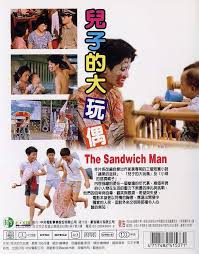
Review - The Sandwich Man (1983)

July 7, 2016

The Sandwich Man – Taiwan, 1983

I’m convinced that films like The Sandwich Man are nearly impossible to do well. They require multiple directors to create works that both blend together and stand alone as solo films. They often have world-renowned directors, yet invariably one or two parts tend to stand out, while what remains either slow the film down, makes dramatic shifts in tone, or tells a story so distinct from the others that one may wonder why it was included in the first place (think Michelangelo Antonioni’s “The Dangerous Thread of Things” from 2004’s Eros). Luckily, the three stories that make up 1983’s The Sandwich Man share enough in common that it seems logical that they are included together. Unfortunately, as the film progresses, both quality and tone decline, and what we’re left with resembles a three-course meal whose concluding dish doesn’t quite leave you wholly satisfied.

The stories that make up The Sandwich Man are all set in Taiwan in the 1960’s, a time when martial law was still in place and Taiwan was still recognized by the UN as China. Therefore, it seems entirely apropos that each one is in some way connected to the influence of the outside world on Taiwan. The first two showcase the influence of Japan on advertising and economics; the latter has to do with the presence of foreigners – mainly, the American military – on average Taiwanese citizens. The theme of family also runs through all of three stories, and most of the lead characters are deeply motivated by the need to provide better lives for them.

The film’s first chapter, set in 1962 and directed by Hsiao-hsien Hou, is “Son’s Big Doll” about a man who is inspired by a newspaper clipping of a Japanese man who dresses in a costume and walks around town as a living billboard. It reminded me of 1958’s masterful Giants and Toys, a film in which characters do things like this to push sales and promote products, often to surprising effect. Having lived in Taiwan now for over eleven years, I immediately thought that it would almost certainly be less effective here. However, our hero, Qun-Shu (Bor Jeng Chen) is undeterred, and in one scene, we watch as he rushes home and makes a costume out of a blanket that was probably being put to good use already.

Smartly, the film is less about his attempts at advertising than it is about his relationship with his wife (Li-Yin Yang) and very young son, and theirs is a tough relationship. We see the strain that economics is having on them, and many of their conversations contain words that are intentionally hurtful – mostly from him. Failing to bring home the bucks can do this to someone as proud and industrious as Qun-Shu, and being the object of scorn and snickers doesn’t help either. In one scene, we see a family member openly express his embarrassment at Qun-Shu’s choice of a profession. I was moved by this story, for in just a short time it created interesting characters, established realistic situations, and presented real emotions. In fact, it is only in its final moments that the film takes a turn from realism to symbolism, but even that is hard to fault completely.

The second film, set in 1964, is less successful, yet still weaves a tale of good people putting too much faith in both themselves and the decency of companies. Directed by Zhuang Xiang Zeng, this part is entitled “Vicki’s Hat,” and it tell the story of two men sent to a small area of southern Taiwan to sell Japanese cooking pots, which, as they frequently remind potential customers, will reduce the time in which it takes to cook from two hours to ten minutes. Again, the film presents us with a family man, here Zai-fa Lin (Ting-li Fang), trying to earn enough money so that his very pregnant wife will finally be able to quit her job, and like Qun-Shu, we hear anecdotally that Zai-fa has had pressure from in-laws.

The story drags somewhat, relying too heavily on attempts to sell the pots. This leaves precious little time to explore the film’s other, more interesting subplots, such as Zai’s fa’s colleague’s interest in a local school girl, the only girl in town, it seems, who wear a hat, and intriguing flashbacks that call into question Zai-fa’s abilities as a salesperson, as well as his constant depiction of himself as prepared and knowledgeable. As a result, I was less involved in this one, and not even its strong finale was enough to pull me back in completely.

At this point in the film, drama has been its consistent tone, and for the first few moments of the third piece, Jen Wan’s “The Taste of Apples,” it appears that the film will continue in this tenor. However, it quickly veers into unadvised and discomforting attempts at comedy, and at times, I could not tell whether the film wanted the audience to laugh with the characters or at them. This portion of the film takes place in Taipei in 1969, and it is about what happens after a southerner living in Taipei with his family is hit by a car driven by an American colonel (another foreign influence on average Taiwanese). Along with a local interpreter, the colonel goes to the man’s home, picks up the man’s family, and takes them in his shiny car to a hospital for Americans. Seeing the looks on the family’s faces, it is clear that they’ve never seen anything like it.

There are things that ring true about this tale, from the joy and playfulness of the two young boys to the mother’s worry over the family’s well-being if her husband dies or cannot work for a long stretch of time. The film also contains a reference to “selling” the family’s oldest daughter into marriage that will remind viewers just how different times were back then. However, all too often this part of the film veers into situation comedy, depicting the family’s interest in seeing the bathrooms or their abrupt switch from sad to happy at the mention of a financial settlement. It’s a film that doesn’t take its characters seriously and seems to see negative or real emotions as simply steps to the next comic moment. In other words, it establishes a character’s negative emotions only to show them smiling and acting silly a moment later. In fact, the message of this segment seems to be that everyone would be fortunate to be hit by a car driven by an American officer.

It reminded me of the last segment in In Our Times, also from 1983, and I wondered why there was such an interest in ending with laughter. Sure, movies have always tried to end with moments of big excitement, huge impressive spectacles, and sheer hilarity, yet usually those are the themes of the movie throughout. Here, it isn’t, and the effect is jarring. It’s as if the directors underestimated their audience, viewing them as capable of handling only so much “realism.” This is unfortunate, for with just a few tweaks, The Sandwich Man could have been that rarest of films – the combination of divergent stories that gelled well together and added up to something special. As it is, the film is watchable, yet much less memorable than it should have been. (on DVD and Blu-ray in Region 3/A as part of the Taiwan New Wave Cinema: 1982 – 1983 box set)

3 stars

*The Sandwich Man is in Mandarin, Min Nan, and English.

*It has incorrect subtitles throughout, and this is truly inexcusable.

Thursday, June 2, 2016

Review - Growing Up (1983)

June 2, 2016

Growing Up – Taiwan, 1983

Kun-Hou Chen’s Growing Up begins with a scene that is quietly powerful. In it, we watch as two young ladies walk along the beach, one talkative, the other silent. There is no audio in the scene, and it seems as if the film is trying to say that this moment is for them – it is theirs to use to open up in ways that perhaps they can’t if they know someone is listening. As the scene progresses, tears begin to stream down the quiet one’s face. Soon we see her reach for the hand of the young child who has until then been further up from them, fascinated by a group of elderly people combing the sands in search of either litter or coins. The exact conversation will remain a mystery for the remainder of the film, yet its highlights become clear in the very next scene, when we watch as the quiet one, revealed in the scene to be a single mother named Hsiu-Ying, accepts the wedding proposal of a man named Ta-Shun Bi, who appears more than a bit older than his prospective bride. Most of the time, a moment like this would be joyful; here, it signifies great shame, the casting off of the shamed woman into exile. Hsiu-Ying has only one condition: that her future husband agree to send her son, Chu-Chia, to university.

The film then takes viewers of a ten-year journey, enabling them to see the family’s highs and lows, trials and tribulations, and joys and sorrows. We see the effects of new additions to the family on the bond between mother and son, as well as evidence of the kind of parental permissiveness that can drive child specialists up the wall. At one point, Mr. Bi even says that as long as Chu-Chia’s grades are good, there’s no reason to do anything about his increasingly bad behavior. Rarely have more erroneous sentiments been uttered.

In an odd, yet interesting move, the film is occasionally narrated by Chu-Chia’s neighbor, a female classmate who always seems to be in the right place to see something important. For example, she just happens to see a student steal a few books from a local bookstore, a crime that Chu-Chia is later wrongfully accused of. I suspected the movie was scheming to bring them together, yet as the film progresses, it’s not even clear than the two of them are even that close. Also, unless this character is sitting at her window with binoculars and a listening device for the whole day, she cannot narrate much of what we see in the film. Still, she does provide observations that are both timely and thought-provoking, the most significant of which is her description of Hsiu-Ying as someone who is neither happy nor sad. She seems to be going through the motions of living, like one who has already given up on life and is now only living because to do otherwise would be to admit failure.

As I watched the film, I found myself slightly split about it. On the one hand, I admired the film’s characters and just how realistic they are. There are no moments in which they get into situations that are not perfectly believable, and throughout the film, kids sound like kids, and adults sound like the models of imperfection that they are. The film also has a number of humorous moments, such as the family’s efforts to get the newest of them to cry less. Perhaps only in the ending does the film truly deviate from its realistic tone, for in a film with this much drama, it is a bit of a cop-out – and a bit of propaganda - to present things as all patched up so soon after a tragedy. In addition, the film is somewhat unevenly paced and can occasionally seem to be moving at the speed of molasses.

The most recent edition of Growing Up was released this year by Central Motion Pictures, one of the premiere companies in Taiwan, and while they usually do a commendable job, here their efforts are a bit of a let down. While the picture itself looks beautiful, their subtitles leave a lot to be desired. In addition to the occasional awkward phrasing, the subtitles show signs of utter laziness. It’s as if they simply couldn’t be bothered to proofread. The only other possibility is that they actually thought they was spelled the.

The film was released a year after Taiwan’s “New Wave” officially began, and it’s clear that Chen was still perfecting his craft. Still, despite the film’s occasional starts and stops, I found Growing Up to be rather involving, and I cared whether Chu-Chia turned his life around. I was also deeply invested in Hsiu-Ying, and I kept hoping that some sort of happiness would visit her. Mr. Bi could easily have been portrayed in a negative light, but instead, he is a man who just wants a family to call his own. It is significant that one of his first acts is to enquire about giving Chu-Chia his last name. Other characters come and go with few of them leaving much of a lasting impact. In fact, only Chu-Chia’s aunt left much of an impression on me. However, those who are willing to give the film a change are not likely to be disappointed. The film is deep, involving, emotionally challenging, and somewhat inspiring. It’s also the kind of film you’re likely to think about long after its credits have rolled. In other words, it’s the kind of film I tend to enjoy. (on DVD and Blu-ray in Region 3/A.)

3 stars

*Growing Up is in Mandarin and Min Nan with English subtitles.
*The film is set in Tamsui (formerly known as Danshui), an area in northern Taiwan where the river meets the sea. I have been there many times, and I recognized several of the locations used in the film. It is truly remarkable how different they look in the film – areas that are today lined with bustling restaurants, food stands, and companies offering passage to neighboring Bali Island appear desolate and underdeveloped. To millenials used to its current state, it must be like looking at an alien world.

Thursday, May 19, 2016

Review - In Our Time

May 19, 2016

In Our Time – Taiwan, 1982

For the first hour, In Our Time fascinates and moves like few other films. And then it doesn’t, getting bogged down in intentionally vague conversations about a competitive event and even vaguer notions of nationalistic pride on a college campus. It’s as if the makers of the film knew that if people talked normally and actually were clear with each other, the audience would release a collective grain of incredulity. After all, when a film spends fifteen minutes keeping something hidden, the secret had better be worth the wait. Here, it is a bit of a letdown. The film then compounds this mistake by closing with a segment whose tone is so utterly inconsistent with what has come before it that it leaves a rather sour aftertaste for some time after the film’s final credits and may lesson the viewer’s overall experience.

In Our Time is a meditation on the stages of life and the influence that changing times can have upon our perceptions of culture, individuality, and identity. There are four segments, each directed by someone who was relatively new to Taiwanese cinema in 1982. None of the segments have any direct connection, and as a result, the film is the equivalent of a stack of unfinished novels, some that made me long for more and others that I couldn’t put away fast enough. The first segment, directed by Te-Chen Tao, takes place in Taiwan in the 1950s, and in it we see a picture of a family struggling to cope with their new reality. Their method of doing so involves seeing no faults in one son and no virtues in the other. The segment is powerful, shedding light on the impact of bullying and favoritism, yet also allowing viewers to see the hope that someone different can inspire. It is easily my favorite of the four segments.

In the second segment, directed by Edward Yang, the young girl from the previous segment, Hsiao-fa, has become a teenager and is pulled, as teenagers are wont to be, by the forces of individuality and sudden interest in the opposite sex. I enjoyed this segment quite a lot and admired the skills of its lead actress, who conveys a great deal with just subtle turns of the head and slight variations in her facial expression. Yang relies too heavily on flashbacks, however, often unnecessarily employing them to remind viewers of events they just saw five minutes earlier. His use of slow motion and close-ups are more effective, though, especially in a scene that focuses on Hsiao-fa’s impressions of the young college student who rents an apartment from her mother. We understand exactly what Hsiao-fa is seeing and exactly what it means that she fixates on it.

It is in the film’s third segments that I began to lose interest, although thankfully not entirely. This segment, directed by Yi-Chen Ko, fast forwards to the 1970s and focuses on a reticent, socially awkward college student (Kuo-Hsiu Li) who yearns for the opportunity to prove himself and who if he had his way would be a poet. I liked this segment’s focus on individual dreams and concepts of filial piety, and it is clear that the characters are still being torn between forging their own path in life and following the road laid out for them by their families. I was also moved by the lead character’s attempts to prove himself. Can he talk to the girl? Can he be heroic? I suspect we’ve all had thoughts like these.

The final piece, directed by Yi Chang, moves viewers into the bustling eighties, yet has very little to say about the time period itself. It opts instead to be a comic exploration of a young, modern married couple on the morning of the wife’s first day at a new job. The segment more closely resembles a slapstick short from the 1920s than a serious reminiscence upon the changes that were taking place in Taiwan in the early 1980s, and it is easily the least consequential of all of the segments.

The film stays away from any overt mention of the politics of these years. The only real mention of China occurs in the first segment, when the family is given a radio and the father is frustrated that he cannot get Chinese radio stations on it. Nothing is said about Chang Kai-shek or martial law, yet its existence can still be felt in the nationalistic undertones of the film’s third segment. Instead, the film focuses on more personal issues – on family and how lasting their impact on their children can be, on education and the results of a test-based approach to learning, and on individuality and the changing nature of culture. Viewers of Taiwanese films will not be surprised to learn that many of the film’s themes are expressed indirectly and often non-verbally. This is not a film in which characters blurt out, “Times are changing, Mom!” Rather, we hear the discordance in the film’s soundtrack, through its early frequent cuts between jazz and classical music, as if society were being pulled toward modernization and then tugged back to the safe and the familiar. The use of the Beatles’ music in the second segment demonstrates just which side won that war. We can also see this conflict in the fashions people wear in the film, for as time goes by, they become less traditional and more Western. In the third segment, we see for the first time a woman with a tattoo, just another sign of society’s ever changing nature.

The film’s directors employ many of the techniques common among films from the first wave of New Taiwanese cinema, which Wikipedia lists as being from 1982, the year In Our Times was released, to 1990. Its characters are, for the most part, realistic, and as the film moves forward, it does so without much of a resolution in sight. In fact, the film leaves viewers with many more questions than answers. Nevertheless, it closes with an image of a society that is advancing and somewhat hopeful, while at the same time resorting to tried and true notions of rules and procedures in the hope that they will enable society to remain orderly and stable. It’s an interesting end to an occasionally delightful film. (on DVD and Blu-ray in Taiwan from Central Motion Pictures)

3 stars

*In Our Time is in Taiwanese and Mandarin with English subtitles. The subtitles have occasional inaccuracies.