Showing posts with label Hong Kong. Show all posts

Thursday, July 23, 2020

Review - The Peony Pavilion

July 23, 2020

Peony Pavilion, The – Hong Kong, 2001

There are stories that demand a longer running time. Suffice to say, Yon Fan’s The Peony Pavilion is one of them. In fact, I would venture to say that about eight hours are needed to adequately tell the story that Fan jams into just over 120 minutes. Predictably, the results are mixed. While the film’s central story of forbidden - and perhaps unacted on – love is magnificently told, many of its subplots receive so little attention that when they come back, it is hard to believe that they were as important as they are made out to be. Take the character of Butler Yee, for instance. He appears in roughly five minutes of the film, hardly speaks, helps out Cui Hua, his employer’s fifth wife, and then heads off to a war that he doesn’t return from. The character didn’t make much of an impression on me, yet there was Cui Hua sobbing later on in the film after learning of his death.

The Peony Pavilion is about two young women, Cui Hua (Rie Miyazawa) and Lan Rong  (Joey Wang). Cui Hua is the fifth wife referenced earlier, while Lan Rong is her sister-in-law. One look at the way they stare into each other’s eyes while singing operatic standards – Cui Hua in tradition attire, Lan Rong in a two-piece suit - is enough to know there’s a bit more to it than that - at least internally. The film begins with a preface – that everything we are about to see exists only in dreams now, and for a moment, that nostalgic sentiment seems to apply to some golden yesteryear in which a family had wealth, kids respected their elders, and the family courtyard was frequently filled with singing and dancing. As the action commences, though, we soon realize that these so-called golden days were also times of financial waste, massive opium addiction, and a general sense of indifference to anything from the outside world that didn’t have anything to do with fashion or items that the head of the house could use to flaunt his wealth. In fact, that explains why Cui Hua joined the family. The master simply had to have his own opera singer.

The film makes frequent jumps back and forth in time, and in its scenes set later on, we watch Lan Rong, sans the make-up and fancy clothing, making a living as a teacher, having clearly been ostracized from her family. Eventually Cui Hua and her daughter, Pearl, come to stay with her, and they begin to have the life together that would never have been possible within the confines of Lan Rong’s family home. Everything seems to be going swimmingly until a young government official named Zhi Gang (Daniel Wu) threatens to come between them. Oh, did I mention that Zhi Gang is a man?

In other words, The Peony Pavilion is a movie about relationships, perhaps too many of them to do them all justice. There’s the moving and involving relationship between Cui Hua and Lan Rong; a mostly unexplored one concerning Cui Hua and Bulter Yee; an intense physical attraction that develops between Lan Rong and Zhi Gang; and the slightly incomplete bond between Cui Hua and Pearl. In other words, there’s far too much for the film to cover satisfactorily in two hours. The film is at its best when it focuses on Cui Hua and Lan Rong, and I would loved to have seen a few normal conversations between the two of them – you know, the kind most of us have around the dinner table or on the couch after a long day at work. I’d love to have heard them talk about their relationship and society’s reaction to it. Sadly, the film has no time for such trivialities. So, Zhi Gang never evolves into anything more than a very fit hunk; Pearl is portrayed as the perfect child, thereby justifying the exclusion of additional scenes with her; and Butler Yee remains a convenient sacrifice.

The film is beautifully shot, and there is honesty in its early scenes at the big house. In most films, performances are presented as sacred; here, children run around singers as they are performing, whispering questions to their parents, and getting answers from characters most movies would depict as giving their complete attention to the entertainers.  I loved these scenes. I also cherished the adorable moments when Lan Rong just can’t resist joining Cui Hua in song, and a scene in which she and Cui Hua dance across the terrace is just perfect. But the film cuts corners and suffers as a result. By the time the credits rolled, I had far more questions than answers. Sometimes this is a sign of a great film, but on this occasion, it was a reflection of frustration, of the awareness of the potential for the source material and a feeling that what I had experienced represented a missed opportunity. Maybe there’s a director’s cut. (on DVD in Region 3)

3 stars

*The Peony Pavilion is in Mandarin with English subtitles.

Thursday, April 23, 2020

Review - The Singing Killer

April 23, 2020

The Singing Killer – Hong Kong, 1970

Director Chang Cheh’s 1970 film The Singing Killer begins in a Hong Kong disco that looks to have enough space for about twenty spectators. Never mind. As a bad paraphrase of an old saying goes, with fans as rabid as these, who needs more? See, after every song – and I mean that literally - they euphorically rush the stage, while ecstatically screaming Johnny!, the name of the band’s lead singer. Apparently, no one associated with the club has heard of the concept of security. In the film’s opening moments, we watch as the crowd sways to a song entitled “The Singing Killer,” the lyrics for which include descriptions of a homicidal criminal stalking a city and spreading fear amongst the general populace – lyrics you’d probably not want your children repeating at home. No matter – the audience eats it up. They also quite enjoy his next number, a slow, sweet ditty called (I think) “My Dream Lily,” and yes, they flood the stage upon its completion, too. For their sake, let’s hope his sets are short.

While “The Singing Killer” seems unlikely to have ever been a Top 40 song, it does a decent job at introducing the film’s lead character. Yes, in his earlier incarnation, Johnny was the worst of the worst – a violent thief, a key forger, and a breaker of hearts. This last one is not necessarily a crime, but characters make it a better measure of someone’s character than their willingness to act violently. And yes, he broke the heart of a young woman named Lily and feels so bad about it that he’s asked the local police to ascertain her whereabouts. In an early scene, Johnny rushes to one of his and Lily’s old haunts after receiving a note indicating that she is there waiting for him. He is sadly mistaken. Instead, he finds himself face to face with his old gang, and it soon becomes clear that they will stop at nothing to enlist his services. Ultimately, their efforts involve the elusive Lily.

The set-up is undeniably silly, what unravels even more so. One character, for example, begins the film a relatively nice guy and ends it the head of a criminal gang so large it is impossible to believe that the authorities wouldn’t have him under constant surveillance. Another is first presented to us as a manipulative, uncaring character willing to use anything and anyone to gain an advantage; by the end, she’s lamenting that Johnny has given his heart to someone else. And then there’s the odd inclusion of martial arts. I can believe that a common criminal would find redemption in music; I can even accept that he may have needed self-defense skills to make it in the criminal world, but how he got this level of skill is beyond me. And don’t get me started on the other characters who are suddenly master martial artists. At times, it was like watching the premiere of Martial Law all over again.

I could go on, but here’s the thing. For all it ridiculousness – from the villain’s Bond-like lair to the film’s over-the-top musical numbers (one begins with the lyrics “I’m trapped in a jungle safari” and is sung by Johnny in a circular make-shift wooden cage a la King Kong) - the film works. It presents a realistic scenario of someone being coerced back into the criminal world, and it becomes quite suspenseful as we watch two concurrent storylines – one involving Johnny and his blackmailers, the other a friendly detective who suspects there is more to Johnny’s sudden return to crime than meets the eye. A critical scene in a bank is masterfully shot, and the film’s finale, while including some of the more ludicrous elements of martial arts finales, pulses with vitality and urgency. The acting is hit-and-miss, but as Johnny, David Chiang is excellent, fully conveying the emotions of a bad man trying not to revert back to what is likely his more natural nature, and Tina Chin-Fei is terrific as Ho Man, the temptress with the supposedly hard heart.

Unforgivably, the film’s biggest fault is its inability to fully convey Johnny’s connection with Lily. This is a couple that has been separated for two years, and life has been incredibly unkind to Lily since their break-up. Their reunion should be emotional; there should be anger and confusion, tears accompanied by looks that pierce the soul and reveal the depths of longing in them. Instead, we get silent stares, soft hugs, and the repetition of their love’s name. It’s not enough. In fact, there’s more emotion in Ho Man’s face when she realizes she has lost Johnny than there is during Johnny and Lily’s long-awaited reunion.

Still, the film succeeds more often than not. It opens with a bang, rises in suspense, and ends with a crowd-pleasing rendition of the standard one-man-vs.-an-army motif. Sure, it’s corny at times and its musical numbers will likely remind some viewers of the Austin Powers movies, but it also draws you in and makes you root for the good guys to come out of top. Interestingly, in one scene, Lily tells Johnny, “You are the hero. Don’t use the gun.” So, what does he do in the next scene? Yep, he grabs a machine gun and begins mowing down the bad guys. It’s not his most heroic moment, but remember, he is the singing killer. (on DVD in Region 3)

3 stars

*The Singing Killer is in Mandarin with English subtitles.

Thursday, May 31, 2018

Review - Love Without End (1970)

May 31, 2018

Love Without End – Hong Kong, 1970

There’s a moment in the Shaw Brothers Love Without End when a man stands at the back of a night club watching the woman he loves and with whom he’d like to reconcile sing that most popular of Chinese songs Wang Bu Liao. For those of you unfamiliar with the song, it is essentially about not being able to forget both the good and bad times after a break-up. It ends with the lines “Never can I forget the bitter taste of parting, and never can I forget the emotions of pining for you.” The song is perfectly appropriate for the moment even though by then we’ve seen this particular woman sing it several times already. The peculiar thing about the scene is the look on the man’s face. Here he is hearing the love of his life crooning about love as if it were a chapter of her life that had been permanently closed and the look on his face is not one that reflects contemplation or joy or heartbreak. No, the man just looks bitter. It is as if he’s thinking, “How dare you?” Which would be fine if that indeed were what the following scene expounded on. Yet there he is a moment later proclaiming his eternal love for her and begging her to stay with him.

The character, Tang Pengnan, is played by Yun Ling, and his performance is a big part of the reason that Love Without End works much less effectively than it should. For one, I know love at first sight. I know the feeling of being frozen in a moment, unable to look away from someone as the mind races and the heart begins to go aflutter. I have experienced the sensation that comes from understanding the urgency of the moment and the feeling that the slightest hesitation could result in a lifetime of regret. And Tang’s reaction was not love at first sight. It was a moment of warmth, there’s no doubt about that, yet that intoxicating feeling likely came more from the alcohol he had just consumed that from being struck suddenly by Cupid’s arrow. In fact, the next day he can hardly remember what happened the night before. I remember the first time I saw my great love like it was yesterday, and it has been over twenty years. That’s love at first sight.

And this is a death sentence in a film such as this one, for if you don’t buy two characters’ claims of sudden love, then the film falls apart, for the two of them don’t spend time getting to know each other. They just start dating. And then they stop. And then they start again. And then one of them runs off to Japan with someone else in exchange for a loan that will keep the other’s business afloat. Wait, what? And then that character is arrested on suspicion of smuggling illegal good into the country. Really, that happens. It’s just one of many storylines that is introduced and then dropped almost immediately. And in a way this makes sense. If a movie is going to go all Nicholas Sparks on us, it can’t get caught up in any details that would slow its path to emotionally manipulative melodrama.

So, the seedy parts of working as a singer in a club hinted at early in the film? Don’t give them a second thought. The weight Tang feels after his father dies and his business is in financial trouble? Resolved in a scene and a half. And the creepy, wealthy customer that sets his sights on Qingqing? Disposed of before you have the sense to ask yourself why a seasoned criminal would be so obvious in his methods. No, this is a film that would rather lay on the sad stuff, to give a woman a chance at happiness only to then take it away if one of the most telegraphed ways ever. Oh, and there’s the film’s other Sparks moment, when Tang misinterprets his love’s motivation and yells to her, “You’re just like the rest of them!”  No, she isn’t, and in movies such as this one, they never are.

In the end, what we have in Love Without End is a love story that never convinces viewers that the two lovers are indeed head over heels for each other. Instead, we get a series of aborted story lines that each could have evolved into something interesting, and a conclusion that is both predictable and wrong in its message. In reality, a man like Tang would be haunted by Qingqing’s final act, much like the boy is in Cinema Paradiso. Here, he just shouts out the equivalent of “How can I ever thank you for walking out of me?” Yeah, that happens.

If there is a silver lining to watching Love Without End, it is being introduced to Jenny Hu, who plays Tang’s love interest, He Qingqing. Hu has a natural grace in front of the camera, and she puts on quite an impressive display of emotion in the film. Even in scenes that rang false, she was enough elevate the material and gave it much more credibility that it would otherwise have had. It’s not enough for me to recommend the film, yet it is more than enough for me to search out Hu’s other films. I can only hope they made better use of her talents and matched her characters with love interests whose feelings seemed genuine. Here, the love is not without end; after all, cinematic love cannot believably last forever if it never convincingly begins. (on DVD in Region 3)

2 stars

*Love Without End is in Mandarin Chinese with English subtitles.

Thursday, August 11, 2016

Review - The Diary of a Big Man

August 11, 2016

Diary of a Big Man, The – Hong Kong, 1988

Chow Yun-Fat is a very talented actor. Blessed with dashing good looks and an appearance that can fluctuate between tender and tough at the drop of a dime, he has dazzled audience for four decades, an impressive feat by any standards. He excels in dramas and period pieces, and his films with John Woo were many young people’s introduction to Hong Kong cinema. I have seen a number of his films and enjoyed many of them. However, nothing I had seen before of his prepared me for Chor Yuen’s The Diary of a Big Man. If that sounds like praise, it is not.

In The Diary of a Big Man, Chow plays Chow Chen Fat, a young stock analyst whose life is utterly changed one rainy night. It is on that night that he meets two young women. The first is Joey (Joey Wang). She meets Chow while her umbrella is giving her fits, and he clumsily tries to assist her. In this movie, being clumsy is rather endearing, and in no time at all, she’s giving him her card so that he can return her umbrella after he fixes it. (Really. That’s what the subtitles said.) A few minutes later, he meets Sally (Sally Yeh). Sally is getting out of a cab, and wouldn’t you know it - she needs an umbrella! Just what’s a guy like Chow to do in this situation, but give her the umbrella? It’s practically love at first sight.

Chow decides to date both of them, and through a series of errors eventually ends up married to them. Thus, begins one of the greatest and funniest of ruses ever put to celluloid. If only. Rather, thus begins is an ill-fated attempt at screwball comedy featuring actors whose director has confused screaming and exaggerating with acting, and who believes that being eclectic is the same as being entertaining. All of this is brought to us courtesy of a screenwriter who seems to think that taking time to establish characters and built relationships is overrated.

Just how much did I dislike this films? Oh, let me count the ways. This is a film which offers a semblance of sweetness in its opening moments only to abandon it seconds later in favor of showing nastiness in the guise of screwball comedy. This is a film that thinks that actors will be funny if they speak loudly and quickly, yet doesn’t put any thought into what the actors are actually saying. There are scenes featuring cockroaches and screaming women, police sergeants who sexually harass their subordinates, and a man making up threats against his life in order to deceive his wives. All of these scenes are intended to be humorous. Then there’s the almost obligatory scene from an eighties comedy - you know, the one in which the lead character pretends to be gay - and the almost obligatory overreaction by the person who sees him do so. Here, the witness seems to be trying to avoid throwing up, and as he departs, he yells at two unsuspecting individuals, “Don’t get AIDS!” Ah, the eighties.

Like a screwball film, The Diary of a Big Man is a film that doesn’t take a moment to breath. It is filmed like a Road Runner cartoon, all frenzied movement with no direction or purpose. Its female character are one-dimensional for most of the film, and then suddenly they’re engaging in actions that are so far removed from what they have done before that it’s unsettling. In one scene, the film seems to be attempting black comedy when Chow’s two lovely wives, previously thoughtful, caring, and devoted, are suddenly pretending to be drugged and arranging for their husband to be roughed up by thugs. The change is simply too sudden to be shocking and the execution too bland to be entertaining. I watched it in exasperation rather than exhilaration.

Calling the film a product of its time would be to let it off the hook, for even films that are dated can still be good films. It would also be an insult to films of its time. Instead, I would say that too much of the film just feels wrong – and wrong at any time in film history. For example, it breaks the fourth wall, but doesn’t know how to use the technique to enhance the story. Also, it seems to think speeding up the action will create comedy, ignoring the fact that speeding up a film only makes it look clunky and dated – just ask the Keystone Cops. And just for kicks, in the film’s final moments, it decides to let Islam in on the fun, proving, I suppose, that the film is an equal opportunity offender.

In the end, I gave up on the film. Oh, I finished it, of course, but I did so with an air of resignation. I simply did not believe that the film would get better or build to anything worth waiting around for. This is unlike me, for I believe even the worst films can have decent endings. However, at one point, Chow asks aloud, “When will this end?” and I would be remiss if I didn’t admit that I was asking the same question myself.

Now there are some people out there who will say that I missed the boat on this one, that all of the things I disliked about the film were not intended to be taken seriously. Essentially, they will be suggesting that I just didn’t get the humor. They may be right. However, I would add this caveat: I did laugh as I watched the film - once. I believe audiences deserve more. (on DVD)

2 stars

*The Diary of a Big Man is in Cantonese with English subtitles.

Thursday, June 30, 2016

Review - A Tale of Three Cities

June 30, 2016

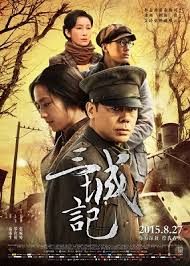
A Tale of Three Cities – Hong Kong, 2015

It’s always good to see Tang Wei on the silver screen. For those of you unfamiliar with Ms. Wei, she was the breakout star of Ang Lee’s 2007 film, Lust, Caution, and as a reward for giving a tough and challenging performance, she was banned from making films in China. Officially, it was said that she had made being a traitor look too glamorous. To his credit, Ang Lee attempted to intervene on her behalf, but it would still be three years before Ms. Wei would appear in another film. By that time, she had become a resident of Hong Kong, and as such, she began working regularly. Since then, she has made 14 films, not all of which have been released with subtitles, and so for me, A Tale of Three Cities is a chance to catch up with an actress that greatly impressed me with her screen debut. I am pleased to be able to tell you that Ms. Wei is indeed wonderful in the film. Thus, I feel somewhat guilty for not enjoying A Tale of Three Cities as much as I’d hoped to.

My problems with the film begin with its opening scene, for it promises something that the film has no interest in delivering. In the scene, a young boy follows a dog which has the almost skeletal remains of a fish between its teeth. What’s left of that fish will eventually find its way into the boy’s mouth, yet in the blink of an eye, it is being devoured by a older man who has no qualms about taking food from a child. The scene is powerful, for in just a few seconds, it has made it clear just what kind of world we are observing – one that is broken morally and where people are lost, one that, in the quest for mere survival, has lost the ability to sympathize and take care of each other. It’s a stunning way to begin a film. The problem is that what the film does from there has been done many times before, and in truth, we’ve seen it done much better.

Director Mabel Cheung, like many other directors of movies set during these times, aims to start the film off with a bang, and indeed it does. Bombs explode, buildings collapse, and everywhere there are the screams of those trying to flee. It should be riveting, yet Cheung films it as if she were filming a movie of the week, replete with slow motion and a soaring musical score designed to tug on the heartstrings through its high-pitched violins and the rest of its emotionally manipulative high notes. I’ve said it again, but it bears repeating: Truly sad or tragic moments do not require orchestras to tell us how we should be feeling.

The film then fast forwards to 1951, and instead of exploring the woman from the previous scene, the audience is introduced to a chef named Daolong (Sean Lau) in Hong Kong. Eventually, he pays someone to pen a letter for him, and we hear him implore a woman – his wife, he tells the man - to join him in Hong Kong. It’s not hard to predict that the woman he is writing to is the same woman from the first scene; thus, if you’ve seen a lot of movies, you likely know what’s coming next – the flashback, that great ruiner of suspense. And so we follow these characters back to the days of the Second World War and watch as they meet, fall in love, and struggle to be together due to war, tradition, and prejudice. With each successive scene, we are brought closer to post-World War II Hong Kong and an almost certain harrowing dash for freedom.

The film is not without compelling moments, for the characters at the heart of the film are living during divided times. China is at war with not only Japan, but also itself, and no sooner does one battle end than another one begins between Mao Zedong’s Communists and Chang Kai-shek’s Nationalists. A scene at a railway station swarmed with people trying to find passage to Hong Kong is rather intense, and one in which a group of gangsters – including Daolong - try to avoid detection by laying low in the middle of a hornet’s nest is quite ingenious. Yet the film’s core story remained curiously uninvolving. Perhaps it was because I knew nothing would happen to them that moments that were intended to be emotionally charged rang false. Or perhaps it was the characters’ odd courtship, for in truth there’s nothing concrete that binds them other than rifle shooting, their mutual belief that a parent should introduce children to alcohol at a very young age, music, and their habit of leaving their children with other people for long stretches of time. This may be enough for some people, but I felt that the film never truly established their initial connection, and without that, it was hard to completely invest in what followed.

Then there’s the little matter of the lack of suspense. Once the film establish that Daolong is in Hong Kong in 1951 and that he’s writing letters to his wife asking her to join him, that pretty much ends the notion that misfortune will befall either of these characters. That means that when he is shot later in the film (but earlier than 1951), there’s no suspense, and when Yuerong (Wei) is forced to flee from men intent on kidnapping her and forcing her into marriage, it is clear that she is in no real danger, either. Therefore, I watched the film with the kind of casual impatience that comes when you know more than the characters on the screen do and all you can do is wait for the film to get to the part that wasn’t made obvious in the film’s opening scenes. Unfortunately, that means waiting at least an hour and forty minutes.

I waited, but I’d have a hard time recommending that anyone else does. (on DVD in Region 3)

2 and a half stars

*A Tale of Three Cities is in Mandarin and Cantonese.
*The film is apparently based on the real-life story of Jackie Chan’s parents.

Thursday, December 3, 2015

Review - Behind the Yellow Line

December 3, 2015

Behind the Yellow Line – Hong Kong, 1984

When I first began watching films from Hong Kong, they had a terrible reputation. There was a belief that they were poorly dubbed (an ongoing gag in the Police Academy movies), that the scripts were often lacking in character development and rife with moments of such incredulity that dramas unintentionally became comedies, and that producers of the film had so little commitment to foreign audiences that subtitles were often impossible to understand. Taylor Wong’s schizophrenic 1984 film Behind the Yellow Line does nothing to dispel these beliefs.

The film stars the late Leslie Cheung as a social misfit named Paul Chan, and in its opening moments, we see him trying his best to get to work on his first day at a new job. The scene is somewhat promising, for it is reminiscent of the kinds of scenes that often signal that we’re in for a screwball comedy, one replete with physical gags and humorous facial expressions, both of which Mr. Cheung could do extremely well. Unfortunately, this is not the case. It is during this mad rush to get to work that Paul bumps into a young woman named Monica (Maggie Cheung), and it is obvious from the start that he has fallen victim to one of Cupid’s arrows. So just what does a shy, socially awkward man like Paul do when love finds him? Well, in this film, he acts like an immature high school student – he follows her from a distance, ducks when she looks in his direction, and becomes tongue-tied whenever he has an actual opportunity to speak to her. It’s as if he has become an adolescent stalker.

Just why Monica doesn’t report him to the subway’s security detail is beyond me, but perhaps it has something to do with her own lack of good judgment. In an early scene, we learn that she is in a relationship with her boss, a married man, and is therefore justifiably miserable. Eventually, Paul and Monica begin dating. The problem is that the film never truly establishes their connection. Instead of dialogue that addresses the awkwardness of their initial meeting and Paul’s subsequent childish behavior, we get a long montage of boyfriend-girlfriend moments that is meant to placate any skepticism on the audience’s part. Just trust us, the film seems to be saying. They really do like each other. Well, of course he does, but why does she? But I digress. Soon Paul is talking about marriage and buying a house, while also displaying moments of jealousy and pouting when he doesn’t get his way. In truth, I never rooted for the relationship, and buy-in is a must for a film of this sort to work.

Had the film devoted more time to building up the relationship, it may have been able to overcome its earlier deficiencies. However, it deviates from the romance far too often, and in these moments, its attempts at quirkiness and comedy simply fall flat. In one of its attempts to be humorous, the film adds a completely unnecessary character named Anita (Anita Mui). In Anita’s first scene, she embarrasses Paul on the Hong Kong subway by pretending that she is a sex worker and Paul one of her patrons. Why the film’s five writers thought such moments would be funny is beyond me. From then on, Anita pops up at the most inconvenient times and the most annoying of locations - in a department store, during a driving test, even at his home. I suppose Anita is meant to provide an alternative to Monica, yet the film never firmly establishes her feelings for Paul, not does it give Paul any reason to like her.

However, the film’s most egregious sin is Monica’s inconsistencies. The film makes Monica a character that blows hot and cold, one that can go from loving to destructive in the blink of an eye. In fact, in one scene, we see her lying next to the man she supposedly loves and intends to marry, and in just a few seconds, she’s breaking up with him. It’s as though no one associated with this film had ever heard of build up or establishing a motivation.

Here are a few other things that simply didn’t work for me – jokes about gorilla urine, conversations between Paul’s parents concerning their son’s sex habits, the threat of date rate used as comedy, break-ups that occur only because one person stands and watches the other person leave while looking dumbfounded and petrified, rudeness used as a device for humor, and the film’s entire insane finale, which is supposed to show once and for all how destined they are to be together. Instead, it comes across as slightly cruel and somewhat pointless. After all, even after it, I still didn’t care about their relationship.

All of this makes Behind the Yellow Line a slog to get through. It is a film that never truly finds its footing and seems content with characters that were not fully thought out or realized. And this is a missed opportunity. Leslie Cheung, Maggie Cheung, and Anita Mui are all talented performers, as they have demonstrated in other films. Behind the Yellow Line simply never gives them anything to work with. Sadly, they seem to be playing caricatures rather than characters, and no amount of hard work on their part can make up for that. (on DVD and Blu-ray)

2 stars

*Behind the Yellow Line is in Cantonese with English subtitles. The subtitles are not always understandable.

Thursday, May 28, 2015

Review - Love in the Buff

May 28, 2015

Love in the Buff – Hong Kong, 2012

There is a trap that always all sequels to romantic comedies inevitably fall into. Having ended the first film with two characters happily in love, the writers of the sequel often make the predictable decision to return its two central characters to the state of misery by manufacturing problems which had not existed previously. Therefore, in a sequel, Bridget Jones and her great love must inevitably break up, and Carrie and Big must have so many problems that they feel the need to spend time apart. However, rarely – if ever – are setbacks like these permanent, and one is often left with the impression that they occur not because it is natural that they would, but because it was the only device that anyone could think of to justify a second film.

Ho-Cheung Pang’s hit 2010 film Love in a Puff ended the way it should. Its two protagonists, Jimmy (Shawn Yue) and Cherie (Miriam ChinWah Yeung), had fought through adversity to be together in the end and were finally on their path to true bliss - and better health after both of them gave up smoking. It seems odd that a sequel would be necessary, yet 2012 saw the release of the oddly named Love in the Buff.

The film quickly dispenses with the pre-ordained separation. It seems that Jimmie refuses to grow up and that Cherie has gotten tired of his misplace priorities and unwillingness to sacrifice. We see that Jimmie puts his job first, and in one scene he even forgets that it is Cherie’s mother’s birthday. Oops. To make matters worse, he seems genuinely surprised that Cherie would have trouble understanding the situation. Nevertheless, she soon returns to her mother’s house, leaving Jimmie free to entertain a job offer in Beijing. Eventually, they both wind up there, where as fate would have it, they bump into each other and are taken aback by how strong their feelings still are.

As the film progressed, I got the impression that Jimmie and Cherie were better for other people as a result of their failed relationship. We see Jimmie happily doing things with his new girlfriend, You-you (Mi Yang), that he had not been able to stand before, and Cherie shows signs of possessing a creativity that she had hitherto not displayed. I rather liked these parts, for they gelled with what many people think of break ups, that while hurting a great deal, they have the potential to make people stronger and better in the end. The film also has a lot to say about old habits being hard to break and how former couples can sometimes find themselves repeating all of the same mistakes that they made the first time around. This part of the film is also to be commended. However, the execution of these themes is where the film makes what I consider to be a major blunder, for a film with such a premise often only seems truly genuine if its main characters ultimately remain apart despite their mutual adoration, and I could sense that the film had no intention of doing that. A more daring film would have.

It is perhaps for this reason that the film includes as its supporting characters two people who are just nice enough to sacrifice their happiness for someone else’s. Jimmie’s girlfriend is one of those loving cinematic characters that turn a blind eye to hints of problems and conflicted loyalty, hoping in vein that their love and stability are enough to keep their significant others from leaving. Similarly, Cherie’s boyfriend, Sam (Zheng Xu), has the look and manner of someone who would be more than willing to step aside in the interest of true love. In truth, I felt bad for these characters, and it was not easy to root for the people whose actions had the most potential to cause them pain. They deserved to be hurt and angry, yet instead the film denies them their just due, instead electing to show them passively accepting their fate. How convenient.

Also problematic is the film’s consistent use of cringe-worthy crude scenarios and suggestive language. In one particularly sigh-inducing scene, Cherie drops her cell phone in a toilet and then gets stuck in the bathroom stall. Her dilemma is this: She hasn’t gone to the bathroom yet. Laughing yet? The film also has enough characters with unrealistic personality quirks that you’d swear you were watching a Judd Apatow film. In a later scene, Cherie asks Sam, who chivalrously retrieved said cell phone from the toilet, what she can do to thank him. A friend’s answer: “Spread your legs.” There are far too many moments like this, and they unwisely distract from the film’s much more interesting storyline. Even worse, they make the film feel overly long and its running time of just under two hours somewhat unjustified.

Still, I did not entirely dislike the film. When it focuses on Jimmie and Cherie, the film is fun and light-hearted, and with a tighter focus it could easily have gotten the reputation as being Hong Kong’s Before Sunset. I can even see the potential for another movie with these characters in it. The problem is that having seen this one, I have no doubt that a third one would be more of the same, and that could pose a challenge. After all, look at how much less I liked it the second time around. (on DVD and Blu-ray)

3 stars

*Love in the Buff is in Cantonese and Mandarin with English subtitles.

Thursday, November 6, 2014

Review - The Adulteress

November 6, 2014

The Adulteress – Hong Kong, 1962

In the opening scene of Han Xiang Li and Meng Hua Ho’s 1962 musical The Adulteress, we are told by way of a choir of singers that in the mid-1870’s a murder case caused a sensation in a small area known as Can Qian. As portrayed in the film, the case involved a rising scholar named Nai-wu Yang  and Bai-cai Xiao, the wife of a struggling tofu vendor. In truth, the case is less about adultery than it is about lust and corruption, but adultery has always been the more sensational charge, while corruption is often viewed as being too commonplace to be truly shocking. As the film begins, Xi-Tung Liu (Bao Shu-Gao), the son of the local magistrate, is venting his frustration to the local apothecary. His complaint: that Xiao (Li Hua Li) won’t give him the time of day. The solution: a potion that, according to the apothecary, will make even the most virtuous of women completely lose her inhibitions. It is an awkward beginning, especially for a movie that wants to be taken seriously as a drama, yet it adequately establishes the characteristics of both the film’s female protagonist and its chief villain.

The situation is complicated further by the never-ending taunts of the area’s residents, who never cease to remind Xiao’s husband, Xiao-da Ge (Mu Chu), that his wife loved another man before him. Naturally, that man is Nai-wu Yang (Shan Kwan), and despite the fact the Yang is married, has a child, and seems like quite a respectable person, Mr. Ge becomes obsessed with the idea that his wife and Yang are having an affair. Such feelings enable Liu to operate with virtual impunity, for his actions can be quickly attributed to Yang. This of course sets the scene for jealousy, rage, murder, and eventually injustice on a shockingly massive scale.

There is much to praise The Adulteress for, from its excellent use of vivid colors and light to its creative use of musical numbers. These are used not only to move the story forward but in one clever bit to allow viewers to hear a character’s thought process during a pivotal moment in the film. The film’s directors also make good use of short shots that convey ironic messages to the audience. In one such moment, they focus their camera on a sign in the courtroom that read “Just and Fair.” Few words have been further from the truth.

After an intriguing first half, during which diabolical schemes are set in motion as those who are entrusted with protecting the innocent devise ways to shield the guilty, the film essentially becomes a courtroom drama. In this part of the film, we see the original case against Yang and Xiao, as well as their subsequent attempts at winning an appeal. While this part of the film is a bit repetitive, it is also quite emotional. To me, what was surprising most of all was just how dramatic and violent this part of the film is. For some time, it appears as if every judge the protagonists come before believes not only that torture is an acceptable means of extracting a confession but that confessions received as a result of torture are both admissible and truthful. Practically every judge utters a variation of the refrain if you didn’t do it, why did you confess either before or after ordering one of the defendants to be inflicted with physical punishment. Such scenes would be shocking in most films; in a musical, they are practically unheard of.

The acting is particularly strong throughout the film. Li creates a character that is on the one hand extremely moral yet on the other hand quite fearful, and the scenes in which she is called upon to demonstrate her character’s conflicted emotions are quite powerful. Kwan has an equally challenging part, for he must convincingly play Yang at two stages. In the first, he is strong, defiant, and upright; later, he is a man whose spirit and body has been broken. He plays both sides equally well. It helps that he is able to play against actors so skilled at coming across as uncaring and corrupt, actors such as Chih-Ching Yang (Shi-Tong Liu), Yunzhong Li (Counsel Wang), and Kuang Chao Chiang (Qian Bao-sheng)   

As with many films of this sort, viewers are at the mercy of the final product, and as with many releases of Chinese films from this period, the final product has problems. The most glaring of these has to do with the subtitles. While more accurate than those found on other DVDs, the subtitles unfortunately have frequent misspellings throughout the film, and this is inexcusable in this day and age. Even a cursory review of the subtitles prior to the release of the disc should have been enough for someone to spot that the letter I was frequently not capitalized or that the letter I was often erroneously used at the beginning of words. Really, who in their right mind would look at iamb and think that was a word? In addition, there are occasional reminders of the perils of relying on thesauruses during the translation process. An example: one character complains of something “leaving me so perturbed.” This translation would only seem justified if the character who spoke the line had an enormously rich vocabulary. He doesn’t. And there is simply no reason whatsoever for every sound made by the film’s chorus to be translated. For example, whenever someone is brought before the judges, the chorus sings the same line, which was transcribed as “Wei wu.” It’s anyone’s guess what this is supposed to mean.

Still, as I am fond of saying in situations such as this one, an imperfect DVD of a otherwise fine movie is better than no DVD at all, and The Adulteress remains a well structured, thought-provoking film. It weaves an intricate tale involving the powerful and the powerless and shows what can happen when corruption is allowed to pervade the government and the legal system. In addition, it demonstrates the consequences of evil allowed to go unchecked and the ability of unbridled obsession to bring about misery. Unfortunately, these are messages that are still very relevant in today’s society. (on DVD in Region 3)

3 and a half stars

*The Adulteress is in Mandarin Chinese with English subtitles.

Thursday, November 14, 2013

Review - Fight and Love with a Terracotta Warrior

November 14, 2013

Fight and Love With a Terracotta Warrior­ – Hong Kong, 1990

In the late 1980’s and early 1990’s, few film collaborations were more respected and more highly anticipated among patrons of art house cinema than those of director Yimou Zhang and actress Li Gong. Their pairings began with 1987’s groundbreaking film Red Sorghum and ended with Shanghai Triad in 1995, the year in which their personal relationship reached its unfortunate conclusion as well. Six of their collaborations are fairly well-known, for they found audiences both inside and outside their home country. However, for every genre-breaking film they made about the plight of women in both modern and ancient China, there are at least two or three movies featuring Li Gong that did not play at film festivals or art house cinemas worldwide. These films run the gambit from supernatural thrillers (Semi-Gods and Semi-Demons) to period comedies (Flirting Scholar), and from contemporary dramas (Mary From Beijing) to historical films (The Great Conqueror’s Concubine). Some of these films did not receive positive world of mouth, and I imagine that others were deemed inaccessible to non-Chinese audiences. In fact, I can imagine a studio executive looking at Gong’s 1990 film, Fight and Love with a Terracotta Warrior (a.k.a. A Terra-Cotta Warrior) and being at a complete loss as for a way to market it.

Fight and Love with a Terracotta Warrior, which stars, but was not directed by Yimou Zhang, is a bit of a head-scratcher. For the first fifty minutes, it is a straightforward drama about a good man named Tian Fong Mong (Zhang) who is loyal to China’s utterly ruthless first emperor. The film takes an interesting turn when Mong meets and falls for Winter, one of the emperor’s concubines. She is played by Li Gong. Through a plot device that works surprisingly well, the second half of the film transports viewers from B.C.E. China to 1930’s China. Here we meet a young actress named Lily, again played by Li Gong, whose life is soon endangered by her association with a group of relic hunters disguised as a film crew and looking for the Emperor’s mausoleum. It is of course Mong’s job to stop them.

Li’s two characters are like night and day. Winter is depressed by what life has reduced her to, suppressed by rules and traditions, and suicidal. Lily, on the other hand, is bubbly, energetic, materialistic, and slightly egocentric. She speaks in a high-pitched voice that seems designed to make her sound simultaneously more appealing, yet also less intelligent. I suspect that Winter is the kind of character audiences expect to see Li Gong play on the silver screen. However, as I watched the film, I got the sense that she was having much more fun playing Lily.

The film was released at a time in which the subject of the first emperor was of renewed interest in China. The Mausoleum of the First Qin Emperor had been designated a World Heritage Site just two years earlier, and films would continue to question whether the first emperor, credited with unifying China, yet using extremely draconian methods to do so, was a figure that should be praised or loathed. This cinematic exploration can be seen in 1996’s The Emperor’s Shadow, Kai-ge Chen’s The Emperor and the Assassin (1998), and Yimou Zhang’s 2002 film Hero. Fight and Love with a Terracotta Warrior begins like many of these films, and thus it lulls viewers into a false sense of confidence, for the film is not about Mong’s inner struggle between his loyalty to the emperor and his disgust and shock over the emperor’s brutality. Instead, the film is about his loyalty to both a place and a woman he swore to protect.

The film will remind some of Robert Rodriguez’s From Dusk till Dawn, yet the narrative thread in Fight and Love with a Terracotta Warrior is much stronger and more consistent. The film also owes a lot to the conventions of mummy films, movies in which tombs are places with booby-trap, and long-dead figures can magically come to life.  Its soundtrack reflects the tonal shift of its two halves, expressing the seriousness and tragedy of Mong and Lily’s forbidden love and the slapstick, comic nature of certain aspects of the film’s second half. In addition, its dialogue reflects the changes that take place concerning our perceptions of historical figures. In one scene, Mong rattles off the names of people who were important during his time, yet Lily does not recognize any of them. She then mentions the only name she can recall, that of a general who tried to assassinate the emperor. It says something that he is now regarded as a hero.

Sadly, like many films from Hong Kong and China, Fight and Love with a Terracotta Warrior has not been preserved well. The only available DVD is clearly not a remastered version, and heavy distortion can be seen throughout the film. In addition, the film’s white subtitles are often too small and dark to be read clearly, and they occasionally change so quickly that even a speed reader would have trouble keeping up with them. There are even a few moments in which subtitles appear on the screen despite the fact that the actors are not speaking. It is as if the subtitles were made using an early version of the script and someone didn’t notice that these lines had not made the final product. However, at least the translations are accurate grammatically.

Fight and Love with a Terracotta Warrior is a dramatic, silly film that works better than it probably should. Credit for this goes to the film’s cast; its director, Siu-Tung Ching; and its writer, Pik Wah Lee, all of whom take the film’s subject matter very seriously and work their best at making it seem as realistic as humanly possible. Gong Li shows an array of acting range, and Yimou Zhang demonstrates that he could easily have had a successful career in front of the camera. The film will never be confused as one of their seminal collaborations, but it is both fun and heartfelt. It is a must for fans of Zhang and Gong and, I suspect, a decent piece of mindless entertainment for other people. (on DVD)

3 and a half stars

*Fight and Love with a Terracotta Warrior is in Mandarin and Cantonese with English subtitles.

Thursday, August 8, 2013

Review - Love in a Puff


August 8, 2013

Love in a Puff – Hong Kong, 2010

Ho-Cheung Pang’s sweet film Love in a Puff is about two people that would never have had the opportunity to meet had attitudes about health remained unchanged. But change they did, and so January 1, 2007, ushered in a new era for the millions of smokers in Hong Kong. In the film’s opening scene, we see that Hong Kong’s new law has pushed smokers out of their comfortable work spaces and into occasionally cold back alleys and thin side streets. However, it has also placed them in new hereto non-existent communities. In narrow, occasionally cramped spaces, groups comprised of secretaries, managers, chefs, and janitors from surrounding buildings huddle together around a makeshift ashtray and pass their break time together for perhaps the first time.

Under circumstances such as this, it is only natural for their conversation to be light and safe, and as they stand around smoking, they swap tales of supernatural events or eerie coincidences, many of them featured recently on popular television shows. Each person takes turns telling a story, but when it comes to one man, the only anecdote he can think of involves a co-worker and the embarrassing discovery of his girlfriend’s infidelity. Juicy, but not entirely appropriate.

It is at this meeting that Jimmy (Shawn Yue), the unfortunate victim in the man’s sordid tale, eventually meets Cherie (Mariam Yeung Chih Wah), whose stylishly colored hair and casual attitude hint at a modern, gentle spirit. Their first meeting is brief and ends almost as quickly as it begins. Their second meeting is a step in the right direction. They take a walk, talk about unidentified flying objects, and exchange contact information. They make enough of an impression on each other that the very next day we see them sending a barrage of text messages back and forth. These messages result in their next meeting, and it is during this one that we get a hint of the bond that is rapidly forming between them. And like many of the first signs of budding love, it comes in the form of a whisper rather than a thunderclap. The scene, set in karaoke bar and containing an array of colorful lights and moving shadows, is perfectly shot, and it is no wonder that Cherie feels at ease resting her head on Jimmy’s shoulder. It is a magical beginning, and the rest should be easy. It never is, of course.

Love in a Puff is an excellent example of the kind of movie that more people should see. Like My Dinner with Andre and Before Sunrise, it is a film driven by the dialogue of its central characters, and what there is in the way of drama is perfectly believable for people in their situation. The most naysayers could say about the film’s central tale is that it all happens so quickly. However, the characters themselves utter those same sentiments, and their rationale for going as fast as they do makes so much sense that it’s amazing someone else hadn’t thought of it sooner.

The film also perfectly captures romance and communication in these times. Cell phones are everywhere, and they are used realistically. After seeing the film, I couldn’t help thinking that cell phones are now the tool through which people send both self-introductions and love letters. Years ago, a shy boy might have handed a handwritten letter to a girl he liked and scurried off before she had a chance to respond. Now he may send her an invitation to his Facebook account or text the kind of message that he would be too shy to say directly. It doesn’t seem all that different.

There are two potential problem areas for the film. The first one is the unwise insertion of snippets of a documentary about either the anti-smoking law or the budding romance. The purpose of the documentary is never fully explained, and other than one interesting revelation concerning the events that led Cherie to start smoking, these moments do not go anywhere significant. The other is screenwriters Heiward Mak and Ho-Cheung Pang’s inability to resist adding below-the-belt, cigarette-inspired comedy to the film. These moments may play well in Hong Kong, but they are unlikely to garner many laughs in countries in which smoking is viewed as a bad habit, even by smokers themselves. However, give the movie credit here, too. Here is a film about two people that smoke that goes out of its way not to glorify the habit in any way. In fact, one of the film’s recurring motifs involves giving up the habit for love.

Love in a Puff is a strong film about extremely likeable characters that I grew to root for a great deal, and I am eagerly looking forward to seeing its 2012 sequel, Love in the Buff.

3 and a half stars

*Love in a Puff is in Cantonese with English subtitles.  

Thursday, June 6, 2013

Review - Center Stage


June 6, 2013

Center Stage – Hong Kong, 1991

Stanley Kwan’s fascinating film Center Stage is a film within a film within a film. It is first a biopic about the short life of one of China’s greatest silent film actresses, Ruan Ling-yu, who rose to fame around 1930 and committed suicide just five years later at the age of twenty-four. Parts of the film resemble a documentary. In these parts, we hear real figures from the silent era, now in their later years, talk about Ms. Ruan and the times in which she lived. At other times the film is about the making of itself. At one point, we see Kwan having to reshoot a close-up of Maggie Cheung because the camera clearly picked up her breathing during Ruan’s wake. All told, we are watching an exploration of who Ruan Ling-yu was, a presentation of what people believe happened to her, and - if one looks between the lines – a thinly-veiled commentary on the media and the destructive power of sensationalism.

The film explores two aspects of Ruan’s life in great detail, and in doing so, it depicts her as a woman who was strong professionally, yet somewhat weak personally. At a time when actresses were often typecast based on their looks or previous roles, Ruan was able to branch out and play a range of characters. This was partly by design. In an early scene, a group of movie executives, including two legendary directors named Pu and Sun, sit around a bath house and plot a course of action that will culminate in Ruan Ling-yu being seen as an actress of great versatility. The plan is for her to play a prostitute in Reminiscences of Peking and a regular person in Wayside Flowers. Later, Ruan will extend her range further by getting herself cast in more modern roles. In this part of the film, we witness Ruan’s professionalism and see examples of the kindness she showed to those also in the movie-making business. We see nothing with even the slightest hint of indignity.

In her personal life, Ruan was involved with two men. The first was Chang Ta-Min, who was an immature, vindictive playboy whose vices included gambling and women. The two of them met when Ruan was sixteen. They briefly flirted with the idea of marriage but eventually settled into a relationship that had no possibility of bringing either one of them real happiness. They lived together, but slept in separate beds, and Ruan eventually became tired of taking care of him. When their inevitable separation occurred, Ta-Min demanded $300 a month in “separation” money for two years. This sum was negotiated down to $100 a month and paid by the second man in Ruan’s life, Tang Chi-shan. Unfortunately, he was only slightly better than Ta-Min, and their relationship left them both vulnerable to charges of scandal and impropriety.

There’s much to admire about the film, from its authentic recreation of 1930’s Shanghai to its equally mesmerizing recreation of Ruan’s films. I was also intrigued by many of the cast’s conversations about the people in Ruan’s life. Not only do these conversations answer many the audience’s questions as they come up, but they also provide a glimpse into how much society’s perceptions of right and wrong have both changed and remained the same. Also commendable are the performances of the cast. Tony Leung is quite effective as Tsai Chu-sheng, a director and the possible object of Ruan’s affection, and Lawrence Ng is equally impressive as Ta-Min, a young man undone by his personal weaknesses.  

Maggie Cheung is simply a revelation in the film, and the film demands a lot from her. First, she must portray a believable version of herself on screen, not a cautious or exaggerated one that the audience would see through instantly. Here, she comes across as inquisitive, slightly playful, and dedicated to the film she is making – all very authentic. Then she must play Ruan, faults and all, and adequately display those qualities that have made her such an unforgettable figure. Early on Ruan is described as being charming, enchanting, and sexy, all qualities on display in Cheung’s performance. Finally, Cheung must portray the characters that Ruan played in her movies. She does this by altering her normal acting style and matching Ruan’s movements precisely. Some may dismiss this as simple mimicry, but it is actually much harder than it looks.

I believe it is impossible to watch this film and not want to rush out and find the films it references. However, this may be one of the few biopics about someone that there is very little left of. It is said that only eight of Ruan’s films still exist, and many of them are said to be in very poor condition. Luckily, one of the ones that survives is her final film, New Woman or, as it is more commonly called, The Goddess. It is also the film that turned the media against her, and viewers can judge for themselves whether the film was as incendiary as they accused it of being. There is also some dispute over Ruan’s suicide note referencing the poisonous effects of gossip, which some people suggest was written by Tang to cover up his abuse of Ruan. Perhaps this is one of those cases of the legend being printed instead of the facts. Even so, the film is moving, fascinating, and eye-opening. It is about a time and a person that could easily have been lost to time and history. That she is remembered as fondly as she is today is a testament to her talent and her importance to Chinese films. (on DVD and Blu-ray)

4 stars

*Center Stage is in Cantonese, Mandarin, and English with white English subtitles. Alas, some of the subtitles are hard to read.

Thursday, September 29, 2011

Review – Zu: Warriors from the Magic Mountain


September 29, 2011

Zu: Warriors from the Magic Mountain – Hong Kong, 1983

A character in a Hong Kong supernatural comedy should never feel either too safe or too worried, for at practically any moment a new character is just waiting in the wings to leap out. This character could be a tree or water god that suddenly appears because he’s been following the same demon our hero is fighting and has only now decided to make his presence known. He could also be an evil spirit throwing yet another obstacle into our hero’s path, as if he needed another chance to prove his heroism. I imagine for audiences in Hong Kong, this is less of an obstacle. However, audience from western countries may find themselves scratching their heads wondering why a man’s beard just stretched out from behind a rock and latched itself onto our hero and just who the mysterious man attached to the beard is suppose to be. The scene I’m referring to is in Tsui Hark’s 1983 film, Zu: Warriors from the Magic Mountain, and even after seeing the film, I’m still not sure I can explain it all to you.

Perhaps it’s not important, though. Perhaps what’s important in a film like this is the overall journey and its endgame. So here’s what I can tell you about this. Apparently, a Blood Devil has decided to create chaos and destruction all over the world, and it will take two swords, used simultaneously, to destroy him. Oh, and our heroes have only forty-nine days to retrieve the swords from an immortal character who seems to have nothing better to do with her time than sit cross-legged while levitating over a lake. Not only can this character break the laws of physics, but it seems that she can also communicate with people telepathically, as well as trigger one of the most random costume changes you’re likely to see in a film. In the scene, two characters go from looking as if they belong in a Hong Kong period piece to doubling for the characters in the Double Dragon video game series, which I’m not exactly sure is a step up.

The journey in the film initially involves four characters. First, there’s Ti Ming Chi (Biao Yuen), a scout for a pair of local warlords. Ti finds himself in a bit of a catch-22 when each warlord gives contradictory orders and he’s asked to decide which order to follow. Whatever answer he gives is bound to displease someone, and soon he’s running for his life. In a cave full of creepy dark demons with glowing eyes, he meets Ting Yin (Adam Yeung), a man with honor and special powers that allow him to fight off demons, devils and evil spirits. Of course, Ti asks if he can become Ting’s apprentice and true to form, the master is at first non-committal. Rounding out the group are a monk named Hsiao Yu (Damian Lau) and his apprentice Yi Chen (Hoi Mang). The less experienced two hit it off right away, while the two that should be uniting against their common enemy instead refuse to work together, each blaming the other for their enemy having escaped.

Zu works for the first half an hour and then gets bogged down when our heroes have to seek help from the elusive, secluded woman known as the Countess (Brigitte Lin). She lives in a secret lair filled with young women who it seems have never left her sanctuary, and she only see visitors if their visit is approved by an odd blue flame that flickers out if their meeting is not meant to be. Brigitte Lin is fun to watch as always, yet the scenes with her are unnecessarily drawn out and just when you think they’re over, another emergency keeps Ti and his team there longer, which further delays the completion of Ti’s mission. I suppose the scenes are intended to show Ting and the Countess developing a bond. However, if one forms, it’s a rather weak one. During a later battle between Ting and the Countess, Ting actually rides a clay statue of an elephant. The scene is clunky and poorly choreographed, and it’s more head-scratching than thrilling.

Zu: Warriors from the Magic Mountain tries hard to find the right balance between comedy and supernatural adventure, yet it only partly succeeds. It wants to be a film with the witty banter of Ghostbusters, the thrills of Raiders of the Lost Ark, and the infantile humor of the American Pie films. It’s a hard combination to pull off, and at key moments, it focuses on humor when it probably should have focused on the mission at hand, for some of its attempts at humor detract from the film’s more serious moments, and those more serious moments make it hard to laugh at its attempts at humor. It should be said that the film also has its fair share of plot holes and inconsistencies. Also working against the film is the special effects, which have not aged well. They are barely a notch above the effects in Desmond Davis’ 1981 film Clash of the Titans, and the film’s closing moments resemble the bright, colorful screens often used to depict psychedelic acid trips in television comedies, the difference being that the effects in Zu are not part of the joke.

Still, Zu: Warriors from the Magic Mountain manages to stay watchable despite its convoluted plot and uneasy combination of genres. Part of the credit for this belongs to the cast, who give the material the amount of energy required for the film to remain at least somewhat interesting throughout. Along with Yuen, Yeung, Lau, Mang, and Lin, Moon Lee deserves mention for her lively performance as Mu Sang, the Countess’s guard. However, it says something that my favorite moments in the film involve Ti and a soldier he meets after temporarily escaping the wrath of the two generals in the film’s opening scene. The soldier is magnificently played by legendary actor Sammo Hung, who has some additional fun in a dual role later in the film. The scenes between these two characters are humorous, and the action scenes they share are well-choreographed and clever. I wish I could say the same for the rest of the film. (on DVD and Blu-ray)

3 stars

*Zu: Warriors from the Magic Mountain is in Cantonese with white English subtitles.

Thursday, June 23, 2011

Review – A Chinese Ghost Story


June 23, 2011

A Chinese Ghost Story – Hong Kong, 1987

Ching Siu Tung’s A Chinese Ghost Story takes place in a world in which a wandering swordsman just happens to stumble upon a beautiful young woman bathing herself in a river. Their meeting appears to be by design, for she is eyeing him in a way that suggests anything but modest and purity. The swordsman, who should perhaps know better, forgets that this is not the behavior one usually finds in a woman from this part of town and wastes no time in joining her in the river, where the two of them soon lose themselves in the moment. The effort is his undoing, for it weakens him greatly and allows an evil Tree Devil to sneak up upon him and steal his longevity, without which he is reduced to nothing more than a grey skeleton that completely melts if a bright light happens to hit it. Oh, I forgot to mention that the woman is a ghost, and the Tree Devil has the power to make her do this sort of things simply because she was buried under him. If that’s not strange enough for you, the film is set to a pop soundtrack despite being a period piece, and one of the main characters is a wise swordsman who loves drinking and slaying ghosts and who at one point in the film breaks into what can perhaps only be described as a “swordsman rap” for apparently no other reason than to allow the character to inform the audience that he “seeks his own way.” When I described all of this to my girlfriend, a young woman who understands Asian culture much more than I do, her facial expression never matched the incredulous look that appeared on my face as I was relaying it to her. “That’s right” she said in a rather nonchalant manner that suggested that the actions depicted in the film were practically everyday occurrences. The lesson here: Sometimes you just have to go with it.

A Chinese Ghost Story is one of those Hong Kong films that combines genres in a way that perhaps few films from other countries can without being labeled B-films and relegated to midnight screenings. It is part love story, part erotic comedy, and part period horror film. That it succeeds for the most part is a pretty impressive feat. The film’s central character is Ning Tsai-shen (Leslie Cheung), a wandering bill collector who could easily have appeared in a slapstick comedy in the twenties or thirties. In his first scene, he opens an umbrella that is so worn out that it provides very little relief from the storm raging around him. Cheung’s deadpan look at the camera and physical pratfalls are reminiscent of the kind one finds in Buster Keaton films. That Cheung could also play characters like Cheng Dieyi in Farewell My Concubine just goes to show the range of this man’s talents.

Through a series of errors and simple bad luck, Ning finds himself having to seek shelter at the Lan Ro Temple. Just the mention of this place is enough to get locals chattering, and one man even runs after Ning in order to measure him - for a coffin. On the way to the temple, Ning is pursued by a pack of wolves who eyes glow an eerie yellow, and upon arrival, he finds himself literally in the middle of a duel between two bickering swordsman out to prove which one of them is better. That honor eventually falls to an old monk named Yin (Wo Ma), who in a rather unpleasant way tells Ning to keep moving. He doesn’t of course, and the next day, he finds himself irresistibly drawn to the intoxicating sound of a lute. Behind it sits the very beauty who lures men to their doom, Nieh Hsiao-tsing (Joey Wang). And yet, Ning is spared the men’s fate primarily because of his naiveté when it comes to women. It seems Ning is more likely to be concerned about a woman catching cold when she shows him her shoulder than to recognize her act as flirtation. The trait makes him somewhat adorable to Nieh. Eventually, the two fall in love, and Ning vows to save her from the Tree Devil. The ensuing adventure is as thrilling as it is confounding, involving not only a trip to the Netherworld but also an escape from a forest that seems intent on preventing them from fulfilling their mission.

The humor in the film does not always work, which may be a result of both the passage of time and the film’s occasional poorly translated subtitles. In fact, there was more than one occasion when what appeared in the subtitles could hardly be described as English. And there’s a running joke involving a couple of corpses trying to get their dusty hands on Ning that has not aged well, perhaps as a result of the fact that the corpses appear only slightly more realistic than the alien spaceships in an Ed Wood film.

What does work extremely well in the film is the relationship between Ning and Nieh. I am often critical of films that portray true love as developing over a rather short time frame. However, the bond that forms between Ning and Nieh is surprisingly believable. It starts off as mere curiosity. Who is this stunningly beautiful woman playing the lute? Who is this sweet fool who seems oblivious to my advances? The curiosity grows to interest and then it becomes so strong that they are willing to risk everything for the other. Along the way, we also witness Ning transform from a weak pushover to a man of great courage and determination, and the journey is rather convincing.

I don’t claim to understand everything that occurs in A Chinese Ghost Story. Much of what takes place after the story moves to the Netherworld requires an understanding of Chinese folklore that I simply do not possess, so when a number of female heads flew out of the Dark Lord’s overcoat, I had no idea what was going on. The characters do though, and if they accept the existence of tree devils, dark lords and ghosts that can be injured by incidental head butts, perhaps we should, too. It’s just more fun that way. (on Blu-ray in Region A)

3 and a half stars

*A Chinese Ghost Story is in Cantonese with occasionally incorrect English subtitles.

Friday, March 25, 2011

Review – The Kingdom and the Beauty


March 25, 2011

The Kingdom and the Beauty – Hong Kong, 1962

Emperors are just like the rest of us in some ways. Therefore, it stands to reason that like us they get tired of doing the same thing day after day. For some of us, what makes us bored may be a job that just doesn’t seem as satisfying as it once did. Emperors might get bored as a result of the monotonous ceremonies they have to sit through on a daily basis, ceremonies such as the one that begins Han Hsiang-Li’s 1962 musical, The Kingdom and the Beauty. That ceremony calls for one hundred extremely privileged members of society to pay homage to the emperor – one at a time. It’s a rite that from appearances perhaps only the most self-obsessed would truly enjoy, and it produces a few well deserved yawns from the emperor. In addition, like us, emperors have earthly interests, whether those interests are children, bicycling, chirping pet crickets or, in the case of the emperor in Han’s film, Emperor Chu Te-Cheng (Lei Zhao), the ravishingly beautiful young ladies who constantly distract him from his studies. Granted, such a reaction may not seem emperor-like, yet it is perfectly understandable that such a young man as he would not be able to prevent his eyes from gazing at the procession of gorgeous singing ladies who gracefully pass by the door of his study. After all, he’s only twenty years old. What’s amazing about the scene is that while gazing at these lovely ladies passing by, he’s still able to comprehend what they are singing about. For most young men in films, the image would have resonated but the words would have sounded like something between gibberish and a record playing at the wrong speed.

What piques the emperor’s interest is a rather melodious tune extolling both the virtues of Kiang-nan (Jiangnan), an area in the southeast part of China, and the women of that area, for according to the song, the women of Kaing-nan are both pleasing to the eyes and rather intelligent. It’s a combination of factors that the emperor finds intriguing. Looking at pictures of Kiang-nan, it’s easy to see why emperors, as well as everyday people, would be so complimentary towards it. It’s filled with lush green hills, beautiful rivers over which well built stone bridges pass, and clean roads that are occasionally filled with large joyful crowds watching street parades replete with carefully crafted colorful floats, impressive acrobats, and stunningly beautiful maidens singing traditional songs about love and romance. Alright, this last part I borrowed from the film, but who knows? Maybe it happens all the time. In any event, it’s the last part of that description of Kiang-nan – the part about the beautiful maidens - that most interests the emperor, especially after one of his ministers whole heartily agrees with the sentiments expressed in the song. Therefore, the emperor decides to don casual clothes and sneaks out of the Imperial City to see Kiang-nan for himself.

Kiang-nan indeed lives up to its reputation, for almost immediately upon arriving, the emperor spots Li Feng (Lin Dai) standing atop a dragon float singing about heavenly blossoms being in bloom and tossing small flower petals to the romantics in the crowd. The emperor gets more than his fair share of them, and from that moment on, his heart belongs to her. They eventually meet in a setting much more conducive to getting to know each other, and get to know each other they do, much to the displeasure of Li Feng’s brother-in-law, Ta Nui (King Hu). At times, the emperor is thoroughly sweet and gentlemanlike; at others, he’s a tad bit too aggressive. As for Li Feng, she finds herself drawn to him, and she does allow herself to be a bit flirtatious, yet just as they get close, just after her hands have joined his, she creates distance. She is still a maiden, after all, and a maiden must act properly. Eventually though, caution is thrown to the wind.

The first half of The Kingdom and the Beauty could rightly be considered a romance involving an unlikely pair. During this part of the film, I particularly liked the innocence of their exchanges, especially the way they react when they can no longer completely suppress their growing attraction. There’s a nice scene of them looking for an elusive cricket with Ta Nui and trying to get close enough for their hands to “accidentally” touch. I also got a kick out of the musical number in which Li Feng explains to the emperor how an emperor is supposed to act and look. The number is sweet, and I couldn’t help wondering how many people in real life believe the stereotypes she sings about, especially the one about all emperors having facial hair. The movie takes an uncomfortable turn when the setting changes to Li Feng’s room. I suspect that like me some viewers will feel extremely uneasy about the emperor’s actions and that that discomfort will not completely abate even after they see the broad smile that appears on Li Feng’s face the next morning. Just what conclusion are we supposed to draw – that Li Feng was just playing hard to get?

The second half of the film is much more serious, for it focuses on the consequences of the night that the emperor and Li Feng spend together, and there are many more consequences for her than for him. In one scene, we see her mocked by small children, gossiped about by the ladies of the town, and criticized by the customers who frequent her brother’s wine shop. Meanwhile, the emperor’s seemingly earnest declarations about her being his empress and his promises of returning for her soon are quickly forgotten, as more young ladies – this time the daughters of noble families - are paraded in front of him. In a rather telling moment, we see his eyes widen at the sight of so many beauties, and as he rises to follow them, the handkerchief that he once cherished is left behind on a chair forgotten, much like the young lady who once called it hers.

The Kingdom and the Beauty is one of those rare films that remains intriguing despite it having a degree of predictability to it. It is well acted, and some things that would probably seem silly in another film are rather effective in this one. The film’s musical numbers are excellent, and they move the plot along nicely. There’s even a sweet-sounding chorus that occasionally using song to explain how certain characters are feeling and fill in any gaps in information that the viewer may have. In addition, the ending of the film, while being somewhat obvious especially if one is familiar with the genre, remains a powerful one. And yet what I will remember most from the film is the performance of Lin Dai. Awarded Best Actress at the Asian-Pacific Film Festival in both 1961 and 1962, Lin Dai appeared in thirty-two films before her tragic death at the age of just twenty-nine. She won’t be forgotten anytime soon. (on Blu-ray in Region A)

4 stars

*The Kingdom and the Beauty is in Mandarin with English subtitles.