Showing posts with label Mickey Rooney. Show all posts

Thursday, April 17, 2014

Guest Review: Paul Cogley - Hideout (1934)

Hideout (1934)
Reviewed by Paul Cogley

Hideout is not well known, but it is an utterly delightful Depression-era movie directed by W. S. Van Dyke and starring a superb cast of players in all of its leading and supporting roles. It is well-paced and funny, and has a clever story about a hardcore criminal who becomes reformed because he hides out with good people.

We are introduced to Lucky Wilson, played by Robert Montgomery, a racketeer with a roving eye for pretty blondes that is revealed to us in a film montage sequence of his female conquests. We are taken to a particular evening where we find him flirting with a nightclub dancer. But as it so happens, Lucky is being tailed by the police and a gun-firing chase ensues. Wounded while fleeing, he is found on the road by a Good Samaritan Connecticut farmer and brought to his home to recuperate. Thus ends the seamy side of Lucky’s life, and for the rest of the movie we will see him change gradually as the values of the farmer’s family rub off on him.

The farmer has a daughter named Pauline, played by a sunny Margaret O'Sullivan, whose naturalness contrasts with the glamorous women we saw with Lucky in the city.  Pauline has a younger brother, Willie, who takes a liking to him.  The young actor playing Willie was my favorite among the excellent supporting cast: Mickey Rooney. The young Rooney was 13 years old but looked younger here. His acting is natural and amazingly feels fully actualized. Rooney’s rapport with Montgomery is especially well done.

A running gag has Lucky attempting to spend time alone with Pauline, but some mishap always foils him up. Finally, caught in a rainstorm, they take shelter in a cabin near the farm and sit in front of the fire, alone together at last. Of course, by now our incorrigible lady’s man has fallen in love with the wholesome, beautiful farmer’s daughter.

This is a heart-warming, family-friendly film with a lot of laughs. Made eighty years ago, it holds up very well. Anyone at any age would enjoy it. 

Tuesday, April 15, 2014

A Note of Respect and Admiration: Mickey Rooney (1920 - 2014)

April 15, 2014

A Note of Respect and Admiration

Mickey Rooney was born on September 23, 1920, and with his passing, we have lost a bit more of our connection to the past and to the early days of film. Mr. Rooney was 93, and he achieved fame fast enough to have been part of the tail end of three of entertainment’s most under-appreciated genres, Vaudeville, silent films, and short films. Imagine what it must have been like for a kid that young to be performing in front of packed theatres and taking in the applause of the crowd. His first film was Not to Be Trusted, released in 1926, just one year before Al Jolson uttered, “You ain’t heard nothin’ yet!” He successfully transitioned to talking pictures, voicing Walt Disney’s pre-Mickey Mouse creation, Oswald the Lucky Rabbit, and appearing in 63 Mickey McGuire shorts. He beat the odds. The number of people whose careers didn’t survive these transitions is staggering.

His career rose with the success of the musical, as well as the Andy Hardy films, yet struggled as he entered adulthood and could no longer play the babyface roles that had made him famous. However, he continued to make films, altogether appearing in them in eight decades. In total, he amassed 338 screen credits, some for television, many for films, and he was still working even at the advanced age of 93. In the works were Night at the Museum 3 and Dr. Jekyll and Mr. Hyde.

There was controversy, of course. While he was there to see the end of those regrettable practices known as blackface and yellowface, it was not before he himself donned the latter to play Mr. Yunioshi in Blake Edwards’ Breakfast at Tiffany’s. He was not the only Caucasian actor to have played this kind of role, yet because of the continued popularity of that film, it is his role that is often held up as an example of Hollywood’s mistreatment and disrespect of both Asian roles and Asian actors. It is a label he did not deserve.

Mickey Rooney was there for the enforcement of the Hayes Code, as well as its eventual demise. He witnessed the explosions of creativity and energy that the 1970s and the 1990s ushered in, and he was there to see – perhaps with a shake of the head – the demise of the Hollywood musical and the increasing dominance of the blockbuster. He witnessed the disappearance of the singleplex theater and the emergence of the multiplex. He was there for the introduction of IMAX and the resurgence of 3D. And through it all, he kept working, kept plugging away at the craft he so dearly enjoyed. True, he made films that are forgettable, yet he also made films that will stand the test of time.

There’s more. He was born at a time when women’s suffrage and prohibition were both in their infancy. The Great Depression hit when he was nine years of age, and at just 21, he was there to watch the United States enter the Second World War. He would live to see his country enter into five other wars after going overseas in what he and his generation likely thought would be the war to end all wars. His generation saw it all, from floods to dust bowls, from recessions to political scandals, from moments of tragedy for the nation to moments of incredible inspiration and hope.

He and the other members of the greatest generation there has ever been saw all of this, and his passing provides us a moment to reflect upon not simple the films and the accolades, but also the caliber of the generation he was part of. Simple put, we may never see their kind again, and I remain in awe of all they experienced and accomplished.

Thursday, January 17, 2013

Guest Blogger: Paul Cogley - Love Finds Andy Hardy


January 17, 2012

Guest Blogger: Paul Cogley

Love Finds Andy Hardy (1938)

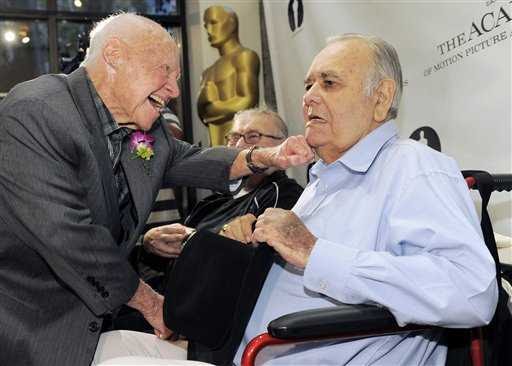
This is a photo of Mickey Rooney hamming it up with Jonathan Winters at a gala event in July. With his good-natured toothy expression, I saw it and thought that the spirit of the 16-year-old Andy Hardy must still live inside him.

The occasion was the Academy of Motion Picture Arts and Sciences 50th anniversary showing of It’s a Mad, Mad, Mad, Mad World. For us Rooney watchers, it was great to see Rooney in such high spirits. Lately, when he’s in the news, it’s often about allegations of elder abuse. Also, that evening, Rooney gave an impromptu tribute to Ernest Borgnine, who had died the day before. It was reported to be quite touching.

The popular Andy Hardy movies made Mickey Rooney a household name. The series would later be a touchstone in entertainment history because they foreshadowed the family sit-com genre that would dominate TV some two decades later. 

But maybe even more socially significant, Andy Hardy introduced a new kind of adolescent to the public’s consciousness, the teenager.  In an often cited article, sociologist Thomas Hine traced the rise of the teenager to the dramatic disappearance of jobs in 1933, when virtually all young people were thrown out of work as part of public policy in order to reserve jobs for men trying to support their families. That action led to an influx of young people with time on their hands, to the huge expansion of high schools, and, finally, to the creation of a self-identity of the new subgroup.  Then, as described by Hine:

“Late in the 1930s a new kind of youth emerged in the movies, personified above all by the bizarre boy-man Mickey Rooney and the Andy Hardy movies he began to make in 1937.”  (American Heritage, Sept. 1999)

The Andy Hardy series of movies are seldom seen today. But at least one in the bunch has earned a respectable critical reputation: Love Finds Andy Hardy (1938), the fourth in the series. Since I had never seen an Andy Hardy movie, I decided to check this one out.

Five minutes into the movie, I decidedly parted company with Hine and his description of the 16-year old Rooney as a “bizarre boy-man.” I was thoroughly charmed by the 16-year-old Rooney. I watched it along with two other adults, and judging by our bursts of laughter, this young teenager was a very funny guy. When the movie got serious—as when Andy turns to his father, Judge Hardy (Lewis Stone), because he’s in over his head in girl trouble— the dialogue got insightful and warm. Judge Hardy dispenses sound, fatherly advice with a twinkle in his eye. An interesting diversion takes place when a friend makes a Ham radio connection to Canada; detailed and technical, the scene foreshadows the fascination teenagers will have with communication devices.

Of course, this is a movie about youth attracting and coping with the opposite sex. The plot itself has to do with a high school Christmas dance, Andy’s need for $8, how he finds himself with more than one date to the dance and how he stresses over it. Amazingly, two of the young actresses in Love Finds Andy Hardy went on to have important Hollywood careers. Future-superstar Lana Turner is the beautiful head-turner who smooches with Andy on a park bench, and future-legend Judy Garland plays the neighbor’s grandkid with the spectacular singing voice and a crush on Andy. This is Judy at age 14, when she is more child-like and inches shorter than Oz’s Dorothy, a more-perfect fit for the role she would play some 18 months later.

I have no doubt Love Finds Andy Hardy would entertain any audience today, young or old, if they gave it a chance. I expected it to be corny, but what I saw was very clever. I expected it to be plodding, but it’s fast-paced. Also, it’s well scripted and good-natured, and features a very funny teenager who—the experts say—happens to be the first teenager ever featured in a film.

Thursday, June 21, 2012

Guest Blogger: Paul Cogley - The Black Stallion


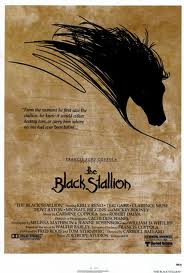
The Black Stallion (1979)
Reviewed by Paul Cogley

Before I begin my review of this family classic about a boy and a horse, I have a news update about Mickey Rooney, who plays the boy’s mentor in this film.  When I was on a bus looking at a New York Post recently, I came across this perplexing, somewhat disturbing item in Cindy Adam’s daily celebrity column:

I’ve known Mickey Rooney forever. He was always easy and available to me. His accessible wife, Jan, appreciated publicity. Following elder abuse allegations against his stepson Chris Aber and Chris’ wife, Christine — who both deny doing anything wrong — rumors were money was tight and some possessions were being sold, possibly on eBay. I called to ask is that true, is he OK, how might I help. Jan said he’s “indisposed” and I could phone back in five minutes. The second time daughter-in-law Charlene answered with “He could speak with no one . . . we must go through his conservator.” And, says Charlene, “Jan has her own lawyer, Mickey has his own lawyer” and “the whole situation is a mess.” Please, will someone who cares look in on this? Mickey Rooney was one of America’s great names.

It’s an odd news item and difficult to know what it might mean regarding Mickey Rooney’s current well being.  For us fans, we can only hope for the best and that he’s being well taken care of.

Mickey Rooney is certainly one of America’s great names, as Cindy Adams says. He may also be the most tireless performer of them all. He has never retired from show business, at least not up to his latest movie cameo in last fall’s The Muppets (2011). When asked about retiring, he has said, “My job is not to retire, but to inspire.”

He’s been inspiring for some time. I’ve watched several of his movies this year, the earliest of them Hide Out (1934) directed by W. S. Van Dyke. Mickey was 13 and he lit up the screen like magic playing a genuinely normal, sometime-hyper farm boy. In The Black Stallion he makes screen magic once again as a retired jockey.

The Black Stallion is a rarity, a family classic that can be appreciated on different levels. I liked it very much, but it is probably most rewarding for children because it has the highest regard for things that are important to them.

The story involves a boy named Alec, played by the 13-year old actor Kelly Reno.  Reno plays the role well, but, naturally, I couldn’t help but think what Rooney at that age would have done with it. 

Be that is it may, Alec gets shipwrecked with the Black, a magnificent stallion, and together they survive on an island that could be compared to the Garden of Eden. Alec spends his days racing the Black on the beach and exploring the surrounding beauty. No bad weather or lack of food to worry about, so it seems, in paradise. 

One day the boy and horse are rescued and brought back to Alec’s home in Flushing, New York.  But how could a near-wild stallion possibly stay penned up in a suburban backyard? The Black bolts and runs and runs until he’s in the country, to be corralled into the barn of Henry Dailey, a retired jockey played by Rooney. Henry knows horses and horses know Henry and so The Black gets a more proper home. Now all that’s needed to happen is for Alec and Henry to train The Black to become—what else?—a great racehorse. Which, of course, they do.

The movie has an unusual structure, presenting essentially two different stories, yet it works as a whole because it has something big to say about life and living resourcefully. When on the island, Alec makes it his goal to connect with the cautious, jittery stallion that was shipwrecked with him. Then during their life on the island, Alec finds fulfillment in the natural world of his surroundings, thanks to his equine companion and his open curiosity. Later, when Alec finds a mentor in Henry, he turns his efforts towards achieving the big goal of a horse race. No matter the situation, Alec has a fulfilling life because he can always find a purposeful direction. 

More tidbits about The Black Stallion:

  • The movie takes place in 1941, the year the book by Walter Farley came out. Farley began the book in high school and was in college when it was published.
  • The movie has been entered in the National Film Registry.
  • It was directed by Carrol Ballard. He went on to make several movies featuring the natural world, including Never Cry Wolf.
  • Cass Ole, a champion Arabian stallion, played The Black in most of the scenes.
  • Rooney earned an Academy Best Supporting Actor nomination but lost to an actor from an earlier generation, Melvyn Douglas, in Being There.  
  • Rooney reprised his role as Henry Dailey in the 1980s TV series The Adventures of the Black Stallion.


Thursday, May 17, 2012

Guest Blogger: Paul Cogley - Strike Up the Band


Strike Up the Band (1940)
Reviewed by Paul Cogley

Mickey Rooney and Judy Garland became close friends during their early adolescence on the MGM lots of the 1930s, a friendship that remained platonic and lasted for all of Judy’s too-short life. When she died of a drug overdose in 1968, Mickey was asked to deliver the eulogy. He couldn’t do it, he said, because he knew it would be impossible to get through it without breaking down in grief. 

At the time Strike Up the Band (1940) was filmed, Mickey was 19 and Judy was almost 18. They were youthful, barely-adults then, multi-talented, and undeniably huge stars. The year before, The Wizard of Oz (1939) had shot Judy to stardom while Mickey had grown to become the number one box office attraction. 

Strike Up the Band was the second in a series of movies Mickey and Judy made at MGM with producer Alfred Freed that became known as the Backyard Musicals.  Their storylines inevitably led to the young stars joining with other young friends to “put on a show,” one that could be done on their own terms unadulterated by stodgy grownups. 

In Strike Up the Band, their amateur show is an elaborate parody of the type of melodrama popular on the stage in the 1890s.  I suppose this might be similar to a group of teenagers in 2012 putting on a show parodying movies from the1960s or 1970s.  However, it’s interesting to think that looking 40 years back from the perspective of 1940 was to return to a world thoroughly unlike the modern world of MGM musicals: Telephones, autos, movies, radio, and electric lights were rare or unheard of.  Indeed, in Strike Up the Band, when one of Mickey and Judy’s schoolmates needs medical attention, he’s put on a plane to Chicago; that’s how much things had changed since Grandpa’s day. 

One thing that the producers of this movie couldn’t have known was that they were making a musical film during the short golden age when Big Band Jazz was vibrantly at its peak. Amazing as it may seem to us today, jazz was once the most popular form of music, enjoyed by teenagers across America in this pre-war era.

The type of music showcased in Strike Up the Band had swept the nation. Today this musical form is considered untouchably classic; big band jazz circa 1940 is studied in music graduate programs worldwide as an important American art form.  Add to it the power of Judy Garland’s voice and the result is a movie soundtrack in Strike Up the Band that music lovers will never get tired of.   

Another active ingredient for this movie was its direction by Busby Berkeley.  The choreography is top-notch entertainment. The highlight in this film is the performances and camera work of an amazing high school dance. Of special note, the Conga line dance scene within the dance is fun and truly brilliant.

In the history of Hollywood, the high school dance would become a staple, as seen in It’s a Wonderful Life (1946), American Graffiti (1973), Grease (1978), Back to the Future, (1985), and so forth.  But the high school dance scene in Strike Up the Band is in a class by itself because of Busby Berkely’s unique and exciting touch.  In fact, for all I know, this may be the first high school dance scene in any Hollywood movie.

Last, but certainly not least, is the brilliant, energetic Mickey Rooney. In 2007, Mickey taped a warm movie introduction that is included in the DVD package currently available for this movie. Rooney mentions his appreciation that Strike Up the Band allowed him to showcase “my passion for the drums.”  

Now, it’s true that he plays drums in several scenes in his role as a bandleader in Strike Up the Band. And, indeed, Mickey does show a talent for the drums. However, in his 2007 introduction Rooney could just as well have said that Strike Up the Band allowed him to display his passions for dramatic acting, verbal comedy, slapstick, tap dance, piano, singing—all of which he does in this movie.  The movie overflows with Mickey Rooney’s infectious spirit, and he is brilliant throughout. 


Sunday, January 1, 2012

Guest Blogger: Paul Cogley


Quicksand (1950)

Reviewed by Paul Cogley

Here is a photo of the cast of The Muppets (2011) gathered together for the red-carpet photo-op at the movie’s premiere in November. The actor with the thumb up and the widest grin is Mickey Rooney, who plays a small town resident in the movie. Why is this astonishing?

For one thing, Rooney’s first movie role was in Not to Be Trusted (1926) and he has contributed his talents to the Hollywood dream machine almost every year since then. For three years (1939-41) he was rated the biggest box-office draw. Rooney achieved Academy Award nominations for Best Actor in Babes in Arms (1939) The Human Comedy (1943) and The Black Stallion (1979). He was nominated for Best Supporting Actor in The Bold and the Brave (1956).

Rooney didn’t win any of those awards, but he was honored with several Emmy and Golden Globe actor’s awards. During his amazingly durable career, Rooney has never had a spell of time when he couldn’t get acting work, when his career was considered finished. And, as you can see in the photo, as of November 2011 he is still happily attending his movie premiers.

One of the open secrets about Mickey Rooney is that he is an engaging actor with a broad emotional range. There are many A-list movies he starred or character-acted in (also see my review here of National Velvet (1944) but for an entertaining, low-budget Rooney movie that shows his acting gifts beautifully, look for Quicksand (1950) in the Film Noir collection at Archive.org, the website for legally public domain movies.

Quicksand opens in a Santa Monica diner where three auto mechanics on a lunch break are soon turning their heads to check out the new cashier, a platinum blonde named Vera played by Jeanne Cagney. The real life sister of tough-guy actor Jimmy Cagney, she serves the movie well as a tough-come-hither femme fatale with the Cagney touch. Dan, the mechanic played by Rooney, wastes no time asking Vera to meet him for a date after her shift. His problem, though, is that it’s Monday and payday isn’t until later in the week. The problem can be solved, or so he thinks, by “borrowing” $20 from the auto shop’s cash register.

The movie proceeds on a singular simple premise that cranks up the story’s tension all along the way to the closing scene. When Dan needs to cover his tracks about the $20, he gets money from a scam involving a hocked watch, and his troubles continue to escalate from there. The fun in watching this movie is following the depths of trouble Dan digs and digs himself into. If you stop to think how realistic the story is, that might spoil your fun because many of the scenarios require a stretch of the imagination.

For his character to be believable, Rooney blends two sets of personality traits into Dan. On the one hand, he is not a bad guy, and when he’s allowed to be himself, he is quite decent. On the other hand, when Dan is under stress or under threat, his moral center evaporates and suddenly he is capable of doing anything no matter how risky or potentially fatal. A tricky role to pull off, Rooney’s naturalness seems authentic.

Peter Lorre is in a few scenes as a pinball arcade owner, but the other co-star worth mentioning is the Santa Monica amusement park pier where much of the action takes place. It is a kind of Coney Island west in its kitschy hay day. Director Irving Pichel also provides fascinating glimpses of the local street and beach town culture (including a cameo by early jazz musician Red Nichols) at mid-century.

Monday, September 19, 2011

Guest Blogger: Paul Cogley


National Velvet (1944)
Reviewed by Paul Cogley

It is said that MGM sat on the rights to the bestseller National Velvet for years with no plans for a film because no one could think of anyone to fill the role of Velvet Brown, the English country girl whose passion for horse riding brings her beloved horse Pie to compete in the Grand National Sweepstakes. But then along came Elizabeth Taylor—raised in London, experienced horse rider—who was fresh from an impressive debut in Lassie, Come Home (1943). Thus the Technicolor film project got the go-ahead and the first starring role of the popular movie star was made.

At every stage of her movie career, the camera loved to showcase Taylor’s face. In National Velvet her face sparkles with youthful innocence and enchantment. The character of Velvet Brown—improbable dreamer fortified by self-assurance—was a natural fit for the young Taylor. For this story to work, she had to be convincing as the pivotally inspiring figure to the other important character, the vagabond Mi, played by a post-adolescent Mickey Rooney. In the story, it will take both Velvet’s passion and Mi’s knowledge to get the Pie ready for competition.

At the time, Rooney—who had been put on the stage before he was two—was a seasoned professional. Only 5’2”tall and in the bloom of young manhood, Rooney was perfectly cast to play the role of the former jockey Mi with the personal demons to contend with if he was to discover what was missing in his life.

After Velvet and Mi meet, it is through the gentle manipulations of Velvet’s mother that Mi is allowed to sleep in the Browns’ barn and take a spell off from his vagabonding ways. Velvet’s mother describes Mi’s inner conflicts when she says “What's the meaning of goodness if there isn't a little badness to overcome?” Later in the film, Rooney does an exceptionally fine acting job in a scene where his character has had too much to drink and is tempted to betray Velvet’s trust.

Velvet’s mother is also complex having been the first woman to swim the English Channel when she was a young woman. Played by Anne Revere (who won Best Supporting Actress Academy Award) she is now a middle-aged country woman whose insights help her twelve-year-old daughter and this vagabond youth to dare to dream big. “I believe that everyone should have a chance at a breathtaking piece of folly once in his life,” she says, turning the pages of her scrapbook.

And then there is the performance of the horse. Through the combined masterful editing by Robert Kern (who won the Oscar for editing) and Clarence Brown’s direction, the scenes with Pie are excitingly portrayed. We come to know the horse to be young and skittish, talented but also nervous and inexperienced. We see Pie get frightened by obstacles, make mistakes and bolt. But as the story proceeds, Velvet and Mi keep Pie moving forward, coaxing and training him for that one day he will be in the Grand National Sweepstakes. National Velvet is simply one great, classic family movie.