Showing posts with label guest reviews. Show all posts

Thursday, October 18, 2018

Guest Blogger: Paul Cogley


Musing On the 4th A Star Is Born (2018)
by Paul Cogley

In 2014, I wrote a review on this blog about the 1975 remake of A Star Is Born. Or rather, it was more like a musing on the film, since Azrael had already reviewed it, as well as reviewed the original A Star Is Born (1937) and A Star Is Born (1954). Here again I want to present my musings rather than write a typical film review. However, I recommend you see the film if you enjoy a good musical romance-tear-jerker. On the scale of its predecessors, my rating for this film would be on the upper side between the 1954s great remake and the 1975s botched remake.

Previously I wrote of my opinion that Barbra Streisands self-indulgence on the classic story spoiled her film version in various ways, which accounted for why filmmakers avoided newer remakes. So this summer I was gratified to hear that finallyafter more than 40 yearsHollywoods banishment of A Star Is Born was finally at an end.

And so, earlier this month, Dyanne and I took our seats at the Del Oro Theatera historic Art Deco theater in Grass Valley, CA for the opening night screening.  How lucky we are to have one of the grand vintage film venues in our community to see first-run films!

While we waited for the movie trailers, I looked around and saw a crowd of about 200 with a good cross section of millennials, Xers, and boomers. I asked the young couple near us what brought them to the show and they said they were fans of the two stars. They were referring to Bradley Cooper, 43, who plays the falling star and who also directed the film in his directorial debut, and Lady Gaga, 32, who plays the rising star in her film acting debut.

Timing can be everything, and I very much approve of these two stars decision to make this film now in their respective careers. In my previous review, I discussed the reasons why the ages of the stars of A Star Is Born are so important in the casting of the story, which still holds for this version as well:

In any version of A Star is Born past or, hopefully, future, the rising female star cannot be an ingénueshes done her journeyman work and is now past her 20sand we absolutely must see the male lead prematurely burn out from the pressures of stardom and his own ego. We could not simply watch his downfall because hes aging ungracefully. Its not a story about the young and old, its about love and rivalry within the 30s and 40s set. A Star Is Born can be redone for every generation because it is about the select few whose struggles get them to the top and then peers into how badly it can go from there, and therein lies its appeal.

I have heard of two sources for the inspiration of the original A Star Is Born in 1937. The George Cukor directed What Price Hollywood (1932) is often cited because of its similar storyline.  Recently I heard another theory that the original A Star Is Born was inspired or based on Hollywood gossip of the day about the rocky marriage between superstar Barbara Stanwyck and her husband Frank Fay, a faded star of the New York stage. Fay pushed Stanwyck in her early career while neglecting his own, and by 1937 his career had nosedived and reputation soured from his alcoholism and own misbehavior. I find it interesting that in 1937 Fay was 45 and Stanwyck was 30.

In my previous review, my biggest complaint about the flawed Streisand version was her decision to play up her own role while downplaying Kristoffersons. She basically played a Streisand-type singing sensation, while Kristofferson was relegated to impersonating a Jim Morrison-type rock god.  That was a shame because he was in top form in the 1970s as a Americana-style singer-songwriter. However, perhaps Kristofferson is having the last laugh. In this version, Bradley Cooper plays a singer whose persona might have been modeled after Kris Kristoffersons. The songs are in the Americana style and co-written by Lukas Nelson, son of Willie Nelson.  Kristofferson toured with Willie Nelson in the 1970s in the supergroup The Outlaws, with Johnny Cash and Waylon Jennings.

The box office draw for the new A Star is Born has a lot to do with peoples curiosity about Lady Gaga in her debut film. Her fans want to check out if the superstar entertainer will be able to build a second career in Hollywood. Over the decades, many hit-making singing sensations have tried, but few succeeded with that ambition. The winners include Bing Crosby, Frank Sinatra, Doris Day, Elvis Presley, Barbara Streisand, Will Smith, and Justin Timberlake. Oh, and give Kristofferson an honorable mention.

In this film, I feel that Bradley Cooper was charitable to Lady Gaga. For one thing, Lady Gaga gets to play a singer who sings like Lady Gaga. Also, her characters development is often depicted in easygoing improvised scenes involving her and  Cooper. This doesnt tax Lady Gagas acting ability too much, and she gets to show off her natural charm. As a film star, she has an appealing and interesting face and natural body language, which are both must-haves for any sustainable Hollywood career.

Music is central to all of the A Star Is Born remakes. The earlier versions did not disappoint musically. Version #2 had Judy Garland singing one of her biggest hits, The Man Who Got Away, which still ranks #11 in the American Film Institutes Top 100 Film Songs. Barbra Streisands film has her singing one of her biggest hits, Evergreen, which ranks #16 on the AFIs song list. The Bradley Cooper/Lady Gaga duet Shallow debuted on the Billboard Top 100 at #23.  Its a good song, but who knows if it will make the AFI list someday.

One postscript: seeing A Star Is Born on opening night made for a fun evening out. For one thing, its always a joy when ones laughter at comedy bits is joined by that of a couple hundred other people also enjoying themselves in the same theater. That would most likely happen when youre out to see a star-studded romantic movie on opening night. Not enough films these days fit that bill.

Thursday, August 18, 2016

Guest Blogger: Paul Cogley

 Adventures of Robin Hood (1938)

Reviewed by Paul Cogley

Here is movie star Olivia de Havilland photographed regally in June 2016 wearing a blue dress in a blue room in her Paris apartment on the occasion of her 100th birthday. Also shown here is a publicity photo of De Havilland as Maid Marian with Errol Flynn as Robin Hood, taken when the two were enthralled in an offscreen romance.
 
The screen star has long been known for her intelligence and independence. In a 1944 landmark court case which resulted in what became known as the De Havilland Law, she sued Warner Bros. to reduce the studio’s power and extend creative freedom to performers.

De Havilland still possess her sharp mind and independent streak. For her 100th birthday, she gave several interviews—including with NPR—that are well worth Googling. Reading those interviews led me to seek out “The Adventures of Robin Hood,” from my local library.

Never trying to be an historical account of the late Middle Ages, the Michael Curtiz film presents the legend of Robin Hood redone as Hollywood Movie Magic. It remains one of the greatest family movies of all time. In nearly all aspects, the film feels as fresh today as it was during its successful 1938 release and second go-round as a feature-movie rerelease back in 1948.

The story begins some time after King Richard has ridden off from Merry Olde England and gotten himself jailed after fighting a Crusade. The king’s mean, hedonistic brother Prince John has taken full advantage of the situation to raise taxes and in all ways ruin the lives of the peasants. Eventually, his life of debauchery will be foiled by the eagle-eyed archer and good-natured forest dweller Robin Hood, with the help of his motley band of income-inequality warriors. Also, Maid Marian, who lives in the court, will fall for the charms of Robin and have a change of heart about her royal privileges when she considers the injustice its cost has on the commoners.

This is a movie with many elements, all of them working in-synch together. It is a Technicolor production, which until then was still a mediocre technology. Due to the new breakthrough in color processing introduced in this film, the costumes and scenery were brilliantly toned to dazzle the audience, similarly to what would be seen again in “The Wizard of Oz” (1939). 

The Oscar-winning film score was composed and arranged by the Austrian opera composer Erick Wolfgang Korngold. His music superbly pushes the battle action and fits the film’s many moods, such as the lighthearted times in Sherwood Forest and the romantic interludes between Marian and Robin.

The film was a milestone in action choreography. Our modern standards for adventure film battles - featuring clashing swords, whizzing arrows, etc.- began with the sophisticated realistic action that was carefully plotted in this movie. At times I thought I was seeing bits of action that would be actually referenced by George Lucas four decades later in his Star Wars trilogy.

Finally, the film has a wonderful cast. In the 1930s, in his earlier films, Errol Flynn had reinvented the role of the irreverent swordsman and rakish man of action using the template of the silent era’s Douglas Fairbanks Sr. Flynn was charming, young, and athletically gifted, and a wonderful fit for the role of Robin Hood.

Regarding Olivia De Havilland’s performance, in this modern era we tend to more fully appreciate an interpretation such as her Maid Marian, who is a strong and thoughtful woman. Nothing is played saccharine sweet with this Maid Marian.

Prince John is nicely played by Claude Rains, who would later again work with director Curtiz as the French inspector in “Casablanca” (1943). Also notable in the cast is Prince John’s very intelligent aide, Sir Guy, played by Basil Rathbone. Poor Sir Guy, almost every bit as intelligent as Robin Hood, hatches one doomed scheme after another to defeat his nemesis, and eventually faces off with him for one final sword duel.

“The Adventures of Robin Hood” is a movie that is fun for the whole family. However, battle scene are often intense and may not be appropriate for children under six.  

Thursday, June 23, 2016

Guest Reviews: Paul Cogley

BITTER RICE (1948)

Reviewed by Paul Cogley

The opening scene of Bitter Rice (1948) seems like a documentary. A narrator speaks of the plight of migrant women, known as mondine, who arrive yearly in northern Italy’s Po Valley for the 40-day rice harvest season. The camera pans over scores of women packed in rows of Fiat trucks, cheering and waving to onlookers. But we soon see that our narrator is a character within this film, a news reporter telling the story of the day for his radio audience. He will disappear from view as we continue to follow the women to the rice fields where the film’s real story unfolds.

The opening documentary approach becomes the first of several genre twists that director Guiseppi De Santes embeds into this golden age neorealistic film masterpiece. The film is so rich in details that they are difficult to sort out. Even when a scene fails in its intent, it nevertheless manages to succeed in unintentional ways. For example, over-choreographed scenes of the mondine singing in the fields still manage to work as Greek chorus-like interludes pushing forward the sense of fatalism of the main characters.

The story is about two couples whose lives interlock during the rice harvest. Francesca, is with the thief Walter. She sneaks on the train with the mondine and meets Sylvania, who gets her work as a clandestina, an uncontracted worker. Sylvania avidly reads photo-romance magazines and is enthralled that Francesca may be involved in a jewelry heist reported in the daily papers. As things proceed, Walter will jilt Francesca for Sylvania while planning another heist, this time to steal the season’s rice harvest. In the meantime Francesca will gain the affections of Sylvania’s spurned boyfriend Marco, an upstanding career army sergeant. The final confrontation takes place in a grizzly slaughterhouse. 

Silvana Mangano plays the role of Sylvania and gives an exceptional performance. She acts sensuous and innocent yet also seasoned, torn between facing her future as either a rice worker or a thief’s accomplice. In the New York Times’ 1949 review, Bowsley Crawford compared the 19-year old actress to Anna Magnani, Ingrid Bergman, and Rita Hayworth. In two scenes she simply dances while crowds of onlookers cheer; like everything else in this film, these scenes fit in perfectly.

De Santes began his film career as a scriptwriter for Vincente Visconti’s Ossesione (1942), the important precurser of the neorealistic film movement. Much like Ossessione, Bitter Rice is a hybrid film, weaving together Hollywood-style suspense and pure melodrama, not to mention cinematically beautiful wetlands scenery of sun reflections on the water. 

Reintroducing Hollywood elements into neorealistic filmmaking was De Santes’ contribution to the evolution of the movement. Until De Santes, the overtly theoretically based neorealistic films tended to take their social messages a bit too seriously. De Santes showed a way to stay true to the movement’s mission and principles while more fully entertaining audiences. For example, even as we see women workers donning straw hats to begin a hard day bent over knee-deep in water, the camera turns to show us lush panoramas of gushing water spilling over the dykes

As with any other neorealistic film of the era—including De Sica’s Bicycle Thieves, also made in 1948—Bitter Rice refuses to end with a wrapped up resolution. A mark of a true neorealistic film was not to deliver a happy ending but, rather, to emphasize that the struggles of the proletariat always face another day. As the word FIN fills the screen of Bitter Rice, we are left to understand that the mondine will return to the Po Valley again next year to live new stories filled with passion and injustice.

Thursday, April 21, 2016

Guest Review: Paul Cogley

I KNEW HER WELL (Italy, 1965)
Review by Paul Cogley

Image result for i knew her wellAdriana is young and fresh from the country. In Rome, she is easily lured into the hedonistic, fast life, where she will meet many men who are eager to show her a good time, make promises they will not keep, and inevitably discard her.

At one point Adriana happily takes care of a baby boy while her neighbor runs an errand.  She gives up an opportunity to audition for a film in order to have this one afternoon of babysitting. Precious few moments like this allow her to express her inner life. Over time we see her ever-ready smile become not so ready. Sooner than anyone could have expected, Adriana must face up to the lonely fate of so-called party girls.

Antonio Pietrangeli’s “I Knew Her Well” (1965) fits in the genre of Italian modernist movies that includes Fellini’s “La Dolce Vita” (1960) and Antonioni’s “L’Eclisse” (1962).  These filmmakers sought to uncover the malaise of post-war 20th century materialism and explore the harm to the soul that comes with unreflective relationships. Their films took place in Rome’s fashionable but ultimately empty, fast-paced world. All feature Rome’s night scenes and use black-and-white cinematography to convey a darkness of mood.

In “La Dolce Vita” American style rock is featured in just one scene. By Pietrangeli’s film—made five years later—rock has become the pervasive soundtrack. The early British Invasion style rock it features seems, in retrospect, to innocently foreshadow the excessive drug subculture that will pervade the youth culture by the end of the 1960s. 

Most strikingly, these films are modernist in their experimental, un-narrative approaches to storytelling. The filmmakers wanted viewers to spend some effort to discern clues about the unseen, interior lives of their characters. Thus, “I Knew Her Well” begins with a series of vignettes featuring Adriana. With frequent and abrupt segues, the film’s vignettes don’t start to add up as a unified story until we catch on that Adrilana’s self-realization is beginning to awaken. 

A turning point occurs in a bedroom scene, when Adriana—draped only in a sheet—recognizes herself in a character description that her novelist lover has left in his typewriter. From there, Pietrangeli’s storytelling technique works better since we are no longer left to wonder about the overall point for the vignettes.

Unlike Fellini and Antonioni, in his lifetime Pietrangeli never achieved high critical regard, nor did his films receive the notoriety that they deserved. He died in 1968 from an accident and for many years was virtually unmentioned in Italian film histories. Then, in the early 2000s, film academics began a reappraisal of his work. Screenings took place at the Museum of Modern Art and elsewhere. Critical and popular acclaim increased. 

In 2013, his reputation was further restored when “I Knew Her Well” was listed among the Venice Film Festivals “100 Most Important Italian Films to Preserve 1942-1978.” (It is #75). In February 2016, “I Knew Her Well” finally became widely available with English subtitles in the Criterion DVD Collection. 

The film is also well served by the natural performance of Stefania Sandrelli as Adrana. Sandelli was 19 in this film but seems to be a few years older. Already a seasoned film star, she had key supportive roles in Pietro Germi’s dark comedies “Divorce Italian Style” (1961) and “Seduced and Abandoned” (1963). Today Sandrelli still works in film; according to IMBD, she is featured in a new film to be released in 2016, “Il Crimine Non Va In Pensione.”

Thursday, May 15, 2014

Guest Blogger: Paul Cogley - Ordinary People

Ordinary People (1980)

Reviewed by Paul Cogley

Subtle and profound, Ordinary People is a movie about a family in the aftermath of a calamity.

Before we know what has happened to this family, we see them carrying on as if nothing in life is out of the ordinary. When the teenage boy Conrad talks to his doctor, he says “I want to be more in control so people stop worrying about me.”

“Well, I’m not big on control,” the doctor replies.

The next scene is at Conrad’s home. We linger a moment at a row of rolled linen napkins in gleaming silver napkin holders, tended to by his mother. “Isn’t it time we get back to normal?” she asks her husband.

As I watched, I was drawn to the idea that the inner turmoil beneath the surface of this family was strongly referenced in these two simple scenes. As the story moved along, I increasingly saw that each relationship in the family was different in its own way, between that of father and son, son and mother, and husband and wife.

At the time of its release, Ordinary People was a big success both at the box office and critically, winning Best Picture and Best Director at the Academy Awards. Yet it is remarkable to learn just how unlikely it was that Ordinary People came together as a movie project in the way that it did.

A few short years earlier, an ex-teacher without a literary agent sent her first novel to Viking Press. Surprisingly, an editor bought the rights to publish it. Judith Guest’s Ordinary People was the first unsolicited manuscript that the company had bought in 26 years.

A short time later, before the novel was even published, Guest received an unexpected visitor at her suburban Minnesota home. Robert Redford—the ruggedly handsome Hollywood star—had come calling to acquire her novel’s movie rights.

Redford was well regarded as a lead actor at that time, although never nominated for prestigious acting awards - a slight very recently reiterated by the Academy when it did not nominate him for his incredible portrayal of a lone sailor in All Is Lost. In the late 1970s, Redford surely knew he was well suited to play the part of father and husband Calvin Jarrett in Ordinary People, a role that might have given him a shot to deliver an Oscar-level performance. However, for this project Redford focused his intentions on trying his hand as a first-time movie director.

The Calvin role would go to Donald Sutherland, best known then as the original Hawkeye in the movie MASH, at the time a TV hit staring Alan Alda. The other two major adult roles went to a couple of TV sitcom stars. The part of Beth Jarrett went to Mary Tyler Moore, easily the most popular female comedian on TV since Lucille Ball. Judd Hirsch from the sitcom Taxi would play psychiatrist Dr. Berger, a role that in today’s world we would associate as a family or cognitive therapist. The two major teenager roles went to Timothy Hutton and Elizabeth McGovern.

It was an unlikely group of creative talent that came together as cast and crew of Ordinary People. Interestingly, the stars’ background work tilted towards lighter fare and comedy, while the underlying storyline theme in this story—in the words of author Judith Guest—was “about the anatomy of depression.”  

A major contribution also came from screenwriter Alvin Sargent. His beautiful work won a clean sweep of awards including Academy Award, Golden Globe, and Writers Guild of America awards for Best Adapted Screenplay.

Hutton won the Best Supporting Actor Academy Award for his role as Conrad Jarrett. It was a role so important to the movie that they easily might have given him the award for Best Actor instead.

One more thought: as the story unfolded, I came to believe that viewing the teenage Conrad come to grips with depression would be most powerfully experienced by a teenaged audience. I think teenagers today would still get a lot from this movie. But it’s not only for them; for the rest of us as well, Ordinary People remains one of the great family dramas in film history.

Thursday, April 17, 2014

Guest Review: Paul Cogley - Hideout (1934)

Hideout (1934)
Reviewed by Paul Cogley

Hideout is not well known, but it is an utterly delightful Depression-era movie directed by W. S. Van Dyke and starring a superb cast of players in all of its leading and supporting roles. It is well-paced and funny, and has a clever story about a hardcore criminal who becomes reformed because he hides out with good people.

We are introduced to Lucky Wilson, played by Robert Montgomery, a racketeer with a roving eye for pretty blondes that is revealed to us in a film montage sequence of his female conquests. We are taken to a particular evening where we find him flirting with a nightclub dancer. But as it so happens, Lucky is being tailed by the police and a gun-firing chase ensues. Wounded while fleeing, he is found on the road by a Good Samaritan Connecticut farmer and brought to his home to recuperate. Thus ends the seamy side of Lucky’s life, and for the rest of the movie we will see him change gradually as the values of the farmer’s family rub off on him.

The farmer has a daughter named Pauline, played by a sunny Margaret O'Sullivan, whose naturalness contrasts with the glamorous women we saw with Lucky in the city.  Pauline has a younger brother, Willie, who takes a liking to him.  The young actor playing Willie was my favorite among the excellent supporting cast: Mickey Rooney. The young Rooney was 13 years old but looked younger here. His acting is natural and amazingly feels fully actualized. Rooney’s rapport with Montgomery is especially well done.

A running gag has Lucky attempting to spend time alone with Pauline, but some mishap always foils him up. Finally, caught in a rainstorm, they take shelter in a cabin near the farm and sit in front of the fire, alone together at last. Of course, by now our incorrigible lady’s man has fallen in love with the wholesome, beautiful farmer’s daughter.

This is a heart-warming, family-friendly film with a lot of laughs. Made eighty years ago, it holds up very well. Anyone at any age would enjoy it. 

Thursday, April 3, 2014

Guest Blogger: Paul Cogley - Eccentricities of a Blonde-haired Girl

Eccentricities of a Blonde-haired Girl (2009)

Reviewed by Paul Cogley

Portuguese movie director Manoel de Oliveira was born on December 11, 1908. According to his Wikipedia page, he is currently in pre-production on a movie called The Old Restelo.

Back when de Olieveira was only 101 years old, he made a spare, dreamy elegant movie “Singularidades de Uma Rapariga Loura,” the Portuguese title of Eccentricities of a Blonde-haired Girl. It is an adaptation of a short story by Eca de Queiroz, Portugal’s great 19th century writer, and it retains the feeling of a tautly told story in every gesture and spoken line.

The movie opens on a train. A narrator states that sometimes the things you can’t tell your family you can tell a stranger. A young man —clearly in duress—then proceeds to tell his story to a fellow passenger, a middle-aged woman who listens with curiosity.

While the story is shown in flashback, the movie returns on occasion to these two on the train, as if we need reminding that the story remains an unresolved chapter in the life of the young man. In the course of the story, the young man, whose name is Macário, is told that he is foolish. Certainly he is foolish as only a romantic young man can be, although, in his case, somewhat more so. 

One day, while he is working at his desk, a young woman appears at the balcony across from him. She is a real beauty, and Macário is instantly infatuated. On the night they finally meet, they sit in at a poker game. A poker chip falls to the floor. The dealer searches, but the poker chip is not found. Is the movie moving into shades of magical realism with a vaguely paranormal event? No, only dropping a clue that will only be understood when Macário completes his tale. 

The two decide to marry. But things start to go wrong.  And, since we know this will end with Macário traveling alone on the train, we are drawn into the tension of what happened.

After seeing two of his movies, I notice a delicacy to the atmosphere of de Oliveira’s direction that I haven’t seen anywhere else. 

Often, de Oliveira does not allow his cameras to move, but has his actors play into the frame, a technique that goes back to the earliest days of filmmaking. The furniture, wall fixtures, and rooms match the eras they were built in, late 19th and early 20th-century Lisbon. People wear the dresses and suits that hark back to the sartorially sophisticated first decades of the 20th century. We might spend a moment at a harp recital of a Debussy song, another moment with a poem by a Portuguese poet. 

In one scene, Macário kisses the hand of his uncle in homage to him, perhaps as was the custom when Eça de Queiros wrote this story in the 19th century. Nevertheless, when we see Macário at his desk, he works in front of a laptop computer.

When Macário brings his story to the present—the trip on the train—I wanted to hear from the woman passenger. Surely, she would have something to say from which Macário might learn a thing or two. But, de Oliviera doesn’t give much voice for the one character that might just have a bit of wisdom to share, since she is in a later stage of life.  She was placed there on the train by de Oliviera as a stand-in, so-to-speak, so that we might listen along with her as we watch this movie.  In the end, we are left to rely on our own experiences to reflect on what we’ve seen and heard from the young and foolish Macário.

Thursday, July 18, 2013

Guest Blogger: Paul Cogley - The Last Rites of Joe May

The Last Rites of Joe May (2011)
By Paul Cogley

We meet Joe May as he is being released from a stay at Cook County Hospital after a bout of pneumonia. Once outside, Joe learns that life in his small corner of the West Side of Chicago has gone right on without him. Wherever he goes, he hears the same thing:  “Joe May! I thought you were dead!”

In a very short time, Joe finds himself without an apartment or a car. Or, for that matter, a best friend, since his buddy Billy (Chelcie Ross) entered a senior home and wants nothing to do with life on the outside. Joe becomes another of the aging homeless men spending nights on a bus bench.

Dennis Farina gives a stunning performance as the sixty-something Joe May, a washed-up, smalltime hustler who will get one last chance to make something of his life.

That last chance comes from Jenny Rapp (Jamie Anne Allman) and her seven-year-old daughter, Angelina (Meredith Droeger). They have recently moved into the apartment that was Joe’s home for 40 years. Finding Joe on a bench on a cold winter night, Jenny takes pity on him and invites him to stay the night.

While I was watching that scene I thought how unlikely it was for a single woman in her position to take such a risk with a virtual stranger. However, as the movie later reveals, Jenny has a pattern of putting herself in risky situations with men without learning the lessons she needs to learn.

Joe and Jenny become friends. No romance develops. In fact, when Jenny asks Joe for a hug in a crisis moment, Joe simply says, “That wouldn’t be a good idea.” End of subject.

Joe’s relationship with the seven-year-old daughter Angelina grows significantly. Joe’s most endearing trait is keeping pigeon coops on the roof of the apartment building. The care of the pigeons becomes a natural bonding activity for an old man and young girl.

Joe Maggio, who wrote and directed The Last Rite of Joe May layered symbolism and metaphors throughout the film’s screenplay. One would be the girl’s name, Angelina. She is indeed like an angel who Joe can share his passion for pigeons with and learn to become her protector.

Another metaphor would be Joe’s pigeons, which are meaningful to Joe in a way similar to the pigeons that Marlon Brando tended as the longshoreman Terry Malloy in On the Waterfront. Both stories are in essence stories about redemption and justice. In Waterfront Terry was a confused hustler who was transformed into a self-sacrificing protector champion. In The Last Rites of Joe May, we will see Joe transform from a confused hustler as he faces a similar challenge.

That challenge comes from the presence of Stanley Buczkowski (Ian Barford), Jenny’s stalking, abusive boyfriend, who is also a bad cop.

The movie relies a bit too much on overly-familiar cinematic techniques in order to build up the sense of tension needed for the finale. Nevertheless, I was satisfied it lived up to its title. The Last Rite of Joe May is, on many levels, a deeply moving movie. 

*The Last Rites of Joe May has adult content, including strong language and violence.

Thursday, January 17, 2013

Guest Blogger: Paul Cogley - Love Finds Andy Hardy


January 17, 2012

Guest Blogger: Paul Cogley

Love Finds Andy Hardy (1938)

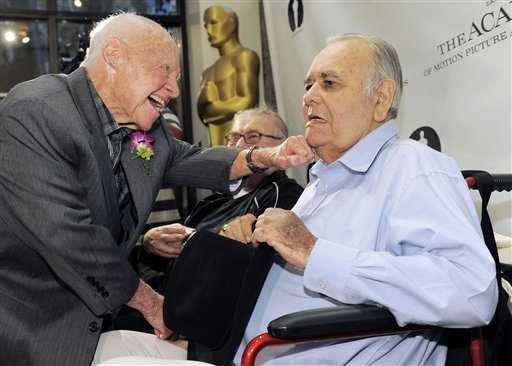
This is a photo of Mickey Rooney hamming it up with Jonathan Winters at a gala event in July. With his good-natured toothy expression, I saw it and thought that the spirit of the 16-year-old Andy Hardy must still live inside him.

The occasion was the Academy of Motion Picture Arts and Sciences 50th anniversary showing of It’s a Mad, Mad, Mad, Mad World. For us Rooney watchers, it was great to see Rooney in such high spirits. Lately, when he’s in the news, it’s often about allegations of elder abuse. Also, that evening, Rooney gave an impromptu tribute to Ernest Borgnine, who had died the day before. It was reported to be quite touching.

The popular Andy Hardy movies made Mickey Rooney a household name. The series would later be a touchstone in entertainment history because they foreshadowed the family sit-com genre that would dominate TV some two decades later. 

But maybe even more socially significant, Andy Hardy introduced a new kind of adolescent to the public’s consciousness, the teenager.  In an often cited article, sociologist Thomas Hine traced the rise of the teenager to the dramatic disappearance of jobs in 1933, when virtually all young people were thrown out of work as part of public policy in order to reserve jobs for men trying to support their families. That action led to an influx of young people with time on their hands, to the huge expansion of high schools, and, finally, to the creation of a self-identity of the new subgroup.  Then, as described by Hine:

“Late in the 1930s a new kind of youth emerged in the movies, personified above all by the bizarre boy-man Mickey Rooney and the Andy Hardy movies he began to make in 1937.”  (American Heritage, Sept. 1999)

The Andy Hardy series of movies are seldom seen today. But at least one in the bunch has earned a respectable critical reputation: Love Finds Andy Hardy (1938), the fourth in the series. Since I had never seen an Andy Hardy movie, I decided to check this one out.

Five minutes into the movie, I decidedly parted company with Hine and his description of the 16-year old Rooney as a “bizarre boy-man.” I was thoroughly charmed by the 16-year-old Rooney. I watched it along with two other adults, and judging by our bursts of laughter, this young teenager was a very funny guy. When the movie got serious—as when Andy turns to his father, Judge Hardy (Lewis Stone), because he’s in over his head in girl trouble— the dialogue got insightful and warm. Judge Hardy dispenses sound, fatherly advice with a twinkle in his eye. An interesting diversion takes place when a friend makes a Ham radio connection to Canada; detailed and technical, the scene foreshadows the fascination teenagers will have with communication devices.

Of course, this is a movie about youth attracting and coping with the opposite sex. The plot itself has to do with a high school Christmas dance, Andy’s need for $8, how he finds himself with more than one date to the dance and how he stresses over it. Amazingly, two of the young actresses in Love Finds Andy Hardy went on to have important Hollywood careers. Future-superstar Lana Turner is the beautiful head-turner who smooches with Andy on a park bench, and future-legend Judy Garland plays the neighbor’s grandkid with the spectacular singing voice and a crush on Andy. This is Judy at age 14, when she is more child-like and inches shorter than Oz’s Dorothy, a more-perfect fit for the role she would play some 18 months later.

I have no doubt Love Finds Andy Hardy would entertain any audience today, young or old, if they gave it a chance. I expected it to be corny, but what I saw was very clever. I expected it to be plodding, but it’s fast-paced. Also, it’s well scripted and good-natured, and features a very funny teenager who—the experts say—happens to be the first teenager ever featured in a film.

Thursday, June 21, 2012

Guest Blogger: Paul Cogley - The Black Stallion


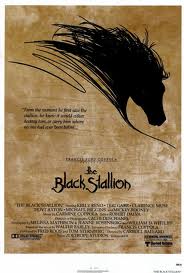
The Black Stallion (1979)
Reviewed by Paul Cogley

Before I begin my review of this family classic about a boy and a horse, I have a news update about Mickey Rooney, who plays the boy’s mentor in this film.  When I was on a bus looking at a New York Post recently, I came across this perplexing, somewhat disturbing item in Cindy Adam’s daily celebrity column:

I’ve known Mickey Rooney forever. He was always easy and available to me. His accessible wife, Jan, appreciated publicity. Following elder abuse allegations against his stepson Chris Aber and Chris’ wife, Christine — who both deny doing anything wrong — rumors were money was tight and some possessions were being sold, possibly on eBay. I called to ask is that true, is he OK, how might I help. Jan said he’s “indisposed” and I could phone back in five minutes. The second time daughter-in-law Charlene answered with “He could speak with no one . . . we must go through his conservator.” And, says Charlene, “Jan has her own lawyer, Mickey has his own lawyer” and “the whole situation is a mess.” Please, will someone who cares look in on this? Mickey Rooney was one of America’s great names.

It’s an odd news item and difficult to know what it might mean regarding Mickey Rooney’s current well being.  For us fans, we can only hope for the best and that he’s being well taken care of.

Mickey Rooney is certainly one of America’s great names, as Cindy Adams says. He may also be the most tireless performer of them all. He has never retired from show business, at least not up to his latest movie cameo in last fall’s The Muppets (2011). When asked about retiring, he has said, “My job is not to retire, but to inspire.”

He’s been inspiring for some time. I’ve watched several of his movies this year, the earliest of them Hide Out (1934) directed by W. S. Van Dyke. Mickey was 13 and he lit up the screen like magic playing a genuinely normal, sometime-hyper farm boy. In The Black Stallion he makes screen magic once again as a retired jockey.

The Black Stallion is a rarity, a family classic that can be appreciated on different levels. I liked it very much, but it is probably most rewarding for children because it has the highest regard for things that are important to them.

The story involves a boy named Alec, played by the 13-year old actor Kelly Reno.  Reno plays the role well, but, naturally, I couldn’t help but think what Rooney at that age would have done with it. 

Be that is it may, Alec gets shipwrecked with the Black, a magnificent stallion, and together they survive on an island that could be compared to the Garden of Eden. Alec spends his days racing the Black on the beach and exploring the surrounding beauty. No bad weather or lack of food to worry about, so it seems, in paradise. 

One day the boy and horse are rescued and brought back to Alec’s home in Flushing, New York.  But how could a near-wild stallion possibly stay penned up in a suburban backyard? The Black bolts and runs and runs until he’s in the country, to be corralled into the barn of Henry Dailey, a retired jockey played by Rooney. Henry knows horses and horses know Henry and so The Black gets a more proper home. Now all that’s needed to happen is for Alec and Henry to train The Black to become—what else?—a great racehorse. Which, of course, they do.

The movie has an unusual structure, presenting essentially two different stories, yet it works as a whole because it has something big to say about life and living resourcefully. When on the island, Alec makes it his goal to connect with the cautious, jittery stallion that was shipwrecked with him. Then during their life on the island, Alec finds fulfillment in the natural world of his surroundings, thanks to his equine companion and his open curiosity. Later, when Alec finds a mentor in Henry, he turns his efforts towards achieving the big goal of a horse race. No matter the situation, Alec has a fulfilling life because he can always find a purposeful direction. 

More tidbits about The Black Stallion:

  • The movie takes place in 1941, the year the book by Walter Farley came out. Farley began the book in high school and was in college when it was published.
  • The movie has been entered in the National Film Registry.
  • It was directed by Carrol Ballard. He went on to make several movies featuring the natural world, including Never Cry Wolf.
  • Cass Ole, a champion Arabian stallion, played The Black in most of the scenes.
  • Rooney earned an Academy Best Supporting Actor nomination but lost to an actor from an earlier generation, Melvyn Douglas, in Being There.  
  • Rooney reprised his role as Henry Dailey in the 1980s TV series The Adventures of the Black Stallion.


Thursday, May 17, 2012

Guest Blogger: Paul Cogley - Strike Up the Band


Strike Up the Band (1940)
Reviewed by Paul Cogley

Mickey Rooney and Judy Garland became close friends during their early adolescence on the MGM lots of the 1930s, a friendship that remained platonic and lasted for all of Judy’s too-short life. When she died of a drug overdose in 1968, Mickey was asked to deliver the eulogy. He couldn’t do it, he said, because he knew it would be impossible to get through it without breaking down in grief. 

At the time Strike Up the Band (1940) was filmed, Mickey was 19 and Judy was almost 18. They were youthful, barely-adults then, multi-talented, and undeniably huge stars. The year before, The Wizard of Oz (1939) had shot Judy to stardom while Mickey had grown to become the number one box office attraction. 

Strike Up the Band was the second in a series of movies Mickey and Judy made at MGM with producer Alfred Freed that became known as the Backyard Musicals.  Their storylines inevitably led to the young stars joining with other young friends to “put on a show,” one that could be done on their own terms unadulterated by stodgy grownups. 

In Strike Up the Band, their amateur show is an elaborate parody of the type of melodrama popular on the stage in the 1890s.  I suppose this might be similar to a group of teenagers in 2012 putting on a show parodying movies from the1960s or 1970s.  However, it’s interesting to think that looking 40 years back from the perspective of 1940 was to return to a world thoroughly unlike the modern world of MGM musicals: Telephones, autos, movies, radio, and electric lights were rare or unheard of.  Indeed, in Strike Up the Band, when one of Mickey and Judy’s schoolmates needs medical attention, he’s put on a plane to Chicago; that’s how much things had changed since Grandpa’s day. 

One thing that the producers of this movie couldn’t have known was that they were making a musical film during the short golden age when Big Band Jazz was vibrantly at its peak. Amazing as it may seem to us today, jazz was once the most popular form of music, enjoyed by teenagers across America in this pre-war era.

The type of music showcased in Strike Up the Band had swept the nation. Today this musical form is considered untouchably classic; big band jazz circa 1940 is studied in music graduate programs worldwide as an important American art form.  Add to it the power of Judy Garland’s voice and the result is a movie soundtrack in Strike Up the Band that music lovers will never get tired of.   

Another active ingredient for this movie was its direction by Busby Berkeley.  The choreography is top-notch entertainment. The highlight in this film is the performances and camera work of an amazing high school dance. Of special note, the Conga line dance scene within the dance is fun and truly brilliant.

In the history of Hollywood, the high school dance would become a staple, as seen in It’s a Wonderful Life (1946), American Graffiti (1973), Grease (1978), Back to the Future, (1985), and so forth.  But the high school dance scene in Strike Up the Band is in a class by itself because of Busby Berkely’s unique and exciting touch.  In fact, for all I know, this may be the first high school dance scene in any Hollywood movie.

Last, but certainly not least, is the brilliant, energetic Mickey Rooney. In 2007, Mickey taped a warm movie introduction that is included in the DVD package currently available for this movie. Rooney mentions his appreciation that Strike Up the Band allowed him to showcase “my passion for the drums.”  

Now, it’s true that he plays drums in several scenes in his role as a bandleader in Strike Up the Band. And, indeed, Mickey does show a talent for the drums. However, in his 2007 introduction Rooney could just as well have said that Strike Up the Band allowed him to display his passions for dramatic acting, verbal comedy, slapstick, tap dance, piano, singing—all of which he does in this movie.  The movie overflows with Mickey Rooney’s infectious spirit, and he is brilliant throughout. 


Sunday, January 1, 2012

Guest Blogger: Paul Cogley


Quicksand (1950)

Reviewed by Paul Cogley

Here is a photo of the cast of The Muppets (2011) gathered together for the red-carpet photo-op at the movie’s premiere in November. The actor with the thumb up and the widest grin is Mickey Rooney, who plays a small town resident in the movie. Why is this astonishing?

For one thing, Rooney’s first movie role was in Not to Be Trusted (1926) and he has contributed his talents to the Hollywood dream machine almost every year since then. For three years (1939-41) he was rated the biggest box-office draw. Rooney achieved Academy Award nominations for Best Actor in Babes in Arms (1939) The Human Comedy (1943) and The Black Stallion (1979). He was nominated for Best Supporting Actor in The Bold and the Brave (1956).

Rooney didn’t win any of those awards, but he was honored with several Emmy and Golden Globe actor’s awards. During his amazingly durable career, Rooney has never had a spell of time when he couldn’t get acting work, when his career was considered finished. And, as you can see in the photo, as of November 2011 he is still happily attending his movie premiers.

One of the open secrets about Mickey Rooney is that he is an engaging actor with a broad emotional range. There are many A-list movies he starred or character-acted in (also see my review here of National Velvet (1944) but for an entertaining, low-budget Rooney movie that shows his acting gifts beautifully, look for Quicksand (1950) in the Film Noir collection at Archive.org, the website for legally public domain movies.

Quicksand opens in a Santa Monica diner where three auto mechanics on a lunch break are soon turning their heads to check out the new cashier, a platinum blonde named Vera played by Jeanne Cagney. The real life sister of tough-guy actor Jimmy Cagney, she serves the movie well as a tough-come-hither femme fatale with the Cagney touch. Dan, the mechanic played by Rooney, wastes no time asking Vera to meet him for a date after her shift. His problem, though, is that it’s Monday and payday isn’t until later in the week. The problem can be solved, or so he thinks, by “borrowing” $20 from the auto shop’s cash register.

The movie proceeds on a singular simple premise that cranks up the story’s tension all along the way to the closing scene. When Dan needs to cover his tracks about the $20, he gets money from a scam involving a hocked watch, and his troubles continue to escalate from there. The fun in watching this movie is following the depths of trouble Dan digs and digs himself into. If you stop to think how realistic the story is, that might spoil your fun because many of the scenarios require a stretch of the imagination.

For his character to be believable, Rooney blends two sets of personality traits into Dan. On the one hand, he is not a bad guy, and when he’s allowed to be himself, he is quite decent. On the other hand, when Dan is under stress or under threat, his moral center evaporates and suddenly he is capable of doing anything no matter how risky or potentially fatal. A tricky role to pull off, Rooney’s naturalness seems authentic.

Peter Lorre is in a few scenes as a pinball arcade owner, but the other co-star worth mentioning is the Santa Monica amusement park pier where much of the action takes place. It is a kind of Coney Island west in its kitschy hay day. Director Irving Pichel also provides fascinating glimpses of the local street and beach town culture (including a cameo by early jazz musician Red Nichols) at mid-century.

Monday, September 19, 2011

Guest Blogger: Paul Cogley


National Velvet (1944)
Reviewed by Paul Cogley

It is said that MGM sat on the rights to the bestseller National Velvet for years with no plans for a film because no one could think of anyone to fill the role of Velvet Brown, the English country girl whose passion for horse riding brings her beloved horse Pie to compete in the Grand National Sweepstakes. But then along came Elizabeth Taylor—raised in London, experienced horse rider—who was fresh from an impressive debut in Lassie, Come Home (1943). Thus the Technicolor film project got the go-ahead and the first starring role of the popular movie star was made.

At every stage of her movie career, the camera loved to showcase Taylor’s face. In National Velvet her face sparkles with youthful innocence and enchantment. The character of Velvet Brown—improbable dreamer fortified by self-assurance—was a natural fit for the young Taylor. For this story to work, she had to be convincing as the pivotally inspiring figure to the other important character, the vagabond Mi, played by a post-adolescent Mickey Rooney. In the story, it will take both Velvet’s passion and Mi’s knowledge to get the Pie ready for competition.

At the time, Rooney—who had been put on the stage before he was two—was a seasoned professional. Only 5’2”tall and in the bloom of young manhood, Rooney was perfectly cast to play the role of the former jockey Mi with the personal demons to contend with if he was to discover what was missing in his life.

After Velvet and Mi meet, it is through the gentle manipulations of Velvet’s mother that Mi is allowed to sleep in the Browns’ barn and take a spell off from his vagabonding ways. Velvet’s mother describes Mi’s inner conflicts when she says “What's the meaning of goodness if there isn't a little badness to overcome?” Later in the film, Rooney does an exceptionally fine acting job in a scene where his character has had too much to drink and is tempted to betray Velvet’s trust.

Velvet’s mother is also complex having been the first woman to swim the English Channel when she was a young woman. Played by Anne Revere (who won Best Supporting Actress Academy Award) she is now a middle-aged country woman whose insights help her twelve-year-old daughter and this vagabond youth to dare to dream big. “I believe that everyone should have a chance at a breathtaking piece of folly once in his life,” she says, turning the pages of her scrapbook.

And then there is the performance of the horse. Through the combined masterful editing by Robert Kern (who won the Oscar for editing) and Clarence Brown’s direction, the scenes with Pie are excitingly portrayed. We come to know the horse to be young and skittish, talented but also nervous and inexperienced. We see Pie get frightened by obstacles, make mistakes and bolt. But as the story proceeds, Velvet and Mi keep Pie moving forward, coaxing and training him for that one day he will be in the Grand National Sweepstakes. National Velvet is simply one great, classic family movie.

Wednesday, December 1, 2010

Guest Blogger: Paul Cogley


La Notte (1961)
by Paul Cogley

For nearly a decade, Italy’s great director Michelangelo Antonioni made movies that examined the theories he embraced about movies and human behavior. From Le Ameche (1955) to Il Deserto Rosso (1964), Antonioni sidestepped the usual cause-and-effect continuity that drives conventional storytelling. Words and behavior in his movies were used as much to reveal the inner life of characters than to serve predetermined plotlines. For example, Antonioni wouldn’t show reaction shots to someone speaking, which is a common moviemaking devise. He felt such shots distracted the viewer from objectivity, and so, instead, his actors might be shown speaking their dialogue as seen from behind the person listening.

In La Notte, one day and night in the lives of a married couple leads to them realize the bad shape their love is in. The movie opens with Lidia (Jeanne Moreau) and Giovanni (Marcello Mastroianni) as they visit a friend who is in a hospital with an inoperable disease. The sick man has long been in love with Lidia. To Giovanni, a writer, his friend has been a mentor. From his hospital bed, the friend praises Giovanni’s new book.

Antonioni intermingles the progression of the day into an exposition of the psychology of the characters. Each episode plunges us deeper into their worlds. At the hospital, a psychotic female patient flirts wantonly with Giovanni. The incident will be brought up in discussion later on, but otherwise will bear no consequence on the plot. Lidia will walk through the streets of Milan in the neighborhood that the couple used to live in, underlining her confusions about her dying friend and her troubled marriage. The built-up urban form of Milan is featured in this sequence, and at one point Lidia is shown at the foot of a wall that seems about to crush her.

The title of La Notte refers not only to the metaphorical night of a marital relationship, but also to the actual night in which most of the movie takes place, when the couple ends up at an all night party. The cast of characters at the party (including Monica Vitti as an industrialist’s daughter) is drawn from bourgeois society and conveys the emptiness of feelings among them. While at the party, Lidia will be told that her friend at the hospital has died. By the time dawn comes, she will use this sad news to confront feelings that help her arrive to self-awareness.

La Notte’s all night party echoes the famous party scene of Federico Fellini’s La Dolce Vita (1959), a movie which had burst on the international scene, peaking interest in modern Italian directors. Antonioni here attempts to capture the vanity of bourgeois society much as Fellini had done. Interestingly, Luciano Visconti’s The Leopard (1964) would also cumulate in an all-night ball scene in which 19th century bourgeois society celebrates while oblivious to pending irrelevance.

Antonioni’s experimental approaches to moviemaking went about as far as anyone could go in what was essentially a commercial medium. Although he would make other critically acclaimed movies, such as The Passenger (1975), it is the half dozen unconventional psychological movies of the 1950s and ‘60s that are at the core of Antononi’s legacy. La Notte is among this group of movies that achieved the artistic heights the director aimed at, and can be readily enjoyed today by viewers willing to accept an unconventional movie on the terms that it was made.

Wednesday, August 4, 2010

Guest Blogger: Paul Cogley


Nights of Cabiria (1957)
Review by Paul Cogley

Nights of Cabiria is a neorealist-tainted version of Chaplin’s City Lights, a movie that Fellini said was its inspiration. In an expressive, tragicomic performance, Guiletta Masina dances madly, rants voraciously, and beams with childlike bravado in her career best film performance.

Its harrowing opening scene shows Cabiria getting robbed and pushed into a swiftly flowing river. She survives and, that evening, resumes her trade as a streetwalking prostitute. Cabiria is downtrodden and isolated, a reject of society. For her, whenever her luck seems to have changed, it is probably an illusion that a plot twist will reveal. But, although she can rant at life’s hard knocks, nothing that happens will ultimately succeed in taking away her buoyant spirit.

On one level, The Nights of Cabiria is a religious movie. Cabiria is moved profoundly by two spiritually engaged men, one a religious brother and the other an altruistic layman who feeds the poor. Eventually, Cabiria herself will undergo a spiritual transformation in the face of a shattering disappointment in her life.

Cabiria’s birth name is Maria, a name no one has known her by since the day her mother sold her into prostituion. Hypnotized in a stage show, we learn that the young innocent Maria is still very much alive in her. It is a scene simultaneously touching and cruel, as she is exploited by the showman to reveal her innermost self.

Caught up in the frenzy of a Catholic procession where healing miracles are expected by the faithful, Cabiria watches a group of religious sisters and others parade joyfully to the church. She joins the crowd and says a simple prayer that she may experience change. Later she scorns the sisters when she concludes that her prayer failed to change anything. Yet her prayer will be answered—although not in the way she expected. Her inner Maria will know how to accept life on life’s terms without the ranting of a frustrated Cabiria, and she will be surrounded by another parade of joyful people much like the religious sisters she once scorned.

In City Lights, Charlie befriends a millionaire who only recognizes him when drunk, and the relationship eventually lands him in prison. After he is released, Charlie is shabbier and further outside the margins of society. Similarly, Cabiria becomes pushed further outside of society by an unlikely relationship which at first seemed as fortunate to her as Charlie’s with the millionaire. But—as Chaplin did in City Lights—Fellini does not offer a clear resolution for us to take with us from this movie. Instead, we are left after the film ends to ponder on the meaning of a smile of hope.

Friday, May 7, 2010

Guest Blogger: Paul Cogley


Ginger and Fred (1986)
by Paul Cogley

Ginger and Fred is the story of two ex-show biz partners. In their hay day, Amelia—played by Fellini’s real life wife Giulietta Masina—and Pippo—played by Fellini’s alter ego Marcello Mastroianni—were a vaudeville dance team known as Ginger and Fred. They were also lovers for 15 years who only knew life on the road.

We meet Amelia first. She is in Rome’s train station, wearing the plain, respectful clothes of the married woman from a northern town, which she has in fact become. Amelia, we learn, is in Rome for one final pax de deux with her ex-partner on a TV variety show called We Proudly Present.

Several minutes into the film, Fellini tips us off that the role-types and conflicts revealed in Amelia’s and Pippo’s relationship are intended in some way to reflect the real life conditions of his and Masina’s marriage. When Mastroianni/Pippo arrives on the scene, we rarely see him without a hat; Mastroiani’s Guido in 8 ½, also wore a hat because Fellini famously wore hats and was rarely seen on a film set without one.

Viewers familiar with Fellini’s films will recognize—or, more accurately, relish identifying—the references in this movie to his body of work. For example, when Amelia rides to the hotel from the train station, the van passes a series of stylized billboards that I thought were reminiscent of the milk billboard which was a key element in The Temptation of Dr. Antonio, the short film in the anthology movie Bocaccio ’70. When Amelia looks outside a window, she sees a towering contraption straight out of 8 ½; a gang of motorcyclists roar by her during an evening walk evoking a famous scene in Roma; and, of course, the co-stars of the variety show—acrobats, midgets, psychics and clerics—recall the paean of Felliniesque characters ranging from Variety Lights onward.

Fellini’s signature flying dream image reoccurs in many of his movies and I believe is reflected in the characters’ names. “Amelia” reminds us of the historic/mythic air navigator Amelia Earhart. “Pippo,” a quick search on Google revealed, was, in Italian urban myth, the name of an aircraft during the Nazi occupation of Italy that people believed loomed nightly over the skies to instill terror in the towns below.

The strong nostalgic element in Ginger and Fred is counterpoint to its sustained rant against the contemporary culture of television. The reunion of Amelia and Fred occurs in an Italy that is a generation or three removed from the Italy of Giuseppe Tornatore’s Cinema Paradisio.

Historically, until the 1970s television in Italy was considered a national public service medium. In 1976, a ruling by the Corte Costituzionale allowed the transmission of radio and television programs at the local level and thus the floodgates opened for nonstop competitive, commercial television. By the mid-eighties, when Ginger and Fred was filmed, television seemed to have saturated daily life. And so, at every juncture, this film offers satiric commentary on the strangely powerful medium and its endless stream of stupefying entertainment.

In the book I, Fellini (1994) by Charlotte Chandler, the director compared movies to TV, as follows:

“Going to the movies is a true personal choice to go see one film or another film. The person walks into a dream. When the film ends, he leaves and walks back out into real life. It’s different with television. Television talks to us, at us, when we are defenseless, even unaware. Its message of vulgarity and wrong values is transmitted to people watching while they are on the phone arguing with each other, even eating conversationless dinners. The best way to watch TV is while you’re asleep.”


For me, the great cinematic moment in Ginger and Fred is the blackout scene. As a dishelved and unconfident Pippo is about to start the dance routine, a blackout occurs in the studio that lasts several minutes. In the dark Pippo expresses his fears and anxieties to Amelia, a rare moment of truth telling. By now we have learned that Pippo had a nervous breakdown following their break up. Since then, he has seemingly drifted through life, as sure as Amelia lived the life of a secure bourgeois housewife. While the blackout lingers on, Pippo encourages Amelia to sneak out of the studio with him. But, suddenly, the lights come back to life, and the two dancers must face the music—and a live, TV audience.

In 1992, Fellini and Masina made a trip to Hollywood to pick up a special Oscar given in recognition to his body of work. Later, Fellini recalled how that evening at the Oscars evoked something he found especially endearing about Ginger and Fred. Again, from I, Fellini:

“When Giulietta cried at the Oscars, I suppose that she was crying with joy for everything that was, and with sorrow for everything that wasn’t. That moment had the same magic for us that Giuleietta and Mastroianni had felt as “Ginger” and “Fred” dancing together again, after all those years, together again. Their professional and their personal life was summed up in that moment.”